

Learning the History of “The Art Spy” Rose Valland
Minnesota Women's Press arts coverage is supported by the Minneapolis Institute of Art, offering inspiration, family fun, date nights, and galleries to unwind and relax. Everyone is welcome.
Minneapolis Institute of Art (Mia) offers several “Inspired by Books” tours, in which volunteer guides lead visitors to certain artwork related in some way to a book of the month. I attended two of the 12 tours in July related to Michelle Young’s non-fiction book “The Art Spy,” which tells the story of the remarkable work of little-known heroine Rose Valland, a Paris museum employee who quietly kept track of the significant pilfering of valuable art by German for four years, noted where it was going with her photographic memory, and spent decades after the war helping to recover it.
I share details of the book here — which is a fascinating look at the times and the role of this woman in art history — followed by insights from two very different tours I attended.



The Book

“The Art Spy” book cover
Several times during the German occupation of France — which lasted May 1940 to December 1944 — Nazi officers denied Rose Valland continued access to the Jeu de Paume museum where she worked. The museum served as a storage and viewing space for certain art dealers and noted art thief Hermann Göring, “but she talked her way back in every time, explaining calmly that she was just a lowly employee of the French national museums who oversaw the building’s maintenance and the remaining art collection,” Young writes. “In reality, she was one of the most well-educated art historians in France.”
The author did meticulous research, devoting much of the first quarter of the 328-page book to the preamble to the four-year German occupation of Paris. She writes that two anti-immigrant and anti-Semitic national politicians influenced Hitler and energized what would become his base of voters. By June 1932, the continuing economic crisis had “become the perfect rallying cry for Hitler’s rhetoric of fear, anti-Semitism, and national pride.”
As Young wrote, “The Nazis suppressed civil rights, used a paramilitary force to intimidate voters and political opponents, opened the first concentration camps for political prisoners, and passed the ‘Enabling Act,’ which gave Hitler dictatorial power. In tandem came a general ‘cleansing’ of anything ‘un-German,’ which included art, literature, and scientific ideas that did not align with Nazi ideals.”
On August 22, 1939, Hitler shared orders with top military commanders to “kill without pity or mercy all men, women, and children of Polish descent or language.”
After Germany occupied France as well, the book details how a Portuguese counsel issued thousands of last-minute visas for people fleeing France. This was despite government orders to deny refugees who were deemed “inconvenient or dangerous,” such as Jews and various foreigners. “Salvador Dali fled this way, as did Margret and Hans Rey, who escaped with the manuscript for their children’s book Curious George in their bicycle basket.”
The author wrote extensively about the preparation museum directors were making to evacuate valuable art from potential bombings. She writes about the “118 fragile pieces of white Parian marble” that made up the Winged Victory of Samothrace — which needed to be encased in scaffolding, attached to a complex rope-and-pulley system, lifted off her pedestal, and rolled inch by inch down a ramp to the bottom of the grand staircase. “By nightfall, the Louvre was nearly empty” — 95 trucks had whisked away more than 1200 crates, thousands of paintings, and tens of thousands of sculptures.
In addition, the country’s art-collecting families — most notably the Rothschilds — entrusted their carefully curated art into the hands of national museums as well. Artist Fernand Léger, for example, deposited 69 paintings. By November 1939, 5,000 crates of art had left Paris from national museums. “The Mona Lisa was strapped onto a gurney and covertly moved in a hermetically sealed, airtight truck” for a roughly 100-mile trip, eventually spending “the winter hibernating inside an armoire.”
But eventually, the threat of bombing attacks were not the only thing for which they had to create extensive plans of protection.
How Art Factored Into Hitler’s Plans
As a rejected art student, Hitler had grand ideas of building a Führermuseum in his hometown of Linz, Austria, so his conquests of Europe included the seizure of art to fulfill his vision. Hitler named modern art as “degenerate,” indicating the artists belong in “insane asylums or prisons.”
In 1937, under the direction of his Minister for Propaganda, Joseph Goebbels, the Nazis removed over 16,000 modern artworks by 1400 artists; much of the art was burned after being displayed in an exhibition designed to make fun of the art and artists.
Hitler also gave a hysterical speech that year about cubism, impressionism, and other forms of art as “the stilted stammering of people to whom God has denied real artistic talent and has given instead the gift of blather and deception.” It was Hitler’s desire to rid the country of “cultural decline.”
In early 1941, Göring began plundering the collections for the personal collections of him and Hitler. Initially, it was two railroad cars full. Hitler’s 15 crates included 53 paintings that had largely belonged to Jewish families.

“Out in Front,” by Emma Amos, 1982, on display at Mia
Rose Valland’s Personal Life
Despite Valland’s value to museum management for years — as well as risking her life many times, and walking hundreds of miles after a boat logjam out of Paris to find other transportation for museum staff and art during one exodus — Valland largely worked as an unpaid volunteer, partly because of a particularly sexist museum director.
She was able to secretly keep track of what the Germans were doing. As the book lays out, in limited detail, she also had what would be a private 50-year relationship with her partner Joyce, a British citizen, who was employed at the U.S. embassy in Paris, where she was valuable for fluency in German, French, and English. Though it would have been safer for her to leave Paris, especially after the occupation, she chose to stay — likely because of Rose. Eventually Joyce was arrested and sent to a German camp with atrocious conditions — holes in the ceilings that let in freezing air, lice and rats, rotted vegetables, a hole in the floors as toilet for dozens of women crammed into small rooms.
Several months later embassy officials discovered she had been swept up in a purge of English citizens and arranged for her release as a valuable German-speaking employee.
Valland’s office at the Jeu de Paume museum — where most of the art trafficking took place — enabled her to take papers and carbon copies left in trashcans by German officers, have Joyce translate them at home, and then return the crumbled materials back into the garbage. She was keeping track of who came to claim art, and where it was sent.
The Museum Tour

“The Animal Nature of Man,” by Emerson C. Burkhart, on display at Mia
The two tours I attended inspired by the book showcased completely different pieces of art. The tours are organized by each museum guide according to their interests and what might have resonated to them as a representative element of the book. No guide is required to include any particular work of art on their tour. Given that the tours are more about symbolic stopping points than any “book club” discussion, both tours I attended had a very different feel and centerpiece of discussion.
In the first tour, the guide and the tour group members were focused more on one big connection to the book — Hitler’s fascination with art as a rejected student and resulting loathing of modern art — and one implied connection. The implied element was embodied in a few pieces of art on the tour related to the nature of evil, which led to an interesting group discussion at one point about whether evil is innate or created. The general consensus was that no one is born evil, but through environment and choices (and rejections to ego) can evolve into making tragic decisions and taking horrific actions.
A particular painting in the Kunin Collection on Mia’s third floor galvanized this conversation. Emerson C. Burkhart did a striking self-portrait in 1947 — one of 200 he did of himself during his career — titled “The Animal Nature of Man.” Depending on your interpretation, it might embody the complexity of being human — primal, rooted in the earth, mischievous, worn. What is man’s nature? To me, the visible veins of hands, clothing, desecrated landscape, and blood-orange sky evoke the idea that man and nature are undeniably woven together, as capable of self-destruction as potential for more.
The group discussion centered around the idea that everyone has the potential for a beastly nature if allowed. How might Hitler have evolved differently had he not blamed the rise of modern art for thwarting his younger artistic desires?
Another notable piece of art on this tour included Emma Amos’s “Out in Front,” a blend of color, fabrics, weaving, and paint, created in 1982. Her style in the late 1970s and early 1980s, as Mia describes, involved cutting up fabrics she had woven to create a new identity from fragments of her former self.
This particular work of art was used as a place to discuss the extreme care Valland and her long-time partner had to take to conceal not only their tracking of German activities, but of the nature of their relationship. Valland also had to maintain her undercover poise at the museum for months as she worried about what had happened to her partner — who had been whisked away into a railroad car and taken to a detention camp for British citizens. She did not know if Joyce had been killed or would return someday.

“Three Women,” by Fernand Léger, on display at Mia
The second tour I attended was largely a knowledgeable focus on the history of art that Valland was protecting and tracking. One of Fernand Léger’s paintings that survived the war — more than 500 paintings were burned as degenerate by Nazis as Valland helplessly looked on —is on display at Mia. The tour guide told us that Three Women, painted in 1919, is a representation of the painter’s shifting style, influenced by the mechanistic world that was emerging. What might we be in a mechanistic human form?
We discussed Mussolini’s desire to return the world to order in his vision, and Hitler’s ideal Aryan human form through the use of eugenics.
We also learned about Emil Nolde, a card-carrying Nazi artist — who was nonetheless labeled as degenerate — because of his attempt to convince propaganda minister Goebbels that expressionism should be adopted as a depiction of the Nordic and Germanic spirit in pure form. More than 1,000 of his artworks were taken out of German museums — many of them featured in the degenerate art exhibit. Yet perhaps to curry favor, he turned in the identities of fellow Expressionist artists — who were trying to depict emotions through color, which Hitler definitively wanted to mock.

St. John the Baptist statue, on display at Mia
We also saw a statue of John the Baptist that had been stored in salt mines during the war. The guide showed us a picture of the statue being rescued from its underground space along with thousands of others.
A parting visit on the tour was to a museum replica of Mia, as symbolic of the photo we saw from the docent of Hitler poring over the scale model of the Führermuseum he had wanted to build. The photo was taken a few months before he committed suicide, when it was clear that Germany was losing the war effort, and he likely knew that his vision of a monument to the cultural impact he wanted to have would never come to pass.
Future Book Tours at Mia
Learn more at new.artsmia.org/event/inspired-by-books
August Sea of Grass: The Conquest, Ruin, and Redemption of Nature on the American Prairie by Dave Hage and Josephine Marcotty
September Like Water for Chocolate by Laura Esquivel
October Frankenstein by Mary Shelley
November My Friends by Fredrik Backman
December Get the Picture by Bianca Bosker
January 2027 Project Hail Mary by Andy Weir
To support our unique storytelling


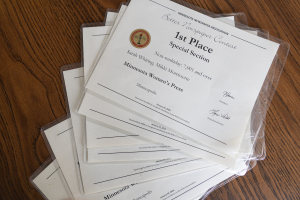 For 2025 coverage, Minnesota Women’s Press earned a community leadership award, three photography awards, and four editorial awards, including for coverage of social issues and for our Spring 2025 “Know Your Rights” special section supported by Unidos MN. Our publisher was named Journalist of the Year by Violence Free Minnesota for gender-based violence coverage.

