


In Winona: “Where Do We Go From Here?”
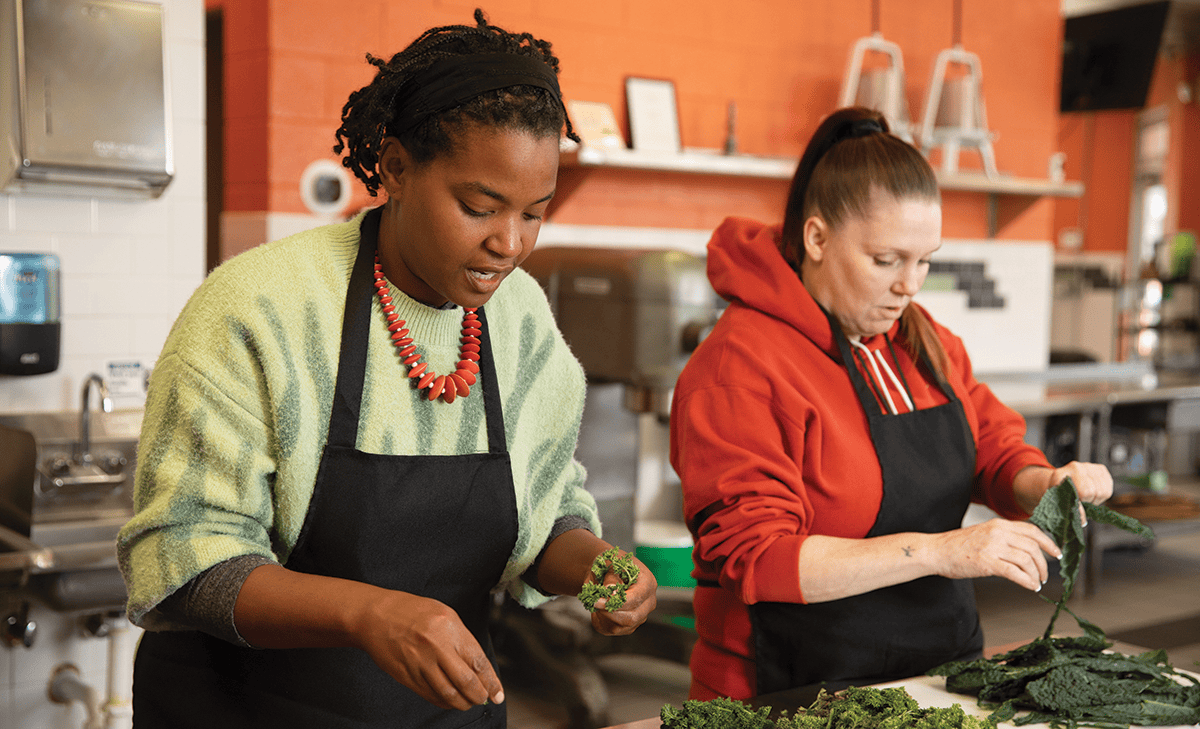
(l–r) Tova Strange, Crystal Hegge, N’Dea Young, and Destiny Walker-O’Grady, at Advocacy Center of Winona. Photo Sarah Whiting
In March, Minnesota Women’s Press worked with Advocacy of Winona’s Tova Strange to cohost a discussion in Winona about needs, issues, and potential solutions to the pain points experienced in that community.
The group Strange gathered included elected officials, advocates, and navigators for those experiencing issues with housing, mental health, immigration, disabilities, and gender-based violence.
The conversation is summarized here, with more to come in individual storytelling from some participants as part of our new “Where Do We Go From Here?” series.
Strange started with this question: What does it mean to be housing insecure, and what does it look like to solve that?



The Needs
Veronica Gontes Carbajal is a bilingual advocate with Advocacy Center of Winona (ACW). She indicated that housing needs to be not only affordable, but secure so that “you don’t have to worry about whether the walls are going to fall in on you. It is about having a good landlord, who will rent to you and your family.” She noted that because there are not many interpreters for newcomers, landlords sometimes take advantage of immigrant renters.
For some, community support is needed in order to be healthy contributors to the town — access to day care, transportation to get to work, and trusting relationships so they can feel safe and included.
Destiny Walker-O’Grady has experienced homelessness and works with ACW as an advocate, especially with Winona State University students. “Housing insecurity is more than the threat of losing a home,” she said. “It is everything that leads up to that — stable, well-paid employment is the strongest need, and being able to properly navigate county systems.” When you don’t have a place to live, the paperwork and meetings required to get off the street are overwhelming.
Even if you have a job, a car, and an apartment, Walker-O’Grady added, “if you have rodents, and you can’t communicate with a landlord who is not doing what they need to do, then that’s not a secure situation.”
Amarissa Swenson-Ruiz is a community mental health navigator with Winona Health’s Community HUB. She said too often there are no available resources she can direct people to. The county cannot step in unless there is an eviction notice. One emergency service offers help only once. A third source has limited funds that run out early each month.
The burnout in community health, Swenson-Ruiz said, is from continually facing people at their lowest point and knowing “I don’t have anything that I can do for them.” For example, she was asked to help navigate alongside one client who was struggling financially and was referred by the local hospital because of suicidal ideation. It was the first week of the month, so emergency housing funding was still available — but would not have been if it had been a few days later.
Ironically, a local housing stabilization program has been unstable — accessible, then closed, accessible, then closed again. In other cases, participants reported, state sources tell systems navigators to look to the county for financial help, but the county simply indicates it has no funding.
Large-scale housing developments in the area have waiting lists of 300 people for a one-bedroom apartment.
Gontes Carbajal says it is even more precarious for immigrants right now. “I don’t want to leave my house. I don’t know if my kids are safe — and I’m a U.S. citizen.”
N’Dea Young works with Engage Winona, which trains, supports, and amplifies community members who want to make positive impact through systems change. She said elders who lose financial security and local college graduates might not be able to afford to live in the area. “If we continue to keep everything the same in Winona, it’s going to get worse,” Young said.
Crystal Hegge, executive director of ACW, shared that some youth are unhoused because their family disapproves of their gender orientation. “There are individuals who are homeless in this community that you would never suspect.”
The discussion included acknowledgment that people in crisis might be angry, frustrated, and depressed, which can make them difficult to talk to. Strange said, “I work in a job that’s really hard. It is impossible to ask people who are in crisis to be completely nice to you all the time. Respect is a two-way street, but we make space for all of it.”
Walker-O’Grady added, “I’m here to be that bridge, and not to take it personally. Respectability politics and tone policing can further extend the gap. If someone is literally on the streets, they cannot make calls or send emails, and those are the voices who need to be heard the most. It speaks to how many gaps there are in access.”
How to Solve for Community Needs

(l–r) Winona community leaders Em Shephardson, Amarissa Swenson-Ruiz, Katie Mueller-Freitag . Photo Sarah Whiting
Chris Meyer, county commissioner, indicated that “making change is a team sport. You need to have people inside government as allies, and you need direct action. You have to have both. There are limits to what any one of us as an elected official can do.” She pointed out that the state legislature, as the session was ending, was considering seven bills about housing. Meyer encouraged people, now and in the future, to call legislators about any bills that matter to them.
Em Shephardson, a community care specialist in Winona, brought up the volatile nature of federal funding. “I think social housing that the city and the county pay for is the magic ticket. Rather than relying on federal funding, which can come and go, the county and the city become purchasers of property, and thus the landlords of places where people can live,” they said. “I don’t think many of our elected officials have had experience with housing insecurity — knowing the exhaustion that comes from not having a place to unburden your body. A place that is yours, where it is safe, and it smells okay, and it’s got a picture of you and your mom on the wall.”
Shepardson pointed out that Saint Louis Park is an example of a Minnesota city that has made progress on tenant protections. Others are working on community land trusts to create social housing. Some countries “have taken social housing initiatives seriously, and we can look to many of them for our inspiration. But state-wise, there’s been a lot of resistance.” They said deregulation attempts in Minneapolis have not gone well. “There hasn’t been a boom in building. … We also don’t want to see people who have the wealth to be housing secure making money off of those who are housing insecure. When we talk about deregulation, I think we need to think about it from the bottom up, rather than who’s going to profit.”
Shepardson added that they lost housing in January “because my apartment was becoming an Airbnb. I had to go from paying $450 a month to $975. I’m working 60 hours a week, and I’m also spending probably 30 hours a week doing organizing work. It’s not sustainable, but somebody has to do it, and I love my community. Short-term rentals can sound great, bringing in tourism dollars, but there are real people who are losing their real housing.”
Adam Muschler, the housing resources specialist for Hiawatha Valley Mental Health Center (HVMHC), finds local landlords who will offer housing to single adults with mental illness. HVMHC houses 11 individuals in private rental units and more than 50 in their own facilities. The health center helps pay the rent while working with clients to secure support services.
One of the difficulties Muschler has in finding spaces is that “everyone wants to have college kids. You can split your house into six different units, charge $500 each, and maintain them poorly. That is a dream scenario for many landlords. Yet, I’ve got a few great landlords, some with backgrounds in social services. We are pretty fortunate with those partnerships.”
Access to other opportunities like health care clinics and employment is important, but can be difficult to find. “It might take an hour by bus to get across town,” Muschler said.
He pointed out that neighboring Olmsted County has a fund to reimburse landlords in a similar program for damage to property. A reimbursement fund could mitigate concerns that “would allow me to place people who might have higher needs, or be at a higher risk. Right now I can feel pressure to make sure that people are stable enough that they are going to maintain the property well. If there was a fund backing me up, I would feel more empowered to take someone directly out of homelessness or another unstable situation and place them in that unit.”
The conversation touched on sober housing requirements that can make it difficult to keep people housed who are in recovery. Yet, people working on sobriety might find it damaging to be around someone who has relapsed. Kicking people out of a group house for substance use, including alcohol, can be a challenge in supportive housing.
If the model was consistently Housing First, Hegge indicated, it would offer more security, based on the notion that everyone deserves a home. “Not having a home is not going to help them.”
Hegge works with domestic violence survivors. Having lengthy paperwork for background checks to get someone into an apartment is daunting. However, like Muschler, she said some landlords in the community understand the experience of being unhoused, or the need to escape domestic violence, and want to offer support.
ACW recently received state funding for a Housing First pilot program for survivors of domestic violence. The funds are flexible and can be used to help pay rent or other bills, including child care, laundry, and transportation. Explained Strange, “The goal is to be flexible, so that I don’t have to make the choices for them. They have the autonomy to make choices about what they need. A core value is to make sure they regain control in their lives.”
Strange ended the discussion by saying: “We all want community members to be housed and safe. People might not agree on the way we get there, but I think it’s important to hear that so many of us want to make sure our community is housed. It is important to make space for these conversations.”
See also Collective Health: Housing



 For 2025 coverage, Minnesota Women’s Press earned a community leadership award, three photography awards, and four editorial awards, including for coverage of social issues and for our Spring 2025 “Know Your Rights” special section supported by Unidos MN. Our publisher was named Journalist of the Year by Violence Free Minnesota for gender-based violence coverage.
