


How I Am Growing My Own Solidarity Economy


Photo Sarah Whiting
It’s hard to “live, laugh, love” in these times. However, as alluring as nihilism and despair are, I cannot give up on change — because that’s what oppressive forces around us want. It takes a certain amount of pride and stubbornness to keep doing something — anything! — whether or not we have hope. I push for change because I feel an intuitive tug inside my body that something is wrong, and know that it doesn’t have to be that way.
Around the world, there are strong movements promoting alternative ways to exist: buen vivir, swaraj, and post-growth, to name a few. In North America, as abundant energy (crude oil, natural gas, coal) becomes less accessible to the vast majority of the population (e.g., the working class), I envision a future with more localized economies and regional governance.



Deep Time

When trying to reconcile our complex world, I center the concept of deep time to stay grounded. Life first appeared on Earth about 3.7 billion years ago. In about 7.5 billion years, the sun will expand and engulf the planet’s orbit, effectively ending all planetary life. To put those large numbers into perspective, we can compare the 12 billion years of Earth’s existence to the clock above. This perspective is not meant to induce existential dread. To me, it is a comforting reminder that nothing lasts forever.
There are real perks to modern society — like having mass-produced toilet paper and strawberries during Minnesota winters. Yet the modern empires of today are not equitable or sustainable, and like civilizations before, this era will not endure.
The collapse of modernity and late-stage capitalism will affect people differently, based on class, race, gender, and geography. Yes, that scares me. Climate migration, food supply chain disruptions, militancy, instable telecommunication, and inaccessible health care will be everyday concerns for millions of people.
The grief many of us are feeling now is a sign of humanity. It is healthy to slow down and process a spectrum of emotions to avoid spiritual burnout. The rise of concepts — like “joy is resistance” from abolitionists, or “pleasure activism” from adrienne maree brown, or “rest is resistance” as popularized by The Nap Ministry — is an invitation to reframe what it means to advocate and exist in dysfunctional systems.
The world does not need more activists. It needs healers, facilitators, growers, creators, mediators, and so many other roles. Many of us in our twenties are at different places, financially and mentally, to fulfill these roles. Yet this is a great time for everyone to experiment with what “better” feels like and how to get there.
Experimenting with Hope
During the pandemic, my peers and I started a nonprofit, The Overstory Alliance. Our mission is to support projects aimed at dismantling exploitative systems that extract human and planetary resources. Some of our accomplishments:
- Coordinating the Line 3 Media Collective to support pipeline resistance and nonviolent direct action.
- Forming Movement School, a political education and organizing initiative for young adults.
- Inspiring a Minnesota chapter of the Sierra Club to start a degrowth working group, to address overly optimistic narratives around Green New Deal transitions. Movements like degrowth and post-growth recognize that endless economic growth on a finite planet is impossible and advocate for a restructuring of the way power, resources, and capital flow through societies.
Other movements around Minnesota give me hope:
- Efforts to support unhoused people at encampments.
- The East Phillips Neighborhood Institute winning a decade-long justice fight to repurpose an abandoned building into a community hub and urban farm.
- Cooperative Energy Futures creating community-owned renewable energy sources.
- Native women establishing food sovereignty through hydroponic enterprises.
- Friends posting stories about global liberation struggles.
All these actions indicate a cultural shift from individual efforts to community-oriented solidarity. By centering the collective and developing communal structures rooted in shared resources, we are developing a more inclusive economy with self-governance.
The end of capitalist systems is not a story of good overthrowing bad, but rather a pluralistic tale of nurturing alternative economies to make the current ones obsolete.
In efforts to further self and community sufficiency, I am taking up skills like gardening, woodworking (check out the Minnesota Tool Library and Fireweed Workshop), and effective meeting facilitation. With the benefit of technology, I can continually learn and share these skills through mediums like the Offers & Needs Market, developed by the Post Growth Institute, or Buy Nothing groups that are nearly ubiquitous in every town. This is how we generate social capital.
I often return to the inspiring words of Samirah the Sapphic Siren, an online educator, to keep building the world I want to share with others: “Mutual aid is not rooted in generosity. It’s rooted in community. I don’t like it when people see community building as selfless. Building community is necessary for both of us. It’s crucial to your survival today, and it might be crucial to my survival another day.”
Resources
Autonomous Yurt Union, building yurts for encampments
If you appreciate our unique coverage:


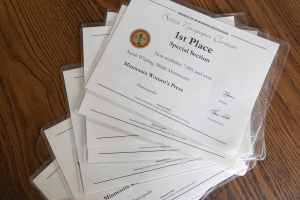 For 2025 coverage, Minnesota Women’s Press earned a community leadership award, three photography awards, and four editorial awards, including for coverage of social issues and for our Spring 2025 “Know Your Rights” special section supported by Unidos MN. Our publisher was named Journalist of the Year by Violence Free Minnesota for gender-based violence coverage.
