

YOUTH: How Do We Apply Community to Housing Solutions?
"Foundation of Housing" coverage, and the May/June 2026 magazine issue, made possible by the donation of Dodd Wilson and the Wilson Social Justice Fund, administered by First Unitarian Society of Minneapolis.

Sha’Micah Hicks speaks at a Minnesota Women’s Press housing forum in December. Photo Olivia Worcester
How to Address Housing Insecurity for Youth
by Sha’Micah Hicks
I am a student at the High School of Recording Arts (HSRA) in Saint Paul. As a teenager, I have experienced homelessness; It’s important to understand how homelessness happens, and why we need deeper community approaches.
In 2017, my family’s house burned due to a gas leak in our duplex. My parents did not have renters’ insurance. They were both already working two jobs It caused tremendous stress. I stopped going to school. My mom was barely able to work. It was really bad.
My mother began looking for help with state and community resources. She discovered that she could receive assistance if she was a single mother or fleeing a domestic relationship. I believe that this limitation in available housing played a significant role in my parents’ separation.
In 2025, I was part of a group of HSRA students that produced a video on Minnesota youth who have experienced homelessness. Using Minnesota Department of Education statistics from 2019 to 2025, we reported that the number of homeless Minnesota children and youth had increased from 8,079 to 10,697.
We found research indicating that people with backgrounds in homelessness when young are far more likely to have similar experiences as adults. They’re more likely to get involved with chemicals and the criminal justice system. They are less likely to graduate and get a job with a living wage.
I talked about my own history at a Minnesota Women’s Press forum about housing in December, and we showed the video, which talked about Minnesota teens who are couch-hopping, sleeping in abandoned buildings, and living in cars to stay warm. Some people hang out in libraries to be safe during the day. We explained that alcohol and drug abuse — and mental health issues like depression — start because of the stress of insecurity.
The video was designed for teens, and noted that there are school social workers and youth service networks that can help youth get assistance, or even secure a Social Security card and government ID in order to access services.
Minnesota offers a decent number of shelter beds — but there not enough, they are a temporary fix, and they do not always keep children safe from theft or abuse.
When people think of homelessness, they think of people outside, sleeping at a park or in the car, but you also can be homeless going house to house. If you go to your cousin’s house, then another cousin’s house, then to your grandma, then to your other grandma, that is homeless. If you don’t have a stable home to go to every night, then you’re homeless.
A lot of programs help kids and young adults, but they have criteria — such as being a single mom — that do not apply to many homeless youth. A shelter is not always an option because there is not always a bed available. Safe Zone and Youth Link are drop-in programs open during the day, but they don’t offer housing or beds. There might be help for this moment, but the moment after that, there is nothing.
If you get into a transitional housing program, you generally have six months to a year to find a home that you can afford, or you are back to being homeless. If you are 17 or 18, like me, you cannot pay $1,500 in rent. My mom is nearly old enough to be in a more secure living situation for seniors — at age 55, her Section Eight vouchers will decrease, which is why they suggest she move. I cannot go with her.
There are cost-effective ways to dramatically reduce homelessness for Minnesota youth. As I said at the forum, the best investment Minnesota can make is investing in permanent housing and programs that give us the skills to build a better future and easier access to health and human services in the neighborhoods where we live. This year we asked legislators to invest in affordable, permanent housing and lower-barrier access to services.
Find the video at tinyurl.com/livingwithhomelessness




Talia Carlson. Photo by Savannah Leigh Photography
From Instability to Nursing
by Talia Carlson
My Ojibway name is Quaysansans, which means “little girl.” I am a descendant of the Minnesota Chippewa Tribe from Bois Forte. My story is one of reclaiming a heritage that was fractured by systemic and familial trauma. My great-grandmother Rose had her children taken from her by the government; it took my grandma Pam years to find her siblings again. My father, David, struggled with addiction and undiagnosed bipolar disorder, and was a perpetrator of domestic violence and sexual abuse. Because of the trauma he caused, I was separated from Grandma Pam, who was the strongest link to my ancestry.
Housing instability was the backdrop of my childhood. I remember being a toddler and sleeping with my mother in a red Ford truck to escape violence. As I grew older, the system continued to fail me. Despite reports of abuse, I was told there was “not enough proof” for the courts to intervene. By 16, I was sleeping in my own truck. When I turned 18, I bounced between my car, my grandfather’s house, and unstable rentals.
I learned quickly that survival is a full-time job. Finding food, shelter, and safety consumed all of my energy, making it nearly impossible to focus on anything else.
Despite the chaos, I fought for the stability I deserved. I worked as a CNA and completed my nursing prerequisites through PSEO (post-secondary enrollment options) while still in high school. I started nursing school in May 2023.
In February 2025, I began receiving $900 a month through Youthprise’s Homeless Youth Stipend Pilot Project. This was a huge turning point for me — and is the reason I didn’t drop out of school. I was able to use that money for housing, which finally gave me a sense of security. The support provided the breathing room I needed to stop living in fight-or-flight mode.
At 18, I reached out to Grandma Pam for the first time in years. She told me that I am part of the “healing generation” — that I am a healer at heart.
I graduated as a registered nurse in May 2025. I am currently working on my bachelor of science in nursing at Bemidji State University. Best of all, I now have a home with my name on the lease.
I am proof that youth experiencing homelessness are more than our struggles. We are resilient. We are capable. Given the right support, we can build a future everyone is proud of.

Michaela Eaton. Photo Spicy-Meatball Photography
Navigating Life’s Hurdles
submitted by Michaela Eaton
I have worked in the hospitality industry since I was 14, starting at the bottom and working my way up to assistant manager, then operations manager. At 25 years old, I am raising two boys, ages three and four. Along the way, I had a falling-out with my family and left home. Some days I’d get a hotel for me and the boys. Other days we’d stay with friends or family. It was a daily struggle.
Like Talia, I was accepted into Youthprise’s direct cash transfer (DCT) pilot program. Currently, I receive a $1,000 stipend each month for what I need. This not only gives me financial stability, but also teaches me about money management. In the program, I am able to see a bigger picture, rather than be stuck in survival mode. The pilot program will end for me soon, but it brought me to a place in my life where I no longer need to worry.
My DCT case manager and I initially touched base about me going to college, but then my mom passed, so I had to put that idea on hold. I recently applied to college, however, and have filled out financial aid forms. I’ve applied at Minnesota West Community and Technical College to pursue a career as a surgery technician.
My struggles have made me a better mother and stronger person. I have learned to be more independent. I know that what is most important is what is in front of me right now.
For any young person struggling with housing instability, I want you to know it gets better. If you’re at rock bottom and things are not going your way, hold on. There are still community resources that you can help as you learn how to navigate.
Learn more at youthprise.org
We cannot continue to cover stories like these without your support:


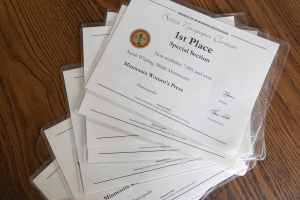 For 2025 coverage, Minnesota Women’s Press earned a community leadership award, three photography awards, and four editorial awards, including for coverage of social issues and for our Spring 2025 “Know Your Rights” special section supported by Unidos MN. Our publisher was named Journalist of the Year by Violence Free Minnesota for gender-based violence coverage.
