

UPDATED HOUSING STORY: How New Life Grows in an Underinvested Neighborhood

Thanks to the Wilson Social Justice Fund for enabling us to continue statewide conversations and action for this series
Minnesota Women’s Press publisher Mikki Morrissette was selected to be part of a small cohort of entrepreneurs being trained in a seven-month “CEO Now” program, funded by Hennepin County, to enhance business models for success. One of the cohort members is Adriane Epps, who finished the challenging two-year-plus process of getting approved to develop his first City of Minneapolis affordable housing project. The April ground-breaking for the property is an example of the work people statewide are doing to try to correct issues that need to be addressed in order to (literally) lay the foundation for healthier communities.
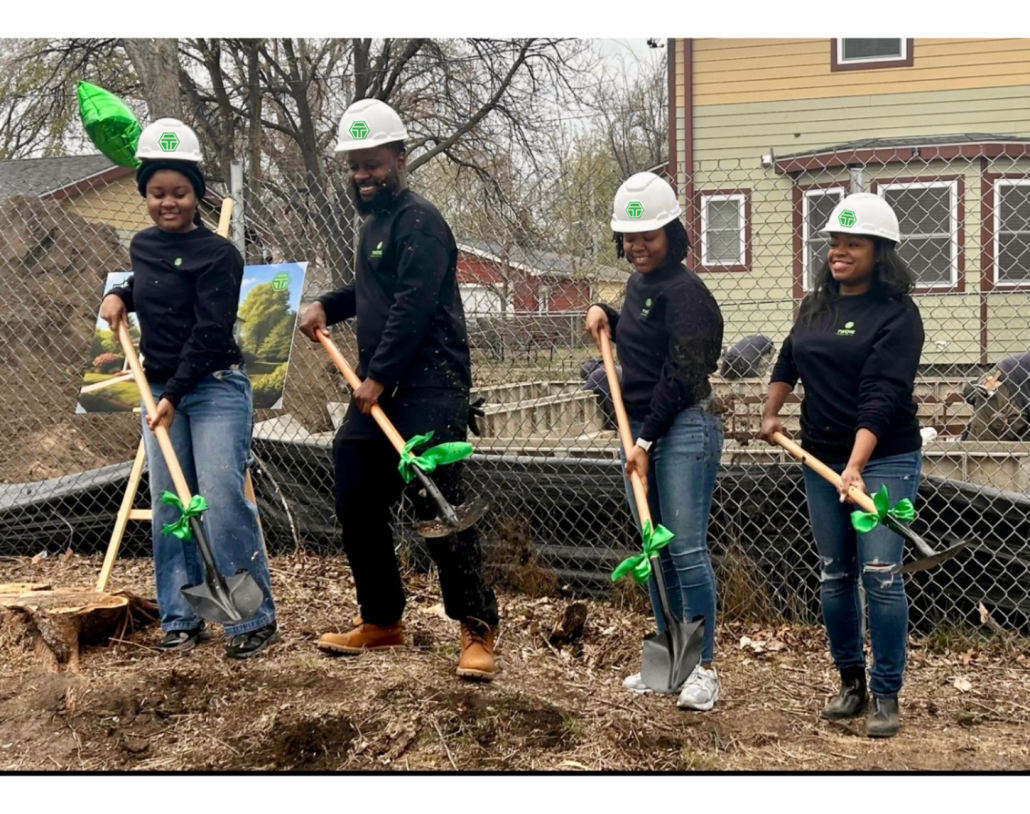
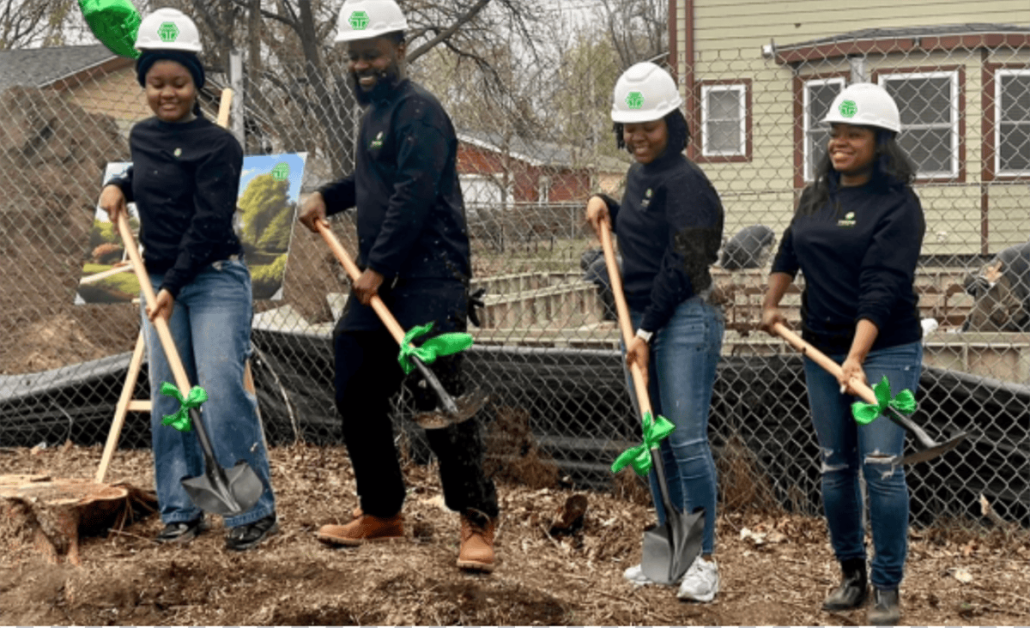
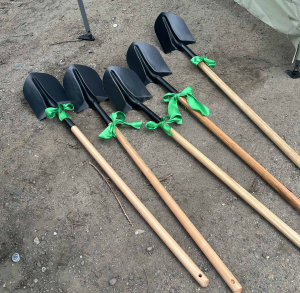
Above: The Before Picture — Nevaeh and Patience Epps join their father in breaking ground, alongside TWOIE operations and project manager Anastasia Hill.
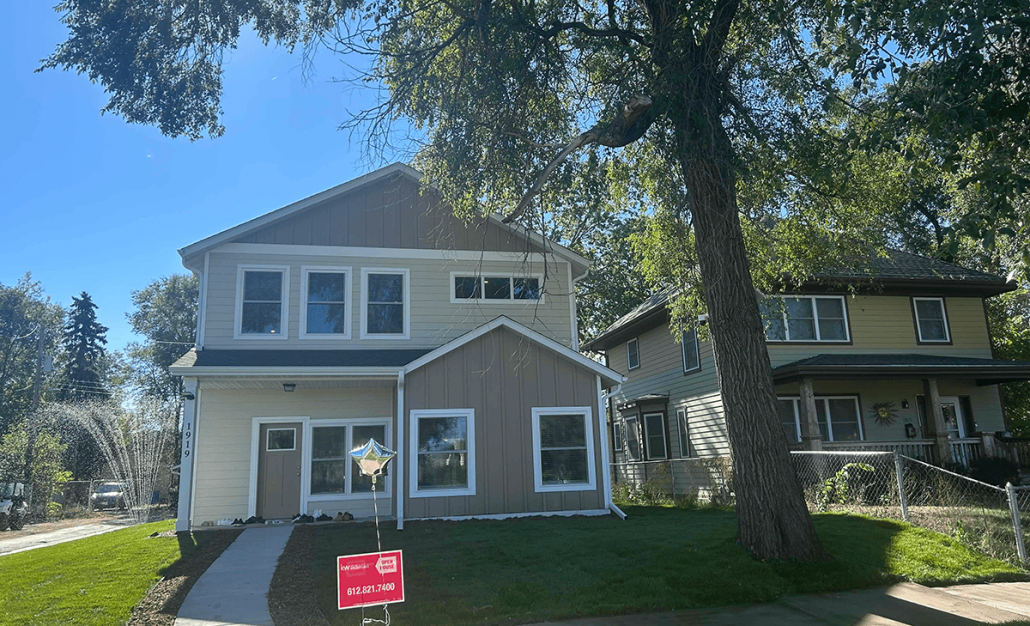
Below: The After Picture — Five months later, a new affordable house has been built and sold to a family through a community land trust. It took 2.5 years to get the paperwork done to get the house accessible for an emerging developer to build something affordable, and energy efficient.
How a four-bedroom affordable home grows in the East Phillips neighborhood of Minneapolis
Irene Ruiz-Briseno, of Greater Minnesota Housing Fund (GMHF), is program manager for the Emerging Developers program, which offers resources to support diverse housing developers statewide as they get access in the industry. As a nonprofit Community Development Financial Institution (or CDFI), GMHF is providing the construction financing for this East Phillips project.
“Projects like this are especially important at this moment in time,” she said. “Median home sale prices have increased 4.5 percent over the past year, and rising interest rates have decreased buyers’ purchasing power, particularly our low- and moderate-income families. Most typical Minnesotans can’t afford a median price home right now. Affordability is exacerbated by our state’s inventory shortage, which drives up home prices and increases competition. There is a high demand for affordable, single-family homes that is likely to continue well into the future.”
Ruiz-Briseno talked about the significance of this home being built in East Phillips, which was heavily affected by redlining — a discriminatory practice that largely started in the 1930s, in which banks, investors, and local governments declared Black residents as ‘too risky.’ Color-coded maps were used to declare entire neighborhoods as unworthy of investment. The Federal Housing Administration’s Underwriting Manual stated that “incompatible racial groups should not be permitted to live in the same communities.”
The effect was to limit access to homeownership for Black families at a time when white home ownership was booming. “White” neighborhoods had investments of healthy foods, transportation access, and local businesses, leading to greater economic and physical health for generations of families. The effects of this practice still impact communities today. Formerly red-lined areas, like East Phillips, generally remains more segregated and economically disadvantaged. As Ruiz-Briseno put it, “They have lower median household incomes, lower home values, older housing stock — and more cost-burdened renters.”



Ruiz-Briseno grew up in east Saint Paul — also a red-lined community. She said being part of correcting injustices from decades ago, which impacts home ownership today, is a personal passion.
“This is why developers like Adriane are so important — developers who care about revitalizing our inner-city neighborhoods, about promoting equitable development, about creating community resilience. It is hard and frustrating work, as Adriane can tell you, but we have to remove those barriers so that more families can access high-quality, affordable, and sustainable homes, and build generational wealth one house at a time,” she said.
“When our housing developers come from within our communities, they know and they see first-hand the ways in which our housing system leaves our people behind, and those developers are in a unique position to come to the table with innovative solutions and better housing options. This project is a great example of a community-aware project.”
Motivation to Build
 Adriane Epps is the CEO of TWOIE Construction, a general contracting firm, and TWOIE Village Homes, a real estate development initiative. He explains that TWOIE is both an acronym and a memorial—The Way Out Is Education—a mission born from pain but fueled by purpose.
He explained that when he was 14, he lost his older brother Twoie to gun violence. “I was a young kid from North Minneapolis, surrounded by circumstances that too often ended in tragedy,” Epps said. “For a while, I was headed down the same path. I was shot. I was incarcerated. But I held on to something. My brother believed that knowledge, discipline, and a commitment to something greater than yourself would lead out of the darkest places. That belief that the way out is education became my foundation.”
Epps said he learned trades to build a career, and founded TWOIE “not just to build homes, but to build hope — to create spaces where people could live with dignity, where neighborhoods could thrive, and where young people could see that there’s a way forward. This project is exactly that. It’s proof that no matter your past, you can design your future, and in doing so, help shape the future of others.”
He added, “We’re not just breaking ground today. We’re breaking cycles. Cycles of disinvestment in our communities — where affordable, quality housing feels out of reach, where young talent is overlooked instead of nurtured.”
Epps credited GMHF for understanding “that real change happens when you invest in people, and not just projects. … I stand here as living proof that no matter where you start, you can rise. You can turn setbacks into steppingstones. One day, you can stand on a site like this and say, ‘I built that.’”

BEFORE (l-r) Ineye Bobmanuel, realtor at Keller Williams Realty Integrity Lakes, who represented the sale of the home; Adriane Epps; Irene Ruiz-Bresano of Greater Minnesota Housing Fund; Abdullahi Sahal, project coordinator with the City of Minneapolis; and Priyanka Shrestha, chief architectural designer and CEO of RAYS Designs, who drafted the architectural renderings.
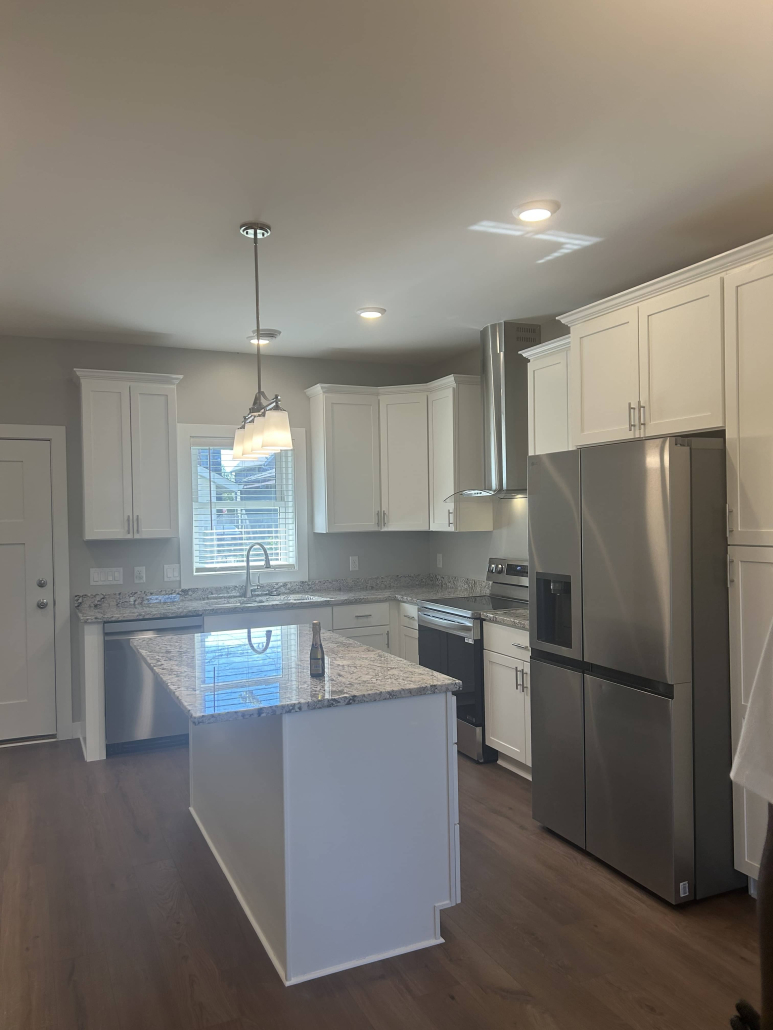
AFTER The kitchen area of the new home, which sold for under $300,000. It is a four-bedroom, 2.5-bathroom house with energy efficient appliances and 1,700 square feet


 For 2025 coverage, Minnesota Women’s Press earned a community leadership award, three photography awards, and four editorial awards, including for coverage of social issues and for our Spring 2025 “Know Your Rights” special section supported by Unidos MN. Our publisher was named Journalist of the Year by Violence Free Minnesota for gender-based violence coverage.
