

Grieving in Company, With Permission to Grow

Princess Titus in the Appetite for Change community garden, across from where her son Anthony died in North Minneapolis. Photo Sarah Whiting
I remember being pregnant with Anthony, coming up with his name, breastfeeding him, seeing his first steps. I see his missing teeth and the way he sucked his thumb in between backflips. I hear his laughter and see how tightly his eyes closed as he splashed in puddles.
I am so proud that my son — a 16-year-old hockey player who got straight A’s in his trigonometry class — didn’t have any cavities. Anthony had a smile so big it would blind you with light and charming energy.
Yet his days of ollieing on a skateboard over his little sister’s moon shoes are no more, because of bullets that flew 15 years ago on the Fourth of July.



My loss — and the losses other women like me have endured — often feel disregarded and invisible. After this type of loss, most families, including my own, go from being able to manage family, work, and school lives to needing support for basic needs, like bathing, eating, and sleeping.
This loss shakes our foundation, and stabilization services are few. The depth of the darkness I was in required me to cope while dealing with biases and broken systems that saw Anthony as if he were the lone victim. The loss left me feeling disconnected from myself and others, and devalued as a mother.
While dealing with my grief, I met mothers working against gun violence and parents of murdered children who were walking in similar shoes. Their stories led to tools I could apply to my own grief. For example, I learned to have compassion for myself, because it was hard for people to understand I was disabled by trauma. Compassion carried me for seven years, and then I gave myself permission to be angry.
Initially, I didn’t know what to do with the love that I have for Anthony. Today I pour it back into myself with sky breathing, chiropractic care, acupuncture, hydrotherapy, swimming, meditation, gardening, and writing. I had to sit with the loss and not ignore it any longer; invisible bondage was keeping me from evolving into a woman who accepts the bitter cup. Acceptance guides me to my passion and purpose.
My Purpose Today
Over the past five years, I have been serving families in the Twin Cities who are impacted by gun violence and its intersections with overdose, incarceration, retaliation, sex trafficking, and self-harm. That is why I created Standard Edition Women (SEW). Our mission is to use the joy of celebration to make healing possible. We host healing retreats, support a 24-hour call line, and offer overdose prevention training.
Our grief circles are called Circle UPs, based on the idea that coming together in a circle will leave you feeling up. We have noticed people are not usually open to healing or grief circles, so we changed the name. It’s a safe space with real food where people get permission to process.
As Dr. BraVada Garrett-Akinsanya, the Minnesota-based leader of the African American Child Wellness Institute, says, “You do not have to teach a cut how to heal — you just have to create the best environment for healing to take place.”
The circles are facilitated by people who have been trained to be grief trauma doulas with a SEW-developed model. I partner with organizations like CPC 2.0, Mothers Against Gun Violence, Black Family Blueprint, HueMan Partnership, Innovative Solutions, and others involved in intervention, prevention, and advocacy. I facilitate the Twin Cities chapter for Parents of Murdered Children, which meets every third Tuesday of the month. I also am working on a book: Before, During, and After the Bullet: A Black Mother’s Theory on Gun Violence.
Focusing on my own healing is challenging during June and July — between Anthony’s birth and death dates. This year on the Fourth of July, I hosted a retreat for people who have lost a loved one to gun violence.
I recently met the young man who took Anthony’s life. Continuing the legacy of Mother Mary Johnson Roy, I sat across from a young man who was 16 when he went to prison. The mother and the teacher in me could only smile and say, “You got so big.” Our conversation is still something I’m processing.
Daily, I despair about the proliferation of guns in our communities. I wonder where the weapons are coming from and what the mental state of the people who choose to use them is. The circle of violence is perpetuated by a lack of community healing. In general, members of our community cannot afford guns or pass background checks — so where are the firearms and ammunition coming from?
Not including mass shooters, many of the children who turn to gun violence are living in communities that are food deserts, surrounded by toxic pollution, living within systems of education and health care that do not serve them well. Often they grow up suffering from adverse childhood experiences without proper healing — they do damage based on the destruction they see around them. They often receive the message that their lives do not matter; they are not seen as young people disabled by trauma.

Where I work, in Minneapolis, having to respond to the community’s trauma feels like not being able to get off the ropes. There were five fatal shootings in a 24-hour period in late April, and that was just the start. Over the next two months, 13 people were killed and 15 others shot: at a graduation ceremony, prom send-off, teenage fight, community park, the homes of politicians, and in a domestic violence incident. A shooting in Boom Island Park alone involved at least nine guns and 130 shots fired.
In all communities, I would like it to be easier to access fresh produce than firearms. I would like everyone to receive messages that their life is valued. If our children can see healthy methods of healing and tending to natural emotions, and if access to weapons in our community can be curtailed, it will reduce gun violence. We must be intentional.
I ask for everyone to reflect on how to play a role in healing. Our community mental health absorbs all compounded trauma from violence — before, during, and after a bullet. There have been far too many bullets in Minnesota just this year to expect individuals and families to heal alone.
Author Gabor Maté says trauma is what happens after an event. It separates you from yourself; then you separate from others and create an altered worldview. I have stood at these crossroads with many other families since I lost Anthony in 2010. I’ve witnessed the transformation that can take people to a higher note — or a bitter note. As local musical artist Lewiee Blaze told me, from the depth of his grief he “chooses to be well.”
Moment by moment, in community with others, I intentionally do the same.
To join me in this effort, reach out via sewmn.org
To support our amplification of women’s voices:

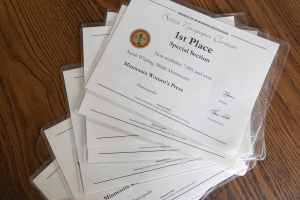 For 2025 coverage, Minnesota Women’s Press earned a community leadership award, three photography awards, and four editorial awards, including for coverage of social issues and for our Spring 2025 “Know Your Rights” special section supported by Unidos MN. Our publisher was named Journalist of the Year by Violence Free Minnesota for gender-based violence coverage.
