


Grief for the Country We Are — and Hope in Our Potential
Coverage supported by the deep donations of long-time supporters Kristin Siegesmund and Becca Brackett.

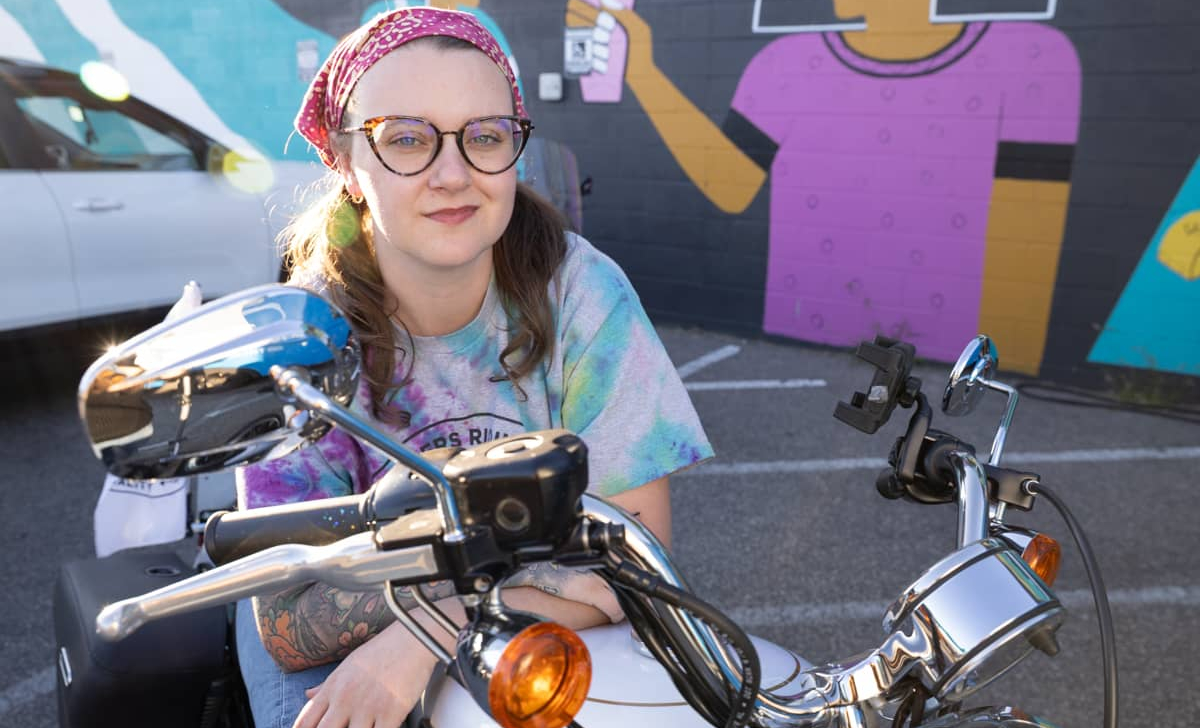
Amie Stager. Photo Sarah Whiting
It’s 2026, and it’s been 250 years of this ongoing experiment of democracy that we call the United States of America. The semiquincentennial has me asking, what is freedom? And would we recognize it if we came across it?
It’s been 161 years since the 13th amendment was ratified, when enslaved workers walked off the plantations, many of them joining the Union army. Standing in our storied marbled state capitol in Saint Paul, one is surrounded by battle flags memorializing the war it took to end the economic and labor system of slavery — a system of mass death and violence.We’re mistaken to think that the system of owning people as property was completely abolished. It wasn’t.
The system of owning people hasn’t ended for those incarcerated in prisons and detention centers, who labor for less than a dollar an hour. It hasn’t ended for people who labor under the subminimum wage, or are victims of wage theft. It hasn’t ended even for the majority of us who work, sometimes multiple jobs, to survive.
Increasingly we see evidence of the CEOs, tech lords, and billionaires who profit off the work done by people who struggle to pay for food, fuel, and a safe space for family to live — whose freedom is that? Jobs are threatened by artificial algorithms, ongoing payments for insurance deny us coverage to a dwindling access to health centers — whose freedom is that? Young adults are sinking under a mountain of debt from post-secondary training and degrees, and our air and water are filled with toxins from consolidated farms and incinerators — whose freedom is that?
Yes, this is a depressing picture of ongoing exploitation and extraction that has always shaped our country. Yet, as we know, Minnesotans also show what true freedom might actually be: life-giving connections and networks, especially visible in the grip of crisis impacting our neighbors and us. A world where we don’t have to fight to live is at the tips of our fingers. We shouldn’t have to fight for it, but we do, and we must.



Labor Rights in Sum
It’s been 91 years since the National Labor Relations Act (NLRA) was passed, after general strikes in cities across the U.S. — including the 1934 Teamsters strike in Minneapolis — demanded and won union representation and rights. This, too, was a story of violence — of people losing their lives to end one system and create another. Excluding public, agricultural, and domestic workers, the NLRA gave employees “the right to self-organization, to form, join, or assist labor organizations, to bargain collectively through representatives of their own choosing, and to engage in other concerted activities for the purpose of collective bargaining or other mutual aid or protection,” as well as the right “to refrain from any or all such activities.”
Every worker covered under the NLRA in the U.S. has this right. Like many other rights, it is at risk from corporate attacks and the Trump administration. The National Labor Relations Board (NLRB), the agency tasked with enforcing labor law, has experienced a historic backlog in cases due to Trump’s removal of board member Gwynne Wilcox in 2024. Lawsuits from corporations like Amazon, Tesla, Starbucks, and Trader Joe’s — whose CEOs are paid thousands of times more than any of their employees — allege that the structure of the NLRB is unconstitutional, challenging the agency’s ability to enforce the law.
The case is still moving through the court system.
If the NLRA is overturned, labor law would be up to the states. Minnesota has strong worker protections compared to surrounding states, including an entire division within the state attorney general’s office devoted to wage theft, but it is not perfect. Employers still have a lot of power that they use to influence what laws are made — and to violate those laws. In April, the Minnesota Department of Labor and Industry announced the recovery of $1.2 million dollars in wages for construction workers employed in 19 projects in the state. It was the largest amount recovered by the agency.
According to the Economic Policy Institute, workers in the U.S. lose up to $50 billion in wages every year.
It’s been 19 years since the paltry federal minimum wage of $7.25 was raised. In addition to wage theft, under the federal Fair Labor Standards Act, employers are allowed to pay workers with disabilities less than the state or federal minimum wage. Data from the U.S. Department of Labor shows there are 47 employers in Minnesota that paid a subminimum wage to 2,646 workers this past year.
We know that if the wealthiest 1 percent paid taxes consistently the way the rest of us do and paid workers liveable wages, we wouldn’t need government safety nets or philanthropic mutual aid. We could feed and house and care for everyone who labors for those profits.
The propaganda many people seem to have bought into is that it is the lower classes — not the upper classes — who are leaving us hungry. The frenzied microscope points to misuse of tax dollars at the lowest of levels. Too many of our neighbors seem to be ignoring the fraud perpetrated at the highest levels. How did we get here?
It’s been six years since I began reporting on essential workers. This intimate look at the narratives that run our economy have helped me see that the most important workers receive the least amount of protections, wages, and dignity.
It’s been five years since my dad died from COVID complications, likely related to work, leaving my family in a surreal reality that befell more than 1.2 million U.S. families.
What is freedom? Maybe the question I should be asking is: “What is the opposite of ownership?”
Belonging, in a non-possessive way, is a collective sense of ownership — in a “we are responsible for each other’s general well-being” way. Our Indigenous neighbors often show us how we can start: forming better relationships with the land, our ancestors, and our descendants.
As a student of radical movement history, I am learning from many teachers that collective stewardship of our land and labor is what protects us. I’m thinking of the small, regional, interconnected operations, enterprises, and congregations that largely remain unnoticed and underground, rejecting the worship of wealth, living the truth of survival.
It’s 2026, and I’m asking questions about how this country was born of collective grievance against a tyrannical empire, built with and on our sold, stolen, and surveilled labor.
It is a tradition worth remembering as we continue to work to co-create community based on love and liberation.
Amie Stager (she/her) is a senior associate editor at Workday Magazine and works for the Labor Education Service. She studied journalism, art, and anthropology at the University of Minnesota and has a master’s degree in heritage studies and public history.
Minnesota Women’s Press uniquely centers marginalized voices — but we need your support to keep doing so. As you might have heard, media outlets like Lavender (newly closed) and Star Tribune (dramatic personnel cuts) are curtailed. So are we. But we are committed to freelance story development with whatever funds we have as we move toward a consumer-owned media co-op model by years-end.



 For 2025 coverage, Minnesota Women’s Press earned a community leadership award, three photography awards, and four editorial awards, including for coverage of social issues and for our Spring 2025 “Know Your Rights” special section supported by Unidos MN. Our publisher was named Journalist of the Year by Violence Free Minnesota for gender-based violence coverage.
