


From Grand Rapids: Local Media Talk About Political Leadership, Housing, LGBTQ+ Acceptance, and More
A visit to Grand Rapids in July — to have local conversations about the issues that mattered to people there — included a discussion with women reporters at KAXE radio about what they were hearing as journalists who have the pulse of community concerns and sentiments. Here are some of the thoughts shared; the comments are not attributed to a particular person (since my notes on that were lost), but reflect the summary of what was said.
KAXE radio state in Grand Rapids
Political Leadership
There’s sometimes a disconnect between our elected officials to those who are boots on the ground and running things. In Itasca County, the nonprofits are for the most part run by women — that’s not a new phenomenon. Women have been running these organizations for decades. We entrust women to make decisions to lead these organizations. Some of our community foundations have strong, powerful women.
But when you look at the ballot, it’s mostly men that are running and being elected.
I had a conversation with a very engaged woman recently and asked if she would ever run for the legislature. She said it just isn’t possible. She had two kids. “How do I do that and get down to Saint Paul; I have some great ideas I would like to do, but my kids are young.” It makes it hard for women to run because of where we are; you can’t just go to the cities and work at the legislature.
I think that often, the national narrative subsumes some of the local conversation. I think there are many ways in which people, no matter their political affiliation, come to agreement around here, when you’re looking at the local government. Everyone agrees there needs to be more housing available; if we’re going to economically develop this community, you have to give people a place to live and an option for childcare. Those are not partisan issues.
Do people sometimes people approach them from a partisan lens? Yes. Sometimes the national narrative and the social media drumbeat leaks into those conversations. But overall, I think there are things happening on the nonpartisan, local level of government — people on all sides can agree on a goal.
Women are leading in many ways here, but the elected people don’t reflect that. There are no women on the local county board, for example. The vast majority of local governments across the region are dominated by older, retired men. When you have additional challenges of not being able to find affordable childcare, not being able to find affordable housing, not making enough money to get by, how are you supposed to extend yourself further to be serving in that way? Rural life is just harder.
Housing
There are challenge in that rural communities do not get the same financial support from the state. The Minnesota Housing Finance Agency is a great example of that — rural communities are inherently disadvantaged to get funds.
There is new to Itasca County a community housing trust model, in which people own the homes but the land remains in trust. The idea is that when it goes for resale, the owner is only selling the home. They are calling these affordable homes, but when you look at the realtor website, the houses are selling for $225,000. So affordable, for whom?
Even trying to so have younger staff — we probably averaged 50 to 55 years old for a while around here — but now we have people in their 20s working for us, and finding affordable housing in the area is hard. We want to encourage young people to return here and start to make a living for themselves; they probably don’t want to be living in mom and dad’s basement. You need places for them to be independent and have space to get their grounding, but there’s not a lot of that up here.
At a national gathering of Report for America, I sat in on a discussion with all of these reporters that have been placed in communities throughout the United States to discuss their experiences. Every single one of them talked about the challenge of finding housing that was affordable. They either had to make a very long drive, or they were spending at least half of their income on housing. So it’s not unique to our region. But there’s something seriously broken with the development piece, the infrastructure behind it, that is not offering the proper incentives to build truly affordable housing. That’s capitalism.
Homelessness has always been an issue in rural Minnesota, it’s just not as visible as it is in other places. So much of that comes back to mental health, substance use — those things are intimately intertwined. There is absolutely not enough programming and resources and beds.
I don’t think it was ever fair to expect law enforcement to also be social workers. That was a failure from the start. The nearby Crow Wing county jail has become the shelter. The Brainerd City Council is pushing for a public camping ordinance.
Safety
We do interviews and focus groups with women. When the #MeToo movement started, we quickly realized women in this area do not have the agency to say what their employers might be doing to them. We had a single mom here, whose boss had been for years pushing her against a wall, harassing her. But she said she could not lose her job, and was trying to find a new one, so didn’t know what else to do. Slowly, everyone in the conversation indicated they understood. One said she talked to her brother who said there were laws against harassment — but if you are going to lose your job, how do you hire a lawyer?
Transportation
I used to work at the Community Foundation, which had funds. One of our biggest requests was people wanting to have their cars repaired. They break down, which keeps them from being able to go to and from work, or get to their probation appointments. We wrote a lot of grants for bicycles, or the transit bus, which had limited hours. If you got a job that was an overnight, you didn’t really have many options other than your legs or a bicycle. We do now have a free self-driving car system, GoMARTI, but that service area is fairly limited. If you’re having a hard time finding housing, and you’re having to live outside of the city limits of Grand Rapids, now you’re also having difficulty with transportation. It snowballs.
Transportation is probably the worst issue, because if you do not have a car and you are not in the right zone — someplace where you can maybe catch a city bus every five hours — you’re screwed.
GoMARTI recently has gained additional funding. They will be expanding westward into the Leech Lake reservation. It’s a pilot project. They’re purposefully testing it to see if these cars can stand up to the winter. It has opened up opportunities for people, especially those who are disabled. The cars are all wheelchair accessible and are able to go out a decent range from the city center. It has a lot of potential, but it’s also something that so far seems reliant on on government funding now. How long will that last?
Health
Itasca County is the only county that administers its own public health insurance program in the state. It depends on whose side of the story you believe, but the program essentially ended up removing from their coverage a major behavioral health provider in the community. It was because of billing disputes and many other things. But it was one of the few places where you could get certain treatments and drugs for extreme depression. Now they have to drive to Duluth. When you have people who are already experiencing serious challenges, to ask them to figure out a way to get to Duluth — or to even have the motivation and desire to go that far for a single appointment — that’s adding barriers that will be insurmountable for some.
LGBTQ+ and Humanizing
I think we’ve been able to tackle some difficult conversations through personal stories. We’ve talked to women who have been the victims of domestic violence. We’ve talked to the abusers. When the marriage equality was on the ballot here in Minnesota, we talked to people within the LGBTQ+ community about what marriage equality means to them. It humanizes these things.
I think a lot of people react and behave at a place from fear. Once you can put a face or a voice to it, you realize “I see that woman at church. I see that person picking up their children at my school.” It humanizes people so you are not so afraid of it.
At the recent LGBTQ+ Pride event, we did multiple stories. We covered the opposition. We covered the response to that. Then we covered the event.
It was framed by some as the first-ever Pride event in Grand Rapids. But, though it was the first-ever large-scale Pride festival, it was certainly not even close to the first Pride event. That erased a lot of the work that LGBTQ+ folks have done in rural places up to this point. There has been work on that front for a long time, just on a smaller scale. The scale of this one is what got people’s attention and rankled some of the people.
I feel like this was another example of where the loudest voices in the room are sometimes the most oppositional. That can make it seem like there is more opposition than there really is. On the day of the event, there were thousands of people who showed up, had a great time, enjoyed the day with their families, and supported the event. If you’re sitting at home, and only consuming through a particular lens of social media, it might seem that there’s this massive opposition.
There were a handful people who showed up that day to oppose. And, frankly, they have such strong viewpoints that they will never change their minds. That’s just the truth of the matter. But there’s a lot of movable people in that middle space — exposure is the best thing. And yeah, so
That kind of brings it back to where we started this conversation — people being in these vacuums without good information in front of them. They’re dependent on social media. We know that the people often behind those keyboards are presenting their deepest, darkest, angriest self. By interviewing people, having conversations, actually looking into what the issues are, you put the actual facts and information out there.
The reason journalists actually covering these things are so important is that you can shine the light and apply the disinfectant on these things. You realize a thousand people are there to have a good time, to help support people in their communities who feel marginalized. Then you had six people who were party poopers, just to spew their hate and be miserable. It was important that we were there to tell that story.
It also was another example of the difference it makes to have coverage based in the community versus coverage from the outside. The outside coverage was of the drag queens. We had much more family-of-all-stripes focus in the photos that we shared.
The event went from 11am to 6pm. The drag performances accounted for about 45 minutes of that time span. Some statewide media were here covering this and just covered that 45 minutes. They didn’t cover the families playing bingo together, the artists that were singing and performing, the community organizations that had tables and booths, people enjoying food and beverage. That was completely lost in their coverage.


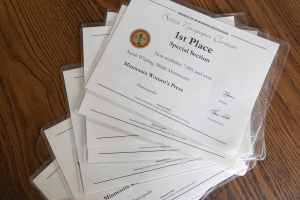 For 2025 coverage, Minnesota Women’s Press earned a community leadership award, three photography awards, and four editorial awards, including for coverage of social issues and for our Spring 2025 “Know Your Rights” special section supported by Unidos MN. Our publisher was named Journalist of the Year by Violence Free Minnesota for gender-based violence coverage.
