


Four Steps to Help Small Farmers
Ecolution reporting made possible by Seward Co-op, which has been a community-owned grocer since 1972: Together, we continue to cultivate a cooperative economy.
Norren Thomas and Melany Thomas
This story was adapted from an earlier version published online in April.
Minnesota Department of Agriculture’s Emerging Farmers Office (EFO) was created three years ago to help solve some of the problems that small farmers face.
Patrice Bailey, assistant commissioner of the EFO, says that these problems include access to money, land, mental health support, and insurance. Challenges can be even greater when the farmer is an immigrant, or is not familiar with the jargon used in documents like grant applications. “It becomes a huge barrier of understanding,” Bailey says.
Noreen Thomas, who operates Doubting Thomas Farms, lists additional challenges for small producers. The lack of accessible packaging infrastructure means that she and her employees need to package their products by hand. When small farmers do have access to equipment, it’s old, difficult to use, and usually needs parts that are hard to get. “You’re not going to buy new equipment. You can’t afford it,” says Thomas.
The economy of scale means that big companies provide goods that are cheaper and more convenient than those of small producers. Thomas says that greenwashing — pretending that a product is environmentally friendly — is also used to lure consumers away from small producers.
“If [a package] says ‘farmer-owned,’” she says, “ask for names and whether the farmers are regional or local. If they can’t name [the farmers], it’s greenwashing.”
Maisie Ganzler recently published You Can’t Market Manure at Lunchtime. Written for brands attempting leadership in sustainability, the book explains problems that arise when small farms attempt to make wholesale connections. These include lack of land, which prevents scale-up; lack of truck drivers, limiting the frequency of deliveries; and incompatibility with delayed corporate payment schedules.
“A farm grossing $500,000 would struggle to support a family without an additional source of income,” Ganzler writes. “A small business won’t survive paying all its expenses today and getting its revenue six months later.”
Organic farms, which promote ecological balance, have additional challenges. The work, fees, and requirements for organic certification can be a significant barrier, says Thomas. Ganzler recounts in her book a conversation with a farmer about the difficulty of complying with organic regulations: “I have one field. If I get a fungal outbreak, I need to be able to use a fungicide as an emergency measure. I can’t afford to [till back into the ground] an entire season’s worth of produce to maintain organic certification.”
She writes that “requiring a small farmer to do the requisite record-keeping for organic certification, pay the certification fee, and tie their hands completely so they [can] never ever use pesticides or fungicides, might be counter to ensuring their success.”
Even large companies are starting to recognize the problems faced by small farmers.



CSAs and Wholesale
Many people in the agricultural sector point to community-supported agriculture programs (CSAs) as a solution to the problems faced by small farmers. This is a great way for consumers to get regular deliveries of fresh produce while supporting local farms. because it can “reduce financial risk, increase stability, and build relationships” for farmers, says Assistant Commissioner Bailey.
But Thomas, who has contributed to CSAs in partnership with other farmers, says that it is a young person’s project that “takes an incredible amount of energy and tenacity.” Selling wholesale to restaurants, schools, co-ops, and other institutions can be a better option, she suggests.
Rachel Wandrei, Minnesota Grown’s marketing manager, says the organization is a partnership between the Department of Agriculture and over 1,300 farms and farmers markets around the state. It provides a license and a unifying brand for farmers whose products are at least 80 percent grown and raised in Minnesota.
Doubting Thomas Farms is a participant, using the packaging cost-share program. Thomas says that local, informal connections between farmers are essential, especially as support to young women farmers. Local collaborations allow small farmers to share shipping costs, teach each other how to use old equipment, and help each other with applications for loans, grants, and certifications.
“Women learn by community,” she says.
 Action = Change
There is a lot that conscientious consumers can do to support small farms with ongoing challenges.
- Check the Minnesota Grown directory for produce. The online directory lists over a thousand producers and farmers markets, “from beef to bison, broccoli to beeswax,” says Wandrei. “Cheese, wild rice, maple syrup, honey, Christmas trees. If you’re looking for an apple orchard, go to the Minnesota Grown directory.” The directory includes the ability to search by organic certification, water quality certification, location, and producer identity.
- Distance isn’t the only metric for sustainable consumption, Ganzler points out in her book: “There could be an industrial farm with poor practices that’s less than 150 miles away. [Buying] local means supporting small producers who are good stewards of the land and members of the community.”
- Minnesota drivers renewing their license plates can now pay extra for an agriculture-specific plate. The proceeds from these plates support Minnesota’s 4H and Future Farmers of America organizations.
- Thomas says that speaking up about your purchases is “tremendous.” She suggests that consumers “write a letter, write an email, and say, ‘I go to the store to buy [this produce] because I know this producer, and I know their quality.’” She suggests following the farmers on social media and telling them why you prefer their products.
“It’s very important to vote with your dollar,” says Thomas. “What you’re doing is making a decision on how the land is treated, how the animals are treated. You’re making a vote.”


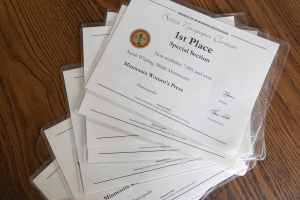 For 2025 coverage, Minnesota Women’s Press earned a community leadership award, three photography awards, and four editorial awards, including for coverage of social issues and for our Spring 2025 “Know Your Rights” special section supported by Unidos MN. Our publisher was named Journalist of the Year by Violence Free Minnesota for gender-based violence coverage.
