

COMMENTARY: Firearms as Symbols of Kinship and Belonging


Writer Amber Lynum (l) with her friend Lizzy Bruder (r) at her family’s cabin. Courtesy photo.
The men in my family, and one or two women, are among the 500,000 hunters that take to Minnesota lands annually during hunting season. Small game or large, it doesn’t matter — if you can get a license for it, they’re aiming to bag the limit. Much of this activity is centered around our hunting cabin in northern Minnesota, about 40 miles south of the Canadian border.
Our cabin, with a neighboring bunkhouse and sauna, was once little more than a crumbling shack next to a sawmill. Since 1951, heading north to deer camp has been an annual tradition, starting with my then-six-year-old grandpa and his dad. With eight decades of use, the shack has seen many updates and new faces, but it remains the heart of our family ritual.
Deer camp, for much of my childhood, represented a male-only space and an unspoken rite of passage. Inclusion of women — first my younger cousin, later myself — slowly shifted the dynamic, though not without resistance from our brothers. The boys grumbled first at her presence, then mine, which said everything they’d learned to think about women in these spaces. Generations of implicit norms.
My grandpa recently described the shack simply as “a guys’ cabin — it’s just the way it was.” For decades, from the 1960s through the early 2000s, the men went north for deer hunting, while women stayed home with the kids. My grandma tells me that she never wanted to go — it was her time to herself — but she also says few women in her generation hunted, and society made it clear it wasn’t fitting for women to do so.



My Exposure to Guns
In Minnesota, young hunters complete firearms safety at 12 and start hunting alone at 14.
The first time I handled a gun was on a trip to the shack. Sitting on a rock outside, my father showed me how to hold a BB gun against my shoulder and look down the bore. My first shot hit the dirt; I had been aiming for a squirrel. From then on, I tagged along on four-wheeler (or ATV) rides, acting as my dad’s scout.
At a logging clearing, he taught me to practice with a .22 shotgun. I never liked the kickback against my shoulder or how hard it was to see through a scope while wearing glasses. Firearms became something familiar by proximity, but never something I cared to pursue myself.
When President Obama was reelected in 2012, I was living in France on a gap year. My new friends asked eagerly about guns, linking them inseparably to American identity. I stuttered, feeling a bit shameful, as I explained our family’s gun culture. I thought of my brother’s firearms safety certificate, my dad’s careful handling of his rifle, and my aunt’s conceal-and-carry permit for work. These examples felt legitimate. But I had no argument for why this was part of U.S. culture beyond “the Second Amendment says we can” and “some people feel safer with them.”
Weeks after graduating college, I moved into a cooperative residential community rooted in Quaker beliefs. Nonviolence was central. Many of my New England housemates had no experience with guns outside of news headlines. At one of our near-nightly dinners, someone asked me directly: what is your opinion on guns? It was another turning point. This time I was old enough to realize I had to take responsibility for developing my own beliefs, not just borrowing the ones I grew up with.
Defining My Beliefs
Well before the school shooting at Annunciation Catholic School in Minneapolis, I knew I needed to face my conflicting feelings more directly. The green-and-blue remembrance ribbons tied to trees around my neighborhood are a reminder to me of the cycles of gun violence in this country.
Yet I also signed up for a firearms safety course — not to become a hunter, but to shed some fear through knowledge and to better understand what responsible handling should look like.
For many Minnesotans, hunting is a way to connect with the land, control wildlife populations, and harvest clean, unprocessed meat. Even as a plant-based consumer, I understand the desire to know where your food comes from.
My family and friends keep firearms, with a deep respect for their power. A gun is a tool, not a symbol. In contrast, the news illustrates examples of how guns can easily become misused when they serve as markers of status or identity or power. When taken to the extreme, they are used as violent weapons to make a statement, to exert control over a situation, or even as a plea for help.
I expected my hunter’s education course to be steeped in talking points from the National Rifle Association, but was surprised to find that most firearms safety programs operate independently, grounded in North American standards of safety and ethics. It’s an expanding field, even in Minnesota high schools, where target shooting teams, including girls’ divisions, are among the fastest-growing sports in the state.
Still, I can’t ignore that firearms carry vastly different meanings, depending on who wields them and how they’re portrayed. Hunting as a tradition gets a bad name when people are careless and irresponsible with their weapons, or when guns are primarily associated with self-defense or violence rather than stewardship and skill. My own family’s story reflects both sides of this divide.
My dad, who didn’t grow up hunting, was gifted his first rifle by my mom, with her dad’s help. He soon joined her family’s rituals at the hunting shack. It was an initiation into belonging as much as a hobby.
In the end, what I keep returning to is that this isn’t only a story about guns. It’s about belonging, and how we find our place between the values we inherit and the ones we choose.
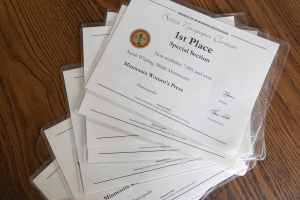 For 2025 coverage, Minnesota Women’s Press earned a community leadership award, three photography awards, and four editorial awards, including for coverage of social issues and for our Spring 2025 “Know Your Rights” special section supported by Unidos MN. Our publisher was named Journalist of the Year by Violence Free Minnesota for gender-based violence coverage.
