


Faith Leaders Bolster the Coming Work to an Audience of 5,000
This story sharing made possible by the donations of Bill and Michelle Pohlad, as well as long-time supporter Kristin Siegesmund.

About 5,000 people gathered in Minneapolis Saturday for a conversation led by ISAIAH and Faith in Minnesota about the people’s agenda — for improved access to health care, childcare, housing, and more — as preparation steps for upcoming caucuses, neighborhood action steps, and legislative conversations. People arrived from around the state, including Muslim coalitions, the Barbershop and Black Congregation Collective, Rural Organizing Project, Kids Count on Us childcare centers, and the Manufactured Home Resident Collective.
The message was urgent but not despairing: ordinary people, organized together, can change the course of the country.
Co-directors Alexa Horwart and JaNaé Imari (newly married; formerly surnamed Bates) framed the conversation as both a moral reckoning and a call to action. “It is hard to look at it. To really see what is happening,” Horwart said, describing federal immigration enforcement actions unfolding in Minnesota. “Masked federal agents are stopping Minnesotans on our streets and asking them for their papers. Citizens have been thrown to the ground, cuffed, abducted, detained, in broad daylight.”
Horwart shared a message from her son’s school that asked parents to prepare for the possibility of picking up children whose parents might be taken by ICE. “I thought of these beautiful, silly, curious third graders… wondering what had happened to their parents,” she said.
The speakers tied those scenes to talks given earlier in the day by statewide faith leaders about broader economic pressures facing families: rising food and energy costs, threatened health care access, and shrinking public supports.
Howart said, “Food supports for tens of thousands of Minnesotans are in jeopardy and millions are bracing for their health care to simply be impossible to afford. A young family is looking at their childcare, healthcare, heating, electric, water, and grocery bills and trying to figure out how to also squeeze in something special for the holidays.”
She added: “It is human to want to look another way — to either think everything will be okay somehow or to be swallowed by despair.”



We Have Been Here Before

Alexa Horwart
Horwart walked through the authoritarian history that people in the U.S. have lived through previously, when nationwide leadership worked to “have all the power concentrated with themselves, be above the law, and use force to compel their opposition into compliance. Some say, ‘This isn’t America.’ But that is not true.”
She walked through the Reconstruction period after the Civil War, when Black Americans were freed from slavery to form schools, build public hospitals, win elected office, and begin to be part of making a new nation. “But it was short-lived,” Horwart said, “and the power of the plantation-owning classes returned to power and took away everything — voice, vote, self-determination — under a new regime called Jim Crow. Can you imagine the grief of that loss?”
State and federal government were still fighting against Black Americans when, in 1955, 50,000 people boycotted the Montgomery, Alabama, public bus system for 381 days. “They worked all day, sometimes multiple jobs. They walked miles to work – for over a year. And after work they went to organizing meetings sometimes for 4, 5, 6 hours a night. Not just one person, or a dozen… 50,000.”
This involved regular people “organizing and taking profound, strategic and courageous risks. They did democracy themselves and refused to wait for someone to give it to them.”
The night after Rosa Parks refused to give up her seat on the Montgomery bus, thousands of people voted at Holt Street Baptist Church to take action. “I think about that vote all the time,” Horwart said. “Here were people who had only ever known the authoritarian system of Jim Crow. Day in and day out they endured terror backed by the U.S. government. And yet, that day in the church, they raised their hands … and forged a path in great darkness with great faith and determination, but also deep strategy and collective discipline. And we have to do the same.”
Horwart indicated that the current crisis has roots in decades of policy choices driven by greed. “There is a poison at the soul of this country,” she said. “That poison is greed.” She described what she called a 50-year corporate strategy to consolidate wealth and power, resulting in levels of inequality “incompatible with democracy.”
She sharply criticized what she called the “Big Beautiful Bill,” labeling it instead “the big billionaire bill.” The legislation, she said, funnels more than $1 trillion in tax breaks to the wealthiest Americans while dramatically expanding funding for immigration enforcement. “Every cent of this is paying Elon Musk and Jeff Bezos’s tax bill and to fund the masked, untrained, federal squads harassing us and our neighbors,” she said. “You are paying for this.”
That contradiction — promises of affordability and safety versus lived experiences of rising costs and fear — is, Horwart argued, why cruelty has become so visible. “The cruelty is not an accident. It is the strategy,” she said. “It is meant to make us afraid. It is meant to keep us divided and distracted.”
She reminded the thousands of people in the audience that in every moment of authoritarian power it has been regular people who have protected and expanded democracy. “Successful movements all had something in common: they had a clear, proactive agenda for a better life for every day people. Our vision has to shift power from billionaires to us. It has to deliver a better life. For all of us.”

The Lie That “the Other” and Self Is to Blame

JaNaé Imari
Imari built on that analysis with a personal and spiritual appeal. “What we are living through right now is not just bad policy,” she said. “It is a spectacle of cruelty — carefully crafted, deliberately staged, and paid for with our money — to keep us afraid.”
She warned that authoritarian movements rely on a familiar formula: “Create the crisis. Exploit the fear. Offer yourself as the solution. Take the power.”
The spectacle is designed to: 1) make people believe that “other people” — immigrants, the poor, Black folks, Muslim folks, rural families, anybody but billionaires — are the cause of our economic pain; 2) that everything is out of control except them; 3) That danger is everywhere, and only they can protect us.
The lie, she said, is that immigrants, poor people, or marginalized communities are to blame for economic pain, rather than billionaires and systems designed to extract wealth.
Imari said the deeper, more insidious lie is that struggling is a personal failure.
- “If you’re struggling, it’s your fault.”
- “If you can’t afford groceries, you didn’t work hard enough.”
- “If you’re drowning in medical bills, you made bad choices.”
- “If your family is suffering, you should’ve pulled yourself up faster.”
“Shame is one heck of a weapon,” she said. “Shame turns us away from righteous anger. Shame turns us away from taking action. And most dangerously, shame turns us against each other.”
Imari said her husband was incarcerated for 20 years, and only recently were they able to celebrate the wedding they had long hoped for. “He spent two decades inside a system designed to teach him, and all of us watching, a single lesson: that some people — even most people — are not meant to flourish. That is the lie. That people marked by poverty, punishment, migration, or race should accept smaller lives, quieter joy, limited futures. … Our flourishing defies their script.”
She continued: “Some of you have stories that tell you to hush. Stories that whisper you are undeserving of better. Stories that say, ‘Be grateful for scraps.’ Stories that say, ‘Don’t make noise. Don’t lead. Don’t dream bigger than what you were handed.’ Stories that say being poor or struggling or ashamed is just your fate. But every faith tradition and moral value represented in this room says something different.
“Every prophet, every sage, every ancestor worth listening to has testified that we were created for dignity, partnership, imagination, and abundance. … The kind that grows when people stand together and refuse to bow to fear. And right now, we are standing inside a moment that demands that kind of power.”
Instead of shame and silence, Imari called for nonviolent, collective noncooperation with systems of cruelty. “Part of our power in this season … is noncompliance,” she said, echoing the lessons of the civil rights movement. “Not in isolated acts of rebellion, but as a collective body choosing to gum up the machinery of cruelty.”

Screens listed the public policy ISAIAH support has led to in recent years
Next Steps
The speakers laid out a two-part strategy:
- Make private pain public by forcing decision-makers to confront the real-life consequences of their policies,
- Advance a clear “better offer” — an agenda centered on affordability, dignity, and shifting power away from billionaires and back to communities.
The goal, they said, is nothing less than repeal of the billionaire-focused legislation and the construction of what they called a New America.
“We are not spectators. Not victims. Not bystanders,” Imari said. “[We are] architects. This is our watch. Our moment. Our choice. Darkness cannot cancel light. Light breaks in every time.”
To engage with this work, visit the Isaiah MN website.

One of the speakers of the day included an 86-year-old faith leader
We need your help to continue our unique community-focused coverage in 2026:
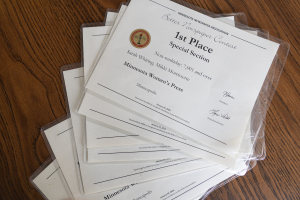 For 2025 coverage, Minnesota Women’s Press earned a community leadership award, three photography awards, and four editorial awards, including for coverage of social issues and for our Spring 2025 “Know Your Rights” special section supported by Unidos MN. Our publisher was named Journalist of the Year by Violence Free Minnesota for gender-based violence coverage.

