


Exploring the Links Between Latina Art and Organizing: Jessica Lopez Lyman’s “Place-Keepers”

from the book cover of “Place-Keepers”
Author and scholar Jessica Lopez Lyman marked the publication of Place-Keepers: Latina/x Art, Performance, and Organizing in the Twin Cities (University of Minnesota Press) with an event at El Colegio High School in South Minneapolis in December that reflected the book’s central argument: art is not a backdrop to social change, but one of its most vital engines.
Place-Keepers examines how Latina/x artists in the Twin Cities have long navigated and contested Minnesota’s deeply entrenched racial inequalities. Centering musicians, poets, visual artists, and cultural organizers, Lopez Lyman documents how creative practice functions as a form of grassroots organizing.



At the core of the book is the concept of “Inter-Latina movidas,” a term Lopez Lyman uses to describe the small but powerful actions through which Latina/x artists build solidarity across difference. These movidas emerge in behind-the-scenes negotiations with nonprofits, city agencies, and arts institutions; in intergenerational mentorship; and in moments when artists leverage aesthetics to claim space in neighborhoods shaped by displacement and erasure.
The Twin Cities provides a crucial setting. Frequently celebrated for its “creative economy” and robust arts funding, the region also ranks among the most racially inequitable in the nation. Lopez Lyman situates Latina/x cultural organizing within this contradiction, tracing how artists respond to gentrification, environmental destruction, police violence, and structural neglect while operating in a state that often prides itself on progressive values.
Importantly, Place-Keepers refuses the idea that the 2020 Minneapolis uprising, following the murder of George Floyd, marked the beginning of racial justice organizing in Minnesota. Lopez Lyman traces a much longer lineage of resistance — one that includes Chicana/x, Black, and Indigenous struggles that predate national attention.
Many artists in the book are women and gender-nonconforming. The book expands dominant narratives about who organizes, how movements are sustained, and where political knowledge is produced.
Place-Keepers profiles artists whose work moves fluidly between performance and protest. Their practices challenge boundaries between art and activism, demonstrating how aesthetics can mobilize communities, foster healing, and sustain long-term organizing.
Whether through music that links climate justice to Black and Indigenous solidarity, or through public rituals that transform contested urban spaces, these artists operate as what Lopez Lyman calls “place-keepers” — cultural workers who defend and reimagine collective belonging.
At a moment when arts institutions increasingly use the language of equity while continuing to marginalize organizers of color, Place-Keepers offers both a critique and a blueprint. Lopez Lyman shows how Latina/x artists have long developed their own infrastructures of care, collaboration, and resistance, often without recognition or resources. By naming these practices, the book positions them as essential to understanding how social movements function.
Ultimately, Place-Keepers argues that art’s power lies not only in representation, but in its ability to build relationships, sustain memory, and create openings for collective action.
As the Twin Cities continue to grapple with uprising, displacement, and institutional reform, Lopez Lyman’s work insists that the future of justice will be shaped not just in the streets or the courts, but in studios, classrooms, and community spaces where movidas quietly accumulate.


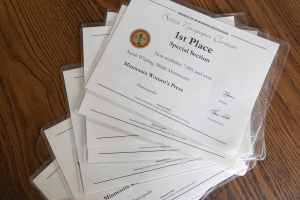 For 2025 coverage, Minnesota Women’s Press earned a community leadership award, three photography awards, and four editorial awards, including for coverage of social issues and for our Spring 2025 “Know Your Rights” special section supported by Unidos MN. Our publisher was named Journalist of the Year by Violence Free Minnesota for gender-based violence coverage.
