

EXPLAINER: Mining in Minnesota

A business sign in Chisholm (photo by Mikki Morrissette taken at a local celebration in 2023)
Minnesota has mined iron for well over a century, and it is still the largest producer of iron ore and taconite in the United States. Now the state is at the center of a bigger question: should it open a second kind of mining, for copper, nickel and other metals, in some of its most water-rich landscapes?
This Explainer is part of a series designed to help people understand how the government — and the people we elect to it — serve the common good with the decisions they make about policy and funding priorities that impact the interconnected whole.



Recent Political Battles
- January 2023: The Biden Administration instituted a 20-year moratorium on mining across roughly 225,000 acres of the Superior National Forest within the Boundary Waters watershed, halting the proposed Twin Metals copper-nickel and cobalt project and restricting development in the Duluth Complex. In response, Congressman Pete Stauber introduced a resolution to overturn Biden’s mining ban in Northern Minnesota, calling it “an attack on our way of life,” citing loss of union jobs and national security in his press release.
- January 2026: Under the Trump administration, in April 2026, the Senate voted 50-49 to overturn the ban. Trump signed the resolution, saying it would create jobs and boost the mining industry.
- August 2026: Governor Tim Walz signed an executive order to block new nonferrous (copper-nickel and sulfide-ore) mining leases and permits in the watershed near the Boundary Waters Canoe Area Wilderness.
Iron and Taconite: The Established Industry
Nearly all of Minnesota’s high-grade natural iron ore has been mined out. Advances in technology made lower-grade ore (taconite) usable: it is crushed, processed into hard, marble-sized pellets and shipped to steel mills. Seven taconite plants currently operate in the state.
The industry is also changing. In September, Mesabi Metallics opened the first new taconite facility on the Iron Range in more than 50 years, on the former site of Butler Taconite near Nashwauk, which closed during the 1980s downturn. It is expected to employ more than 350 people full time and produce up to 7 million metric tons of pellets a year, with an estimated mine life of 23 years.
The pellets are “direct reduction” (DR) grade, which can feed electric arc furnaces, now responsible for about 70 percent of U.S.-made steel. Two other Minnesota operations, Northshore Mining (Cleveland-Cliffs) and U.S. Steel’s Keewatin Taconite, recently upgraded to make DR pellets as well. Mesabi Metallics is still pursuing about $2.7 billion in financing to finish its mine and processing plant.
Copper-Nickel Mining: The Central Dispute
Minnesota has never permitted a copper-nickel mine. These deposits are bound in sulfide rock, which can generate acid drainage and carries a higher risk of water contamination than taconite mining. That is why these projects have drawn far more litigation and slower permitting than iron projects, even as backers and the federal government increasingly describe the metals as critical to batteries and defense supply chains.
Three major projects are in play
- Twin Metals proposes an underground copper, nickel, cobalt, and platinum-group-metals mine near Ely, with a dry-stack tailings system that avoids wet tailings basins and dams. Critics, including panelists at a 2026 League of Women Voters event, point to acid mine drainage risks and the Boundary Waters Canoe Area Wilderness (BWCA) watershed. A federal decision barred mining on 225,000 acres of Superior National Forest land, and Minnesota’s DNR has since moved to cancel Twin Metals’ state mineral leases, covering roughly 13,000 acres. The DNR says the company has not begun mining or paid the required minimum royalties. One lease, MM-9455-N, is set to be canceled effective November 10, 2026. The company is backed by Chile’s Antofagasta.
- NewRange Copper-Nickel (formerly NorthMet or PolyMet, a venture involving Teck) would dig a pit near Babbitt and process ore at the old LTV site near Hoyt Lakes. Eight years ago it looked set to become the state’s first copper-nickel mine, but one key permit has since been revoked and two others are in limbo after lawsuits from environmental groups and the Fond du Lac Band. The company’s redesign swaps a wet tailings basin for dry-stack storage, would place waste in a defunct iron pit rather than on an old tailings pond, drops on-site smelting. and is re-applying for a federal wetlands permit. The Duluth News Tribune’s editorial board called the new plan a significant improvement.
- Talon Metals’ Tamarack project in Aitkin County would be a smaller, high-grade underground nickel, copper, and cobalt mine, partnered with Rio Tinto and backed by U.S. defense and Department of Energy funding. Talon has revised its plan to ship ore by rail for off-site processing, now planned at the Humboldt Mill in Michigan’s Upper Peninsula rather than North Dakota, which shrinks the local footprint. The Mille Lacs Band of Ojibwe and environmental groups remain concerned about the effects on wild rice lakes and the Mississippi headwaters watershed.
Tribal and Water Concerns
Water is the thread running through nearly every dispute. Tribal nations, including the Fond du Lac and Grand Portage Bands, have been prominent in lawsuits and regulatory challenges. Even in taconite country, the two bands recently objected to a draft wastewater permit for U.S. Steel’s Minntac plant, arguing that a 45-year schedule to meet sulfate standards is too long to protect wild rice.
Organizations like Save the Boundary Waters advocate for protecting the 1,000 lakes found within the Boundary Waters Canoe Area Wilderness. They say that “a copper mine in the Boundary Waters watershed will pollute the Wilderness for generations to come, causing irreversible harm to water quality, wildlife, public health, and a sustainable outdoor recreation-based economy.” Concerns encompass not only water quality but also mental and physical health and the economy.
A 2018 Harvard study compared the effects of the Forest Service’s proposed 20-year mining ban near the Boundary Waters with the economic consequences of sulfide-ore copper mining to the Boundary Waters watershed and found that more jobs and more income in the region are generated by protecting public lands near the Boundary Waters than by sulfide-ore copper mining.
What Minnesota’s members of Congress and candidates are saying
Positions largely split along familiar party lines, though most speakers say they support mining in some form.
- Pete Stauber has pushed to open the region to mining. Democrats, including Lt. Gov. Peggy Flanagan, criticize his approach as favoring a foreign company at Minnesotans’ expense. His challenger, Trina Swanson, says she supports traditional taconite jobs but opposes sulfide mining near the BWCA.
- In a recent Minnesota Women’s Press story, we quoted Swanson from a recent event as saying: “I’ve struggled with how my position against the mine in the Boundary Waters watershed is flying in the Iron Range. We’ve had honest conversations with the unions. I said, I recognize you’re not going to like this position, but here are the reasons I’m against it. 1) It is a foreign corporation, already been fined for environmental infractions, led by Antofagasta who rents his house to Ivanka Trump. We can follow the money trail, right? 2) We’re not smelting here — the money is in the smelting and the processing. There’s a sweetheart deal with China to do it for free. None of it makes any sense to me. We also know that most of the extraction will be robotic. So it will not be a long-term job generator.”
- Gov. Peggy Flanagan, a U.S. Senate candidate, says she supports mining and taconite’s history, but wants the Boundary Waters off limits and safety backed by science. She is skeptical of the Trump administration’s commitment to clean energy given its rollbacks.
- In an interview with the Women’s Press last week, Flanagan explained why she thinks environmental protections need to be put back in place: “We’re not there yet to be able to do copper-nickel mining safely, and I’ll do everything I can to protect our water. Not only is that important to me, just as a Minnesotan and as someone who would consider myself an environmentalist, but also as Anishinaabe and as a mom. It’s part of my role and responsibility.”
- Michele Tafoya, a U.S. Senate candidate, argues the country can mine cleanly and should stop relying on adversaries for critical minerals, calling it a national security and economic issue for the Iron Range. Other Republican Senate hopefuls have urged streamlined permitting.
- In an interview with Fox 9 All day, Tafoya explained her position: “It seems to me we ought to be able to do mining, and we ought to be able to do it safely and in a way that is clean and safe for the environment. And that’s what I support, because not only is it about — and it is about — national security, we should not be getting these precious minerals from adversaries. So to the extent that we can, we’ve got to get them here. And I think we can do that cleanly.”
What happens next?
- Twin Metals: State lease cancellation takes effect November 10, and the fight over the federal ban and the Senate repeal effort continues.
- NewRange: The company must secure a new federal wetlands permit, and the remaining permits and lawsuits stay unresolved.
- Tamarack: The DNR expects its environmental impact statement to wrap up around 2029, and only then could Talon seek permits.
- Mesabi Metallics: The test is whether it lands the billions needed to reach full production.
- The midterms: Mining is a campaign issue, and advocates on both sides are mobilizing. Who wins could shape federal protections and permitting.
The underlying question is whether copper-nickel mining can be done safely in a watershed-rich state, something that has never been tried in Minnesota. Supporters say new designs and technology can answer it; opponents say the risk is not worth taking.





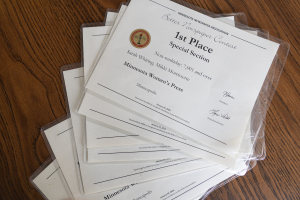 For 2025 coverage, Minnesota Women’s Press earned a community leadership award, three photography awards, and four editorial awards, including for coverage of social issues and for our Spring 2025 “Know Your Rights” special section supported by Unidos MN. Our publisher was named Journalist of the Year by Violence Free Minnesota for gender-based violence coverage.

