

ESSAY: Transportation Blues (or how I became a school escort)
Coverage supported by the deep donations of long-time supporters Kristin Siegesmund and Becca Brackett.

Betsy Hoody (submitted photo)
I idle in the alley, wondering if I should get out of the car.
It’s my first time driving someone else’s child to school. In a few weeks time, this will fade to ordinary, though the anxiety will stay.
The family lives on a busy street with a bike lane and no parking. I was relieved this morning to discover that their house abuts an alley. After turning into the alley, I put the car in park and pulled up google translate on my phone. Estoy aqui, I typed into iMessage.
Now I am sitting, wondering what comes next. Is it better to get out and greet the child at the door or to stay in the car and not attract attention? What happens if another car comes down the alley? Should I pull further back into the alley, so that I’m less visible from the street?
After two more minutes of weighing the options, anxiously imagining all the ways my mistakes could impact this family, I push the car’s flashers on and open my door.
Cold air hits my face. It’s December. The city has been stuck in an endless loop of thaw-freeze for weeks now. The ice below my feet is bumpy — tire tracks temporarily fossilized into jagged peaks of gray and white and brown. I step carefully, looking up at the white house before me. Like many houses in this part of town, it masquerades as a single family home, but the four doors that line the front and side tell me that it has been cut into many apartments over the years.
Even at 9 am, the sun is just peeking up over the roofs to the east; it reflects off of the sole window on the west side of the house. The solstice is just a few days away. I grimace at the thought; every day this month has indeed felt a little darker than the last.
I wonder which door the family will emerge from. I wonder where I should stand, so that they can see me but also so that I don’t attract attention. This desire to be invisible and visible at once will return again and again over the weeks to come.
Just as the worry begins to overtake my brain, the door creaks open. A man walks out, a hesitant smile on his face. His hand leads a little girl. Her small body is enveloped in a puffy jacket and snow pants. A thick ponytail bounces out beneath her winter hat.
Hola E—, I say as brightly as I can muster, trying to hit the Spanish pronunciation of her name that my daughter and I practiced last night. She stares back at me silently.
Somewhere between my haste to get off of the street and my worry about not doing anything wrong, I failed to notice that I had parked the car between two snowbanks. Unable to communicate clearly or quickly enough to move the car, we soldier on. E’s dad helps her ascend the snowbank. She’s so small it looks like she’s climbing a mountain. At the summit, I take her hand from her father’s and help her back down towards the car. At the bottom of the snowbank, she looks up at me silently and then shifts her gaze towards the car.
I hesitate. Glancing back at her father, I pick E up quickly and plop her in the booster in my back seat. Her dad nods, which I take as post-facto consent.
E looks up at me with bright eyes, still silent. When her hands don’t move for the seatbelt, I lean into the car and grab the belt, pushing down her puffy jacket to make sure she’s snugly strapped in. It feels weirdly intimate, to press my body across a child I just met, reaching over and pushing the belt until I hear the click.
I close the door, then carefully waddle back around the car over snow and ice. I wave to E’s father as I step into the driver seat. He looks about as confident as he should — which is to say he looks equal parts nervous and resigned as a stranger who doesn’t speak Spanish drives away with his daughter.
I look out at the chainlink fence at the end of the alley as I put the car into back drive. Not for the last time, I wonder how we got here.
If you like our unique platform for personal essays amidst the news, please support our small editorial team:


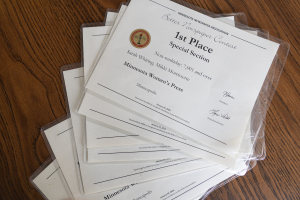 For 2025 coverage, Minnesota Women’s Press earned a community leadership award, three photography awards, and four editorial awards, including for coverage of social issues and for our Spring 2025 “Know Your Rights” special section supported by Unidos MN. Our publisher was named Journalist of the Year by Violence Free Minnesota for gender-based violence coverage.

