

What to Know About ERPOs (“Red Flag” Laws)
Our series on gun violence prevention made possible by the underwriting support of Protect Minnesota.
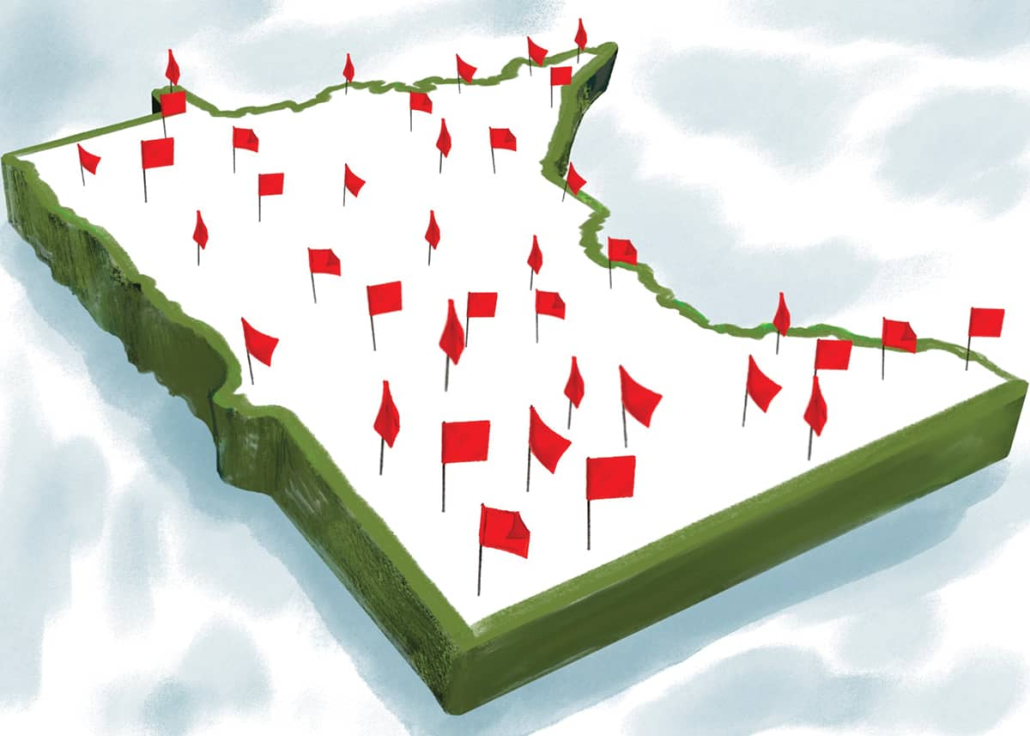
Illustration Chandler Lannes for Project Optimist
Researchers say extreme risk protection order laws help temporarily remove guns from people in crisis, but more research needs to be done and more awareness of the law is needed in Minnesota.
Minnesota’s extreme risk protection order (ERPO) law, or “red flag law,” went into effect in January 2024. Law enforcement agencies, family members, and courts around the state have slowly started to use the law to temporarily remove firearms from people in danger of harm to themselves or others.
Several studies have shown that red flag laws can reduce suicide risk, says Dr. April Zeoli, an associate professor of health management and policy core director at the Institute for Firearm Injury Prevention at the University of Michigan. “The results are remarkably consistent from study to study, and that increases our confidence that we’re finding something real,” she says.
“So we can say that it looks like this is a really promising tool for suicide prevention.”



It’s difficult for researchers to determine the success of ERPOs on homicide rates, Zeoli adds. Homicide is more complicated to assess. “For homicide, you don’t necessarily know the name of the victim to look at for death records,” she says. The perpetrator can be hard to name as well. “[For] a perpetrator of a homicide it’s really complicated, because maybe they’re caught, maybe they’re not caught; maybe there are charges, maybe there’s a conviction; and you have to find all of that data, which is difficult.” Researchers would also have to seek data on attempted homicides or firearm injuries.
Data at the individual level will increase as time goes on, which will increase researchers’ ability to look at the law’s impact on a population level, Zeoli says. It is hard to quantify what would be “enough” data to collect and analyze to determine success. “It depends on a lot of things: how much the state is using it, whether they’re mostly using it for suicide versus violence against others — a lot of things,” she says.
Dr. James Densley, professor and department chair of criminology and criminal justice at Metro State University, and Dr. Jillian Peterson, a professor of criminology at Hamline University, collected and analyzed data from the first year of Minnesota’s ERPO law. Densley understands why researchers look for the population-level impact of red flag laws. However, he thinks the law’s impact on individuals can provide other meaningful insights.
He would like to see research that tracks individuals after their ERPO expires — one, two, five, 10 years down the line. Do they have a criminal history? Suicide attempts? A history of domestic violence?
He doesn’t think we will see suicide rates and domestic violence incidents plummet because of ERPO. “But I think at the micro level and perhaps more qualitatively you can start to see where it’s making an impact on people’s lives,” he says.
Densley would like to conduct further research with people who have their guns removed to learn what the process was like for them. However, Densley and Peterson’s funding was not renewed by the Minnesota legislature this year.

Petitions Filed In Minnesota
A total of 135 ERPO petitions were filed in Minnesota in 2024: law enforcement agencies filed 71 percent of petitions, while only 16 percent came from family members. According to findings from Densley and Peterson, judges granted 95 percent of petitions that lasted for 14 days and 78 percent that ranged from six months to one year.
Here’s what they found from the first year of petitions:
- Respondents’ average age was 40
- 93% of respondents were male
- 83% were white
- 22% had children at home
- 58% had a history of suicidality
- 41% had documented mental health issues
- 40% had substance use concerns
- 15% had prior arrests
- 50% had civil court histories
Limitations of the Law
The implementation of ERPOs is often slow. Law enforcement officials need to put protocols in place in order to investigate and write ERPO petitions. The protocols involve multiple agencies and dictate how guns are removed from a home and how to store them, says Jennifer Becker, director of the National Center on Gun Violence and Relationships at the Battered Women’s Justice Project.
After protocols are established, staff have to be trained.“You can’t even get to training folks if you don’t have the policy, right?” Becker says. “Because so many different stakeholders are required to carry out implementation, that in itself becomes a barrier.”
Officials in King County, Washington, found success by adapting the system they use for domestic violence protection orders to ERPOs, Becker says. “They’ve been at it for several years, so they do collect data, some of which they’ve even worked with researchers to take and analyze. They’re probably the most robust model of implementation and data analysis.”
The law enforcement officers responsible for removing a person’s guns often don’t know how many guns the person owns, which is a limitation of the law, Zeoli says. “We don’t have records of how many guns people own and what guns they own. So if somebody owns five guns and they turn over four, we generally don’t know that.”
The ERPO petition, the court hearing, and police reports could offer clues. Search warrants could also address the issue, Zeoli says. She adds that lack of access to mental health resources is a limitation of the entire system, not ERPOs. “Certainly what we’re also hearing from communities is that there are just not enough resources, particularly around mental health,” Zeoli says. “They’re not accessible, they’re not affordable, or they’re just not there.”
Common Misconceptions
The protection order is not lifelong, Zeoli notes. “It is a temporary order, and there is due process. There’ll be a court hearing, and … you can contest it. Each state provides the opportunity to terminate the Extreme Risk Protection Order early,” she says.
Another misconception is that the measure will be abused. “There is this specter of a vengeful female who is just going to do whatever she can to get back at a guy that she thinks has wronged her. That is largely a myth,” Zeoli says.
Red flag laws include penalties for people who provide false evidence and perjure themselves, Zeoli says. In Minnesota, the minimum penalty for perjury is a fine of up to $10,000, up to five years in prison, or both. “We don’t see those penalties being used, which suggests that judges aren’t seeing cases that they think are bogus,” she says.
Furthermore, Becker says the goal of ERPOs isn’t gun control. “We have decades and decades of research about risk and about lethality, and it’s about removing the risk — in this case firearms — in this moment that exponentially increases the odds that someone is going to die in the near term,” she says.
People should look at the law as a crisis intervention tool, Densley says. “It’s not about disarming law-abiding citizens. These are people who are in crisis.”
This story was edited and fact-checked by Nora Hertel of Project Optimist, a collaborative media partner of Minnesota Women’s Press.
Related Story
To support our coverage of public safety:


 For 2025 coverage, Minnesota Women’s Press earned a community leadership award, three photography awards, and four editorial awards, including for coverage of social issues and for our Spring 2025 “Know Your Rights” special section supported by Unidos MN. Our publisher was named Journalist of the Year by Violence Free Minnesota for gender-based violence coverage.
