

ACTION: Elizabeth Glidden Talks About Housing Next Steps
"Foundation of Housing" coverage, and the May/June 2026 magazine issue, made possible by the donation of Dodd Wilson and the Wilson Social Justice Fund, administered by First Unitarian Society of Minneapolis.
Elizabeth Glidden. Photo Sarah Whiting
With a busy legislative election season coming up, we asked Elizabeth Glidden, deputy executive director of Minnesota Housing Partnership, what readers can do to support housing needs in Minnesota.
This is going to be a very competitive election year across the state. Candidates pay attention to questions and concerns voters have, so it is important for the public to talk knowledgeably about the issues of housing instability and costs, and the fact that most people today can’t buy a home until their 40s. Making continued changes in housing will include a combination of funding and policy. We can tweak policy, but it also requires sustained public investment as a public good so our communities have more attainable homes.
- If there are specific policies or funding needed for programs you care about, ask about those. The more specific you can be with a candidate, the more information you will get about where they stand. A question like “Do you care about housing?” is a softball. A better question might be: “What would you do to find out what people in your district really need, and how would you work to help effectuate change?”
- Check if the candidate has a platform that says something about housing. If they don’t, ask why — since this is an issue in all districts. People often underestimate how powerful they are as individuals who vote and participate in their community. Candidates are trying to understand the issues they should be addressing. You can also call or email a candidate. Go to one of their forums and ask a question. If you have time or energy, work together with neighbors to organize a candidate forum.
- Candidates watch letters to the editor, stories in the news, and events that happen in their community. I don’t expect candidates to come in knowing everything, but I think many of us want to know if they are willing to learn about the issues. If they’re not willing to listen to their constituents, that is a red flag.
- There are other red flags. For example, we have seen proposed federal rules that would restrict how housing can apply to different categories of people, including certain immigrants. Understanding where the lines are for a candidate is good. Of course, it is easier to look at an incumbent’s record. What laws have they supported? What haven’t they supported, and why?
Housing has traditionally been a bipartisan issue. We continue to hear from lawmakers from both major parties their desire to connect with people and hear their stories. The power of story, the power of relationship, is very important when talking to a candidate. With an incumbent lawmaker, you might say, “You weren’t supportive on this issue, but I want you to understand the impact in my community.”
Housing is an extremely small portion of the state budget. Some years there is a bigger investment, but then it becomes a small part of the budget again. You cannot have sustained programs that way. It’s frustrating — to the public who are not seeing housing issues eradicated, but also to lawmakers who feel like they funded a program but are not seeing results. If you fund a program under scale, you’re going to have unreliable results.



Two Campaigns
Currently there are multiple campaigns Minnesotans can get involved with related to housing: Yes to Homes, and Our Future Starts at Home.
- For the Yes to Homes campaign, we have gone outside our usual suspects to build alliances that don’t always exist — grassroots organizations as well as businesses. This campaign has a very big-picture view that will span years. An important aspect of campaigning is being able to sustain and maintain momentum. Not every year shows progress. You have to see the ups and downs as normal, and be ready for the opportunity that captures attention for your issue.
- Our Future Starts at Home advocates for a constitutional amendment in Minnesota similar to examples in other states. Colorado repurposed statewide taxes for housing purposes. Los Angeles County utilized sales taxes for housing and preventing homelessness. Bringing in different partners was important to design a campaign message, reach out to voters, and gain the support needed.
The concept is to bring solutions closer to scale by dedicating an increase in statewide sales tax to housing. If it becomes a constitutional amendment, and voters decide it is important, then it is not dependent on who is in office and we can see meaningful results over time.
Yet a constitutional amendment is not the be-all solution either. It needs to work in concert with efforts from local governments, the federal government, the state, and the private sector.
State Housing Tax Credit
The State Housing Tax Credit program enables Minnesotans to contribute toward housing. Many contributions are for designated projects — asking people to contribute to a particular development. In 2026, so many people applied to contribute that the program was oversubscribed in a couple of hours. Right now the program has a sunset date in 2028, so we want lawmakers to know why they should allow the program to continue.
Public support comes from talking about solutions, not simply problems, and from telling stories. A Minnesota value is about how we care for each other, how we work together to solve problems. Sharing stories of how people are working together will make a difference.
SIDEBAR: Making Good Use of Existing Funding Streams
At the Minnesota Women’s Press December housing forum, we had a panel discuss issues and solutions.
Community land trusts: Sometimes private equity buys housing and land and then does not properly maintain the space, spikes the rental costs, or sells for a high-end development project. If community members invest in the land instead, it can enable attainable homes to be renovated or built on the site and reduce property expenses and taxes on the land.
Training students: Emerging developer Adriane Epps of TWOIE Counstruction said he is developing a mentorship program with High Praise Ministries and its Destiny Center in North Minneapolis. His dream is to build accessible homes with students.
Joe Nathan, of Catalyst for Systems Change, was a forum audience member. He pointed out that the website (catalystforsystemschange.org) shows examples of three-bedroom homes that were built in a year by high school kids for less than $100,000 as part of community collaborations and youth-led legislation advocacy. “Anyone can ask if their local district is applying to the Minnesota Housing Agency, which is giving out grants of $100,000 each to collaborations of school districts, students, parents, and community groups.”
Nathan added: “Through good intentions, we have created an enormous array of red ink and regulations. It is critical for the next election that we have conversations [with candidates] about what can be done so that creative ideas like these can flourish. We have enormous strength in the state. We need an opportunity to unleash much more of it.”
Reducing red tape: As the forum closed, Anne Mavity said: “The point of optimism for me is that human beings have made all these policies — we have tied ourselves up in knots over generations with all these different rules. But that also means we get to change those rules. We can be smarter today and adapt new policies that are reflective of what we need and what we want and how we want our communities to look.”
Teenage panelist Sha’Micah Hicks concluded: “The same people who made the rules are the same people who can change the situations and make new plans. We’re here for a generational change, not just for the moment.”
We cannot continue to cover stories like these without your support:


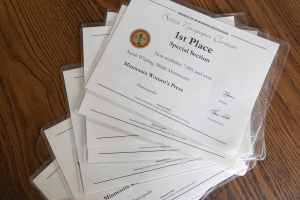 For 2025 coverage, Minnesota Women’s Press earned a community leadership award, three photography awards, and four editorial awards, including for coverage of social issues and for our Spring 2025 “Know Your Rights” special section supported by Unidos MN. Our publisher was named Journalist of the Year by Violence Free Minnesota for gender-based violence coverage.
