

Protecting Democracy #2: How Community and Media Are Working to Support Election Integrity

A group of community leaders, including Lily Cooper from Unidos MN, talked at a news conference about what they are requesting of Minnesota corporations, like Target in backdrop, in defending electoral integrity (photo submitted by Unidos MN)
For months, teams of community leaders, unions, faith networks, neighborhood groups, and journalism organizations have been preparing for whatever this midterm election season might bring. There have been scenario-planning exercises, such as:
- If the U.S. Department of Justice arrests community leaders and union advocates, claiming a conspiracy to steal the election, and there are altercations with federal agents, what do we do next?
- What if there are attempts to invalidate and reject election results, as there was in January 2020?
- What if mail-in votes are rejected for reasons — as was raised earlier — because a return address is too close to the margins?
- What if polling places are made to feel unsafe by obstructionists?
- What if the electronic tabulation of ballots is tampered with by tech owners who want to maintain power access?



Proactive Actions Already in Place
- Minnesotans are being asked to vote early, with many county options for mail-in and dropbox locations prior to the November 3 general election date.
- Teams are being organized to provide transportation and to vote together.
- Information about election rights and options is being shared statewide. [Find our voter education material here.]
- Legal teams are prepared to address concerns as they come up on election day.
- Minnesota companies are signing pledges to call for elections free of federal agent obstruction
In the first three weeks of voting, local election officials in Minnesota have distributed 468,860 absentee and mail ballots. As of close of business on October 8, a total of 47,968 voters have cast their ballots in person and 79,714 voters have returned their ballots by mail – for a total of 127,682 ballots cast during absentee voting so far. In 2022, 99,252 Minnesotans cast their ballots in-person or by mail during the first three weeks of voting.
Community-based measures were successful during the ICE occupation, and organizers are confident that it was a good test of Minnesotans’ resolve to protect democratic principles. If more community protests are needed — as happened during Operation Metro Surge — layers of phone trees and other communication tools are ready to call general strikes and marches, or encourage people to simply stay home, as needed.
Groups are acknowledging that community members have deep relationships and networks in ways that corporations and federal government do not. Neighbors connect, faith organizations coalesce, coalitions are formed in local ways, emergency activation systems will be ready for level 1, level 2, and level 3 threats and realities.
Verification of what is happening is important in the moment, which is why knowing who to trust — including in media and on social media — is key.
Journalism Preparation
At a Democracy Summit for journalists and journalism students, held at Howard University on October 6, one conversation featured leading editors at The New York Times and the Atlanta Journal-Constitution. The conversation was about how newsrooms can prepare for, cover, and explain election interference, misinformation, operational disruptions, and threats to journalists during the 2026 midterms. A few of the points raised:
- Newsrooms should not treat candidate victory declarations or fraud allegations as headlines without evidence. Coverage should prioritize official results, the math of outstanding votes, and confirmation from election officials and the Associated Press.
- Readers should receive clear explanations of absentee-ballot timing, county-by-county reporting, staffing, polling-place disruptions, and why results may change.
- AI-generated content may amplify false claims, including fabricated candidate videos. Multiple data sources, local reporting, and direct official relationships are essential checks.
- Federal efforts recently have attempted to access voter data, challenge state election administration, and create distrust were discussed. Georgia, especially Fulton County, was identified as a central focus because of its size, demographics, political history, and past threats against election workers.
Some of the plans:
- Monitor law-enforcement activity and potential election interference.
- Investigate reports from voters about lines or irregularities.
- Monitor mail-in ballot requests and returns, along with the postal system’s role, to identify and report potential suppression.
- Candidate declarations, fraud claims, non-citizen voting allegations, and viral social-media narratives require evidence and context.
- The strongest guidance for journalism entities is to be right rather than first, avoid self-imposed deadline pressure, and explain what is known and unknown.
Minnesota Women’s Press will have local women-focused Associated Press coverage, data, and graphics on election night, thanks to philanthropic support.

Groups of community members are visiting corporations to ask them to sign the business democracy pledge (photo submitted by Unidos MN)
Business Support
Coalition leaders have noted that civil rights sit-ins decades ago at Woolworth’s — when segregation was the law of the land — led to businesses recognizing that public strikes were “bad for business.”
Today, business leaders are signing pledges to support free and democratic elections. A group of democracy advocates delivered letters asking some of the state’s largest corporations — such as General Mills, Target, Delta, Best Buy, and United Healthcare — to publicly support election integrity by October 19.
Speakers at an October 5 news conference reiterated the disruption communities experienced during Operation Metro Surge and the ways small businesses protected their employees and neighbors. They asked that larger companies do the same. The message: a democratic society requires using their voice to standup for the customers and employees that make their company succeed. Organizers have repeatedly contacted approximately 60 large corporations.

Monica Byron of Education Minnesota explains why democracy is important to students’ education (photo submitted by Unidos MN)
Monica Byron, president of Education Minnesota, connected the future of public schools and educators to having a defended democracy. She noted that a Caravan for Corporate Responsibility will continue to pressure companies who have not stepped up with a response.
Businesses that sign the Democracy pledge are indicating that:
- We believe in the power of civic participation: We will provide information to all our employees about their rights as voters, how to register and other ways they can participate in the democratic process.
- A strong and vibrant country requires free and democratic elections: We will publicly oppose efforts that would prevent or create obstacles to eligible voters casting their ballots
- A thriving economy requires a healthy democracy: Threats to free and democratic elections destabilize our communities and our economy. In addition to the above, if there are attempts to prevent the counting of votes or the seating of duly elected candidates after the election, we will publicly oppose those efforts.
- We believe that the people should choose our leaders. If this ceases to be true, the instability will be felt from our local communities to our national economy. Businesses can and should be part of ensuring the will of the people prevails.
- As business leaders, we will oppose any measures that create obstacles—including the national anti-voter efforts (e.g. SAVE Act), intimidation by armed law enforcement, federal takeover of elections, or any legislative, executive, or administrative actions that keep people from voting or keep trusted election officials from counting all eligible ballots.
- We insist the will of the people prevail and will oppose attempts to overturn results or refuse to seat democratically elected candidates in defense of free and democratic elections. We will use our influence through trade associations and business councils to stand with the people of our state for democratic principles.
The business for democracy pledge
Minnesota Businesses that have signed the pledge

Group of letter deliverers at United Healthcare (photo submitted by Unidos MN)
In a future story, we will share the work that also is moving to prioritize legislative initiatives for the coming year.



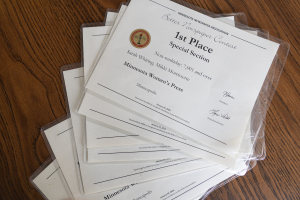 For 2025 coverage, Minnesota Women’s Press earned a community leadership award, three photography awards, and four editorial awards, including for coverage of social issues and for our Spring 2025 “Know Your Rights” special section supported by Unidos MN. Our publisher was named Journalist of the Year by Violence Free Minnesota for gender-based violence coverage.

