

Elected Officials Talk to Students About Their Power in Policy
"Diversity in Politics" coverage is made possible by Women Winning and Vote Run Lead.
More than 100 Students Demand Action volunteers — a network of young people organizing to end gun violence in America — gathered in Minneapolis recently for a panel discussion about gun safety. The network is part of Everytown for Gun Safety’s grassroots movement. Panelists included:
-
Saint Paul Mayor Melvin Carter, member of Mayors Against Illegal Guns
-
Minnesota State Senator Erin Maye Quade, a former Moms Demand Action volunteer
-
Colorado State Representative, Javier Mabrey, a long time advocate who was elected to represent Denver in 2022




Students Demand Action group that met at the University of Minnesota campus (photo by Harper See)
Q: What is your advice for the young people in this room who want to get involved in the democratic process, despite the fact that they cannot cast a ballot?
Mayor Carter asked the legislators on the panel about who tends to request meetings with them, and how often. Both replied that they receive requests from constituents multiple times a day — and that very few of those requests come from people under age 18. They indicated they would absolutely meet with students if asked.
“You maybe don’t understand the amount of communication power that you hold,” Carter said. “Every one of you knows how to get a message out in a way that was not invented when I was your age. So, help create a discussion that has to be dealt with in your local community, in your local neighborhood.”
Carter talked about a time when he was on the Saint Paul city council and a group of young people came to ask him to do something to discourage the promotion of cigarettes with young people. He said, “I’m not going to do anything about it, but I will show you how to use my office to do whatever you want to do about it.” He said the group drafted an ordinance, had meetings with his colleagues and store owners. They got the support of the mayor and got store owners to testify in favor. At a public hearing, the room was filled with young people. It led to regulations against selling candy cigarettes and having tobacco flavors promoted by cartoon characters. “After it passed, that same group of young folks was sitting in my office stuffing envelopes to let stores know this policy had changed.”

Javier Mabrey, Colorado legislator
Mabrey said: “Support candidates who are not worried about taking a vote and how that will impact them.”
He described the legacy of Charles Sumner, of Boston. “He was a fierce abolitionist in the United States Senate in the 1840s and 50s, so much so that he got beaten almost near death because he was speaking up against slavery. He defended a case trying to integrate Boston schools so that black students and white students didn’t go to separate schools in the 1830s.”
People asked Sumner why he was brave enough to call out on the Senate floor colleagues who were raping their slaves. He replied, ‘backbone, backbone, backbone.’ Mabrey indicated that Sumner knew voters and the public would respect him more if he had a backbone and stood up for something. “His advocacy was super important in terms of the Fugitive Slave Act. [After that passed], there was terrorizing in our community; people from the south were coming up to the northern states, kidnapping people, taking them to plantations, and saying the federal government gave them the authority. There are politicians right now who are saying that the Democratic Party should abandon our trans siblings and immigrants. Those are the same types of politicians who would have supported the Chinese Exclusion Act in the 1880s.”
Mabrey encouraged students to support politicians who are fighting for communities and being specific about how they will do it, with no platitudes. “Right now, we have a campaign in Colorado for the governor’s race. Most of the candidates are saying they’re running to protect the Colorado way of life. What the hell does that mean? What are you going to do to prevent gun violence in our communities? What are you going to do to address the skyrocketing costs of rent? Or mass incarceration?”
The group encouraged students to work on campaigns for candidates who are brave and fighting for real change, not just a title.

Minnesota Sen. Erin Maye Quade
Q: Senator Maye Quade, you were one of the youngest people in the state’s legislature when you were first elected. What do you wish that more young people knew about the power that they have, even before they run for office?
You have a lot of power because of who you are. There is an inherent belief that young people don’t care about politics, that they don’t care about policy, that they don’t care about change. When groups of young people show up to do things, it is newsworthy and it does get attention. So, always know that.
It’s also important to know that running for office isn’t the only way you can make change. I have worked for a member of Congress. I worked as a campaign and coalition lead to protect abortion care, and I’m now a state senator — so I have done all three of those things. There is no one good way to make change. All three of those were equally as impactful.
Not everybody wants to run for office. I totally get that. You can work for somebody who’s elected. You can write their speeches. You can schedule their meetings. You can run advocacy organizations and campaign coalitions to help legislators feel they can take those risky steps. You can raise their money. You can door knock with them. You can write their campaign plan. That’s what my wife does. We met in politics, but she does the campaign side; I do the policy. It’s a perfect marriage. But she doesn’t ever want to run for office, she simply helps people win their elections.
[Politics and democracy] has never been like this, not in any of our lifetimes. It is particularly heavy and dire. You cannot self-care your way through this, but you can community-care your way through this. That means being in rooms together with people, physically moving your body, drinking water, getting sun — treat yourself like a plant, but community care your way through this. Getting involved is part of that community care.Lastly, I want to share: The Beatles were very popular. My mom will tell you this. She said that adults used to make fun of teenage girls and how much they loved the Beatles. When I was growing up, it was In Sync. When my wife was growing up, it was lOne Direction.
Adults fear the power of teenage girls. You set culture. The people in this room right now set culture. You can be very intentional on how you want to shape and set culture, but know that you do. The way that things are advertised, the way that fashion is made, the way that food is made and advertised — it is all geared towards you. You literally have the power — none of the money and the ability to vote, but you have the power. Do not forget that.
Q: How do you keep moving when every single day it seems like there’s a new headline, a new crisis, a new issue for you to be working on. How do you stay grounded in the work? And what advice would you give to the young people in this room today who are just starting their advocacy journey?
Mabrey: I’ll echo the Senator. Treat yourself like a plant. Drink water. Community care is important, and so is self-care. I have two jobs. The Colorado legislature is a part-time role; we are in the legislature for the first five months of the year, and then I don’t get paid enough to pay my bills. So I work as a renter’s rights attorney. I would do that even if we did get paid enough money to pay the bills, because this is another way that I stay attached to the work.
When you are in politics, the Capitol is full of people who are getting paid half a million dollars a year to tell us that the sky is green. They are corporate lobbyists for landlords who are telling us that if we pass a bill to give people who are getting removed from their homes the right to a trial by jury, rents will go up — even though the right to a trial by jury exists.
I share that because it’s also important to find ways to be rooted in what is actually going on in the community. Once a week, I go to eviction court and I represent a handful of renters who are facing eviction, to see what is happening in court, to see what’s happening to the poorest people — because that’s who I wanted to represent when I ran for office.
There are plenty of people in the state capitol representing the interests of the corporate lobby, so I stay grounded in the work by staying close to community — and also by taking care of myself. I take time off. This past weekend, I went down to New Orleans on a swamp boat tour. Do things you love with people that you love, because burnout is real.
Also, do not think that you have to solve all the world’s problems at once. You can take it piecemeal — and refresh and be kind to yourself.

Saint Paul mayor Melvin Carter speaks to Students Demand Action group alongside other panelists about civic engagement and gun safety advocacy
Carter: The most selfless thing you can do is preserve yourself to be able to do this work for the next 50 years. The most selfless thing you can do is make sure that you are happy; that you are emotionally, mentally, and physically healthy. I owe it to my constituents to let them know that when I show up to work I can bring my full self, because I’m exercised, I’m rested, I’ve treated myself like a plant.
One of the biggest things for me right now is thinking about the resistance and what that means. We had a big protest here recently, and there were a lot of people — but what made me sad was that the energy consuming us was anger.
Let me put in a plug for municipal politics. If you were to show me something amazingly innovative that’s happening in policy right now, chances nine out of 10 is it is happening in a city or a county or school board. It is some local community that is doing it right. Often, we think we have to impact Washington, D.C., or the United Nations, to change the world. But I love local politics.
During the pandemic, we launched a guaranteed income pilot. We decided that in August and we sent out the first checks in October. That’s what I love about municipal government. For me, it is about being able to keep my eyes on the process of the work that we can do, being able to keep from being distracted like they want us to, in fighting against them.
My goal is: don’t fight back, fight forward.
If you’re tired of yelling in our political discourse, then resist by listening — even when you disagree with somebody, even when they’re sure you’re not going to listen to them. If you’re tired of division, then resist by bringing people together. It can be in your dorm, it can be in your high school, it can be in your neighborhood, it can be in your family. If you are tired of people being intolerant of differences of opinion and differences in life, be tolerant even when somebody’s wearing a red hat. Be the resistance not by doing the same thing in the opposite direction — be the resistance by being the opposite.
If you’re tired of all this stuff at the global level, the resistance is to do it in the circle right around you. The challenge: how do we keep ourselves focused? Connect. Take care of yourself. Stay connected to community.
It’s so easy to see the things we can’t change, the things that we can’t impact. But there are so many things that you can do in your circle, in your neighborhood, in your classroom, in the spaces you are in. Keep your mind focused on fighting forward toward those things. Keep your mind focused on leaving the bait alone. Be the resistance, not by yelling in the opposite direction, but by being a different kind of person than the model that you’re tired of in politics.
Don’t fight fire with fire. Fight forward.
Maye Quade: Movement work is long. I’m a chronically impatient person. We don’t know where we are in this [struggle to maintain democracy and equity] right now. We don’t know where we are in that long arc. I don’t know where we are, but I’m acting like we’re toward the end with a vision of where we can go, that this can be over, and that I can be part of the solution.
Also remember, it’s not all on you. You have to trust that the folks who are in other movements are doing their work, they will tap you in when they need you, but they also are trusting you to handle [your passion]: climate, repro, LGBTQ, housing, economic, justice, you name it. Then you build your movement in a way that is sustaining. That means how you bring people in, how you treat yourselves and each other. This can be a huge part of who you are, but it’s not all that you are.
We hear that joy is resistance. Part of the work of oppression is to convince you that nothing you do matters, so why try? The last act of oppression is not death; it is despair.
If you consume and consume and consume all of the terrible things in depth — and I’m saying this from recent personal experience — it will cause you despair, and it will keep you from being able to show up and be in any movement.
So, actively find things that make you happy. I do hot yoga. It is like crawling over broken glass, especially in the summer, to get myself into a 105-degree room with 50 percent humidity that I know it’s good for my body, my brain. Once I’m there, I’m happy that I do it; it doesn’t make me feel good, but it’s good for me, right? What would make me feel good is eating Cool Ranch Doritos on the couch, which I do sometimes, but I also have to do what’s good for me.
[My fourth piece of advice] is that you must have something unconnected to this one. It can be a friend, it can be a hobby. I sing; I’m in a choir. I also have friends who are wildly unconnected. My friends are small business owners who are healthcare professionals: an optometrist, a therapist, and a physical therapist. It’s nice to have things that aren’t about the serious, the heavy, so that you can be in it when you’re in it — and when you’re not in it, you’re not in it.
If you appreciate our unique grassroots coverage, often not seen in other publications, please support us:

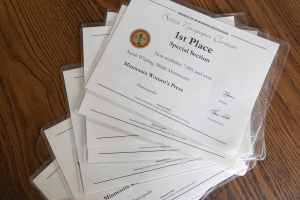 For 2025 coverage, Minnesota Women’s Press earned a community leadership award, three photography awards, and four editorial awards, including for coverage of social issues and for our Spring 2025 “Know Your Rights” special section supported by Unidos MN. Our publisher was named Journalist of the Year by Violence Free Minnesota for gender-based violence coverage.
