


Conversation Circle: How One Neighborhood Is Protecting Itself
Minnesota Women's Press immigrant storytelling is supported by the Minnesota Council on Foundations.
As immigration enforcement swept through Minneapolis neighborhoods this year, mothers, young people, and neighbors built their own networks of protection. I met with a group of Somali mothers who offered to share their stories — which reveal both the lasting trauma and the power of community. [We are not naming the women in this story.]

A group of Somali mothers gathered for a conversation about the impact of federal agents in their neighborhood, thanks to support and translation services from Reviving Sisterhood, led by Malika Dahir (pictured middle of back row). Photo by Mikki Morrissette
Earlier this year, federal agents swarmed through the Cedar-Riverside neighborhood of Minneapolis, at bus stops, on the streets, and inside apartment buildings of the Twin Cities. Many residents in the area had fled Somali during civil war; Minnesota now is home to the largest Somali population in the U.S., and many live in this neighborhood near the University of Minnesota. Unlike immigrants who might live in more widespread suburban areas, and might be harder to find, agents knew the density of immigrants in this relatively small neighborhood were easier to spot.
Some residents are naturalized citizens. Others have green cards, which gives them the right to live and work in the U.S. Still others do not yet have legal status or are navigating the immigration system. Yet legal distinctions have proven to offer little safety to people who have been targeted by federal agents based on skin color. What was once a vibrant neighborhood became quiet.
One woman said, “Every morning, ICE treated us like their cup of coffee — like this is how they get their energy, coming to terrorize us.” One set of agents might go into one of the apartment buildings and start at the top, another in a different building at the bottom, and another in the middle of a building. WhatsApp warnings were shared simultaneously about where ICE was locally. It seemed to the women that the ICE playbook was an onslaught designed to sew confusion and fear.
Many of the cars were Kias, and “they would sit there, almost like gang culture behavior, as if they wanted to say, ‘Look, we’re here. You see, we’re waiting for you.’” Neighbors had to be vigilant walking and driving — “all day you’re fearful of everything and everywhere.”
What made the fear worse was that “we knew the individuals were untrained. They were not law-abiding citizens themselves. They didn’t care what due diligence is, what is lawful, what’s not lawful. The fear of knowing that they can do whatever they want to do and still not be held accountable was. Just knowing it’s pretty much a bunch of people acting like thugs. And without warning, they might start pepper spraying individuals.”
On the other hand, non-immigrant neighbors distributed whistles to give warnings about agents in the area. “They would keep watch. They told us, if you blow this we will come and help support you.” Neighbors accompanied children to school buses and helped residents feel safer walking to the mosque. Some college-aged Somali children, who were born in the U.S., helped patrol the area and deliver supplies — and mothers feared they could be taken as well, despite their legal status.
“Then we found out one of our neighbors died for us, Renée Good. We collected money together. We made sambuusas and tea and bought cups and plates. We went to the memorial sites in that cold weather [including after Alex Pretti was killed], to give our neighbors warm food and drink to show them our love and care and appreciation.”
“We remain grateful for our neighbors. The fuel that was lighting us, despite the fear and the terror we were feeling, was the two who were murdered for us. We are mothers.”
Together neighbors also collected money to help pay rent and utility bills. They bought groceries for families afraid to leave their homes. They checked on neighbors who were sick, needed medical attention, or had children to care for. The work was practical — but it was also an act of resistance against the isolation that fear creates.
“We realized that no one was coming to save us,” one mother said. “We had to save ourselves.”
The mothers “are the community’s backbone,” said one woman.
There are fewer arrests on the streets today, but “we’re still terrorized. Now they’re not easily identifiable. They are dressed in plain clothes, and they’re walking among us. Some people are still afraid to go to work or to take their kids to school. The terror is still there. It just it just looks and feels different.”



The Trauma Experienced by Mothers
“One of our youth went outside to grab food. Clearly this kid was born here, but they attacked him, were harassing him. They pushed him. He fell and broke his arm. His citizenship didn’t help. As a mom and as a person, I don’t even know how to how to describe them. They weren’t even human. They weren’t treating people like human. They wouldn’t ask you questions; they would just surround you. There would always be a group of them, and kind of terrorize you, push you around, yell, threaten.”
In another instance, college students were coming back home from school who were born in the U.S. “ICE rushed them. The kids were saying, ‘We’re citizens. Please stop.’ Even though they showed their birth certificates, they were trying kidnap them. People patrolling saw this and started blowing their whistles. It was the white neighbors who came and stopped them from taking these kids.”
A mother of three said her fear was inseparable from the daily routines of parenting. Her children traveled by bus through the neighborhood where Good was killed, only a few minutes after the school bus would have passed through.
She put work on hold and struggled to sleep. She took her kids to school because “I couldn’t trust others to do the job; my anxiety was so high.” Her phone became a constant companion as she monitored reports of enforcement activity and responded to requests for help. She had lived in Minnesota for more than 20 years. Now she felt compelled to carry her passport alongside her asthma medication, phone, and car keys. She told her teenage son that how he responded to an encounter with authorities might determine whether he lived or died. She had to explain to a younger child that someone might stop or hurt her because of who she was.
“Do I worry about my neighbors? My cousins? My grandparents? Where do I go if it’s not safe to be at home? And how did we get here? What have we done to cause this much damage to our community? Nothing.”
Children also worried in the classroom about whether they would come home from school and find a parent missing. In one case, children feared that their single mother, born in Somalia, would be deported, leaving them without a caregiver. Some children still remain frightened every time their mother leaves the home, even though their mother has reassured them that she has U.S. citizenship.
One woman described the fear she had of potentially being forced to leave this country, where her children were born and raised. She considered evacuating her entire family, so they would not be separated. She slept very little, because of the stress — as well as the work she was doing, talking on the phone at odd hours about mutual aid needs.
“The worst of all for me personally is the youth,” she said. “As an adult, you can figure out things for yourself to a certain extent, but we have youth who had terrorists at their schools and bus stops. How much more inhumane can you get? I realized there is no law, there is nothing holding them back. It became just a matter of survival, day by day.
“I was born in a civil war and even then it didn’t leave me with this type of trauma.”
Crisis Care
One woman’s leg and ribs were injured when she was fleeing immigration agents and she has not been able to return to work. Others are still struggling with the psychological effects of what they had witnessed. “The PTSD is still here,” one community member said, describing people who have been unable to regain a sense of normalcy.
Another described feeling as though she were living in a nightmare. She had once understood law enforcement as a source of help and protection. Now, she said, the people she had expected to turn to are the ones who are terrorizing her. “It messed with my head.”
One community member described a young mother who had recently given birth and was bleeding heavily at home. Afraid to go to the hospital, she hesitated even as her condition worsened. Neighbors had to persuade her to accept help and physically transport her to a hospital. They found women health care providers who spoke her language and could offer reassurance.
One neighbor helped a woman with a physical disability, an infant, and an older child with special needs get to Saint Paul to collect her paycheck. Other neighbors helped a newly arrived refugee who was paralyzed and depended on others to shop for groceries.
Amid the uncertainty, food became one of the community’s tangible expressions of care. During Ramadan, the mothers cooked together and shared a meal with neighbors who had helped protect them. They exchanged stories and cried together over what they have endured.
These acts of care grew from relationships, shared knowledge, and the understanding that a neighbor’s emergency is everyone’s responsibility.
One young adult — daughter of one of the mothers in the discussion — said: “Honestly, if I needed anything, I wasn’t going to people outside of those six buildings that we live in. I would go to all these aunties to help me out and give me what I need.”
Solution-Building in Community
Now, some of these same community members are turning toward electoral organizing, encouraging neighbors to register and vote. One mother joked that some of the youth were “lazy” about seeing voting and politics as important, but now they know better.
The mothers say community recovery must include direct financial assistance, rental support, groceries and mental health services. They are particularly concerned about isolated parents, including women experiencing postpartum depression who have been afraid to seek care or leave their homes.
They also want something more fundamental: a place of their own. Without a dedicated community space, the mothers must depend on facilities they need to pay to rent in advance or have struggled to access when an emergency arises. They want a reliable base where they can gather, share information, support families, hold community events, and respond when someone needs immediate help.
They are frustrated by organizations that claim to serve the neighborhood without asking residents what they need. Services must be accessible to people who speak different languages, they say, and designed with the community rather than imposed upon it.
The mothers know who is sick, who has a new baby, whose children need support, and which families are struggling to afford groceries. Their neighborhood relationships make it possible to respond quickly, often before an outside organization even knows a problem exists. What they lack is the sustained support to make that work possible.
Mutual aid has carried Cedar-Riverside through a period of fear. But they do not want to be a center where nonprofits can claim to be doing work on their behalf — they want the ability to do that supported work themselves.
The trauma of this year cannot be undone by a shared meal, a grocery delivery, or a neighbor’s whistle. It lives on in sleepless nights, and parents and children still unsure of their safety outside.
In our time together in conversation, it was clear that another deep story lives alongside that fear. Mothers organized, young people protected, and neighbors shared what they had. People refused to let terror sever the relationships that made their neighborhood a home.

Yusra Mohamud and Arshia Hussain at a rally in support of Rep. Ilhan Omar after her home was raided by federal officers in Octo ber 2026 (photo by Sarah Whiting)
A poet closed out the gathering with a poem that concluded: “The wall of war has already swallowed them once before, and they turned the beast’s belly into a booming civilization. They built malls. They built homes. They became nurses. Became doctors. Won elections. Raised families. Loved. Lost. Won. And everything in between. … Our roots are too deeply set. You cannot remove us without removing that which gives you life, too.”
At the same event, Yusra Mohamud and Arshia Hussain, co-founders of Baddies for Progress, offered information to attendees about voting.
Said Mohamud: “My biggest advice for the people who are sitting at home not knowing what to do next is to take a look at the electoral politics that are happening in your local community, from your city council to your state district, all the way up to your congressional level. What is the campaign you want to be a part of? Who is the person that you believe in that you want elected? Go out, meet them, knock on doors, and let’s make sure that they get to office.”
Hussain said: “Our biggest priority is ensuring that people are educated on the early voting process and that they have access to early voting. Minnesota has a very open policy and procedure about registering to vote. You can register today. You can register at the polls.”


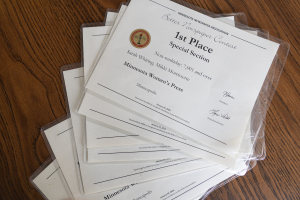 For 2025 coverage, Minnesota Women’s Press earned a community leadership award, three photography awards, and four editorial awards, including for coverage of social issues and for our Spring 2025 “Know Your Rights” special section supported by Unidos MN. Our publisher was named Journalist of the Year by Violence Free Minnesota for gender-based violence coverage.

