


Consumer Boycotts Reflect Who Actually Controls the Economy
"This Is US" coverage, and the March/April magazine issue, made possible by the deep underwriting of Unidos MN.
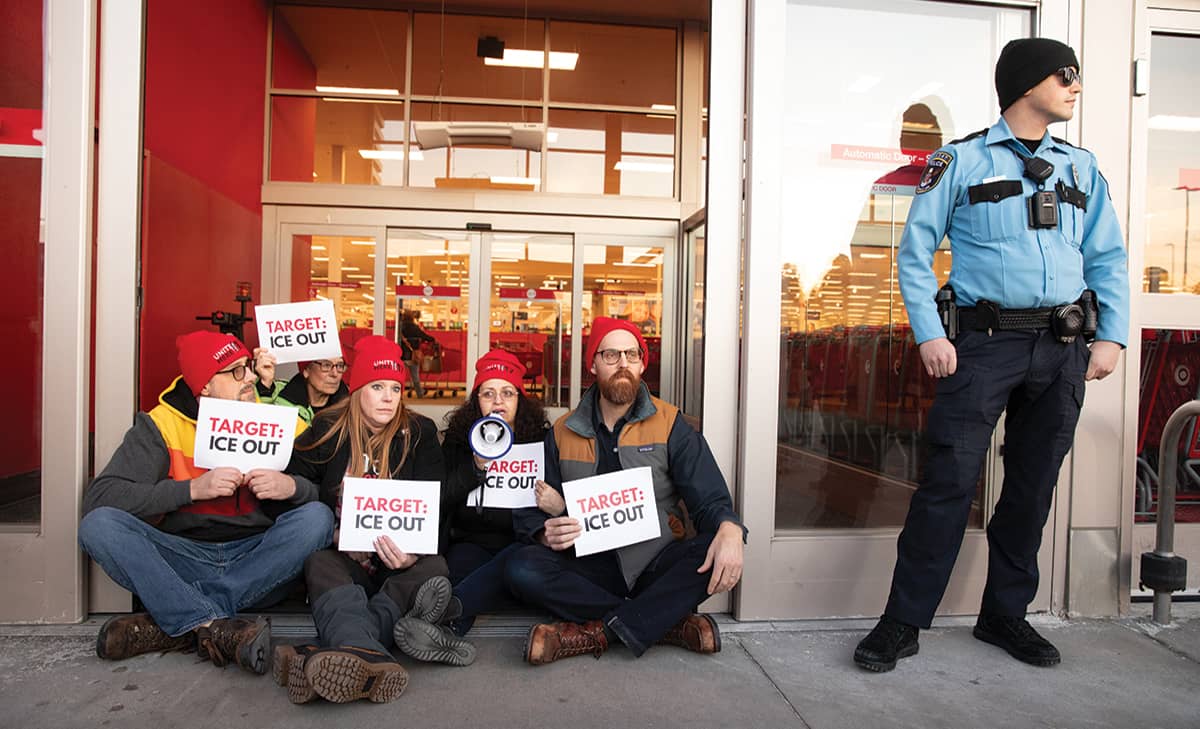
(l–r): David McCann, Sarah Lechner, Christa Sarrack, Rosa Valencuela, and Geoffrey Paquette were among those arrested on February 11. Photo by Sarah Whiting
At a January 31 news conference as sit-ins began at several Target locations, Marcia Howard, of the Minneapolis Federation of Educators, said she once regularly made Target runs for student school supplies and was proud to shop at the locally headquartered Target. But “when a Target run means running from ICE because you allow them in your store and in your parking lots, that’s insane.”
The news conference was held outside the Richfield Target, where two teenage employees — both U.S. citizens — were taken by ICE agents inside the store on January 8; video shows ICE violently abducting them. At least one of them was simply abandoned in a distant parking lot.

Ulla Nilsen from Unidos MN speaks at a Target protest in January. Photo by Riley Bruce
Ulla Nilsen, of Unidos MN, pointed out that “Target is Minnesota’s leading corporate citizen. It is the fourth-largest employer of the state.” She noted that Target relies on immigrant labor: farmers, food processors, shipping workers, and store employees. “Yet Target has failed to speak out against the violent abductions of workers and to call for immigration reform.”
Nilsen pointed out that when tens of thousands of Minnesotans turned out for a peaceful protest in sub-zero weather on January 23, more than 1,000 small business owners closed for the day in solidarity “because they understand what’s at stake, and they made a big sacrifice. Sadly, companies like Target that could afford to miss a day of profit did not.”
Michael Fiddelke stepped in as Target’s new CEO on February 1. Randi Weingarten, president of the 1.8-million-member American Federation of Teachers (AFT), sent him a letter noting that Target’s mild call for “de-escalation,” issued in a public letter alongside 60 other Minnesota corporations, did not constitute leadership, protect workers, or reassure immigrant consumers who represent a $1.7 trillion market. She pointed out to him that AFT member pension funds hold nearly 7 million shares of Target stock and that teachers alone spend an estimated $3.4 billion annually on school supplies.



To increase awareness of the continued silence from Target, dozens of Minnesotans were cited and arrested in February after sitting in the doorways of Target stores in Richfield and the Dinkytown neighborhood of Minneapolis. Similar actions at Target stores were organized in more than 30 cities and towns — including Topeka, New York City, Philadelphia, and Seattle — with sit-ins, sing-ins, and demonstrations.
Erin Pruitt, who is legally blind and was arrested at the Richfield Target, explained why she chose to participate: “What happened to those teenage Target employees shook me deeply.
“I have a 17-year-old son, and all I could think about was him. The idea that a young worker could be roughed up and left out in the cold is something no parent can hear without feeling sick. I joined this action because no company should stay silent when their own workers and customers face harm.”
Megan Swoboda, also arrested at the Richfield store, said, “I risked arrest because I have watched my neighbors live with fear and instability. … Everyday people are doing their part. We are asking why large corporations will not.”
Corporate Values on Display
A national boycott of Target began February 1, 2025, after the company rolled back its diversity commitments under the Trump administration. One of the leaders of that boycott, civil rights attorney Nekima Levy Armstrong, was part of a December news conference, outside a Target store on another cold morning, when community leaders talked about how they want to see community values reflected in the companies Minnesotans support.
As Armstrong put it: “This is a multibillion-dollar company with over 1,900 stores. People like us and our families built it.”
Luis Argueta Jr., of Unidos MN, said: “Some of us have stopped shopping at Target, but we know that immigrant workers keep that store alive, and Target has turned their backs. Stand with the community that made you what you are.”
Unidos MN hosted online conversations to discuss the ICE occupation in Minnesota, how individuals are able to get involved, as well as the status of legal battles and funding bills. Minnesota Women’s Press team member Olivia Worcester attended one of these conversations, including a breakout session about corporate boycotts. “I’ve been aware of the Target boycott for over a year now, but have never had a true grasp on how my boycotting and organizing against them as one individual has any tangible effect,” she shared. The message she heard was that corporations get nervous when they lose money.
Nilsen, who led the breakout session, said: “If we want to be able to have a different kind of economy that cares for people, if we want a world that cares for the environment, we need to be able to move corporations.”
Corporations Are Not Politically Neutral
Target, tech companies, and many other corporations cannot credibly claim political neutrality. Target, for example, was one of roughly 140 donors that gave $1 million to the 2025 Trump inauguration, part of a record-breaking $239 million contribution. Having centered itself in the political arena, Target is now facing political accountability.
Our Revolution executive director Joseph Geevarghese says that corruption is directly tied to the increase in federal immigration operations across the country.
GEO Group, CoreCivic, and CSI Aviation — some of the country’s largest private prison and deportation contractors — gave Trump close to $5 million and received over $5 billion in revenue. [See more on this.]
The new “Future Forward” series of Minnesota Women’s Press is focused on voices of systems change. One story by Amanda Week summarized an online conversation hosted by Our Revolution. It explained the “Defund the Oligarchs, Fund the People Resolution” — legislation that calls on Congress to end corporate tax breaks and federal contracts for billionaires and instead invest in the working class.
Top donors in the crypto, oil and gas, and deportation industries collectively spent $700 million dollars supporting MAGA candidate campaigns, according to research published in The Guardian. In exchange, they received over $170 billion in policies and tax breaks.
Find the full story about Our Revolution here.
Commentary on Ownership
In a Minnesota Women’s Press commentary, we quoted historian Heather Cox Richardson, who reminds readers that a “ruling class” that requires a permanent class of expendable laborers is a long-time concept in the U.S.
In 1858, South Carolina senator James Henry Hammond defended slavery by insisting that “in all social systems there must be a class to do the menial duties, to perform the drudgery of life.” These workers, he argued, needed neither education nor autonomy — only strength, obedience, and loyalty — while elites would extract profit and call it progress.
Hammond claimed that Black Americans, women, and the poor were naturally subordinate, fit only for service and reproduction, and incapable of leadership, in part because of “criminal inclinations.” Southern aristocrats framed this hierarchy as God’s will.
In another striking parallel to history repeating itself, Richardson quotes Hammond as saying that women were made “to breed,” as “toy[s] for recreation,” or to bring men “wealth and position.”
Hammond’s career was nearly derailed when he admitted in 1843 — after being accused while he was governor — that for two years he had sexually assaulted four young nieces. Rather than show remorse or shame, he said he should get credit for showing restraint when faced with four such “lovely creatures.” He also was known to have repeatedly raped enslaved girls, aged 12 and 18.
Hammond was ostracized for several years, but nonetheless was elected to the U.S. Senate, where he served from 1857–1860.
The Full Commentary


 For 2025 coverage, Minnesota Women’s Press earned a community leadership award, three photography awards, and four editorial awards, including for coverage of social issues and for our Spring 2025 “Know Your Rights” special section supported by Unidos MN. Our publisher was named Journalist of the Year by Violence Free Minnesota for gender-based violence coverage.
