


Concerns Raised About Food Shelf Needs Statewide

(February 26, 2025) — Michelle Ness, executive director of the nonprofit Prism marketplace in Golden Valley, said in a Food Group press conference that their food shelf is seeing a significant increase in first-time users, with 2,000 visits a month.
“With the increased cost for food, for health insurance, energy bills going up — folks are struggling to make ends meet. Childcare costs, medical, transportation, all of the fees and costs we have as individuals [is especially affecting] folks who are earning basic wages, along with folks who are on disability,” Ness said. “A majority of the people we see have someone in their household with a disability, which creates additional challenges, costs, and burdens. Wages simply have not kept up with the cost of living.”
Food shelf visits in Minnesota increased by an average of 18.4 percent from 2023 to 2024. The key factors for the increase, cited in a Food Group report, include the rise in grocery prices and the loss of pandemic-era SNAP benefits in March 2023, resulting in a $100 monthly reduction per person.
There are 487 food shelves, mobile programs, and tribal programs participating in Minnesota’s Emergency Food Assistance Program. Children and seniors are 47 percent of the visitors. Southern and western Minnesota have seen the most notable increases in visits.



Sophia Lenarz-Coy, executive director of The Food Group, indicated the rate of increase in food shelf visits in Minnesota slowed compared to previous years, partly due to universal school meals and the child income tax credit. Governor Walz and local legislators seem to understand the critical role of food shelves in local communities and have invested significantly in supporting them.
“Policy wins that Minnesota has had — like universal school meals, the child income tax credit — are reducing the pace of growth. But we are certainly uncertain about what is coming next,” Lenarz-Coy said. “Many of you may have seen the House budget bill that passed last night, with major cuts to the agriculture budget targeted at $230 billion, with lots of talk about cutting the SNAP program. For every one meal that is distributed incredibly well by these amazing 487 food shelves, SNAP provides nine meals to low-income Minnesotans.
“So, the federal safety net is such a dramatic piece of this puzzle. If those $230 billion in cuts go through, in Minnesota that would be about $2.1 billion in SNAP cuts over the next nine years just in our state — a potential of almost $230 million a year.”
The End Hunger Coalition and national coalitions are working to protect and maintain the SNAP program, which is crucial for the solvency of local food shelf networks.
Lenarz-Coy added, “The thing that we are hearing broadly from food shelf partners is that the Local Food Purchasing Assistance Program had a lot of grants that were connecting food shelves to local farmers, which is currently frozen at the federal level. So that is yet another pressure on food budgets, which is really difficult because that was funding that was committed and people were already in the planning process of using that. It’s unclear whether that will get unfrozen.”
The avian flu has affected egg prices, which is a staple protein in food shelves.
Jill Westfall, The Food Group’s statewide food access manager, indicated that every $100 that a family used to spend for groceries — perhaps every week — has increased by $28, “which adds up over time. In addition, the loss of SNAP benefits gives each person about $100 less per month. So, “as households are trying to make up that gap, the price of groceries has risen 25 percent and more families are finding that they’re just not making it to the end of the month and need some additional assistance, so they’re turning to food shelves to get that bit of extra help.”
Ness noted that local volunteers, donors, and state support is needed to sustain food shelves, with consistent funding needed to meet the growing demand. People are learning to trust food shelves as places where they can be “ treated in a respectful, dignified way. They’re getting connected with other resources. We had almost 26,000 visits last year alone. People from over 100 different cities in Minnesota have come to visit us. So the need is very real, and our challenge is being able to have enough quality food for 2,000 visits a month.”

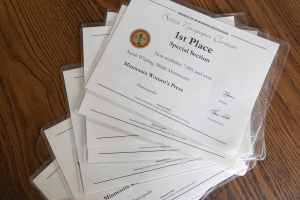 For 2025 coverage, Minnesota Women’s Press earned a community leadership award, three photography awards, and four editorial awards, including for coverage of social issues and for our Spring 2025 “Know Your Rights” special section supported by Unidos MN. Our publisher was named Journalist of the Year by Violence Free Minnesota for gender-based violence coverage.
