

Commentary: The Values of Anger and Unity in the Face of Misogyny and Xenophobia

Coverage supported by the deep donations of long-time supporters Kristin Siegesmund and Becca Brackett.

Noreen Farrell (submitted photo)
In a conversation that Minnesota Women’s Press contributing writer Siena Iwasaki Milbauer had with Noreen Farrell, who leads the California-based Equal Rights Advocates, the trauma and spectacle of today’s White House politics is not simply about a blip in rational leadership. It is following a playbook designed to dismantle financial security for millions of people — leading to subjugation we had not yet fully climbed out of as a country.
“For the first time since the 60s, the gender wage gap has widened for two consecutive years,” says Farrell. More than 400,000 women were pushed out of the workforce in the first eight months of the Trump administration, with Black women and mothers disproportionately represented. “We’re seeing the Trump administration following a clear playbook when it comes to dismantling civil rights: eliminate enforcers, scrap the rules, and erase the evidence.”
With government agencies eliminating the enforcement of civil rights measures and the collection of data on disparities, the intended end is a simultaneous spike in inequity and a statistical erasure of that spike.
Young women, for example, will be generationally set back. “The wage gap starts from someone’s very first job,” Farrell says. A weakened start “affects lifetime earnings. Having our young folks start out in an economically precarious situation is an important part of this conversation.”
A question we might start asking ourselves: How much of misogyny and racism is simplistic, emotional thinking, and how much is intentional sabotage? Who gains what by the rollback in equity? Is it as basic as trying to put full power and control fully (again) into the hands of a few wealthy men?
What follows are a montage of ideas — food for thought — from a variety of sources as we explore our past, and our potential future.




June 2026 cover of The Atlantic
The Mentality of Subjugation and Patriarchy
Earlier this year, The Atlantic featured a cover story by Helen Lewis titled “The Men Who Don’t Want Women to Vote, or Work, or Have Opinions.” She interviewed public misogynists, such as Douglas Wilson, whose Idaho-based congregation has 171 affiliates nationwide, and who was asked to lead a prayer service at the Pentagon by Defense Secretary Pete Hegseth. Among other things, he wants to repeal the 19th Amendment that gives women the right to vote.
Lewis writes that isolated young men are bonding over sexism and racism in group chats. Nick Fuentes fuels this subset: “Just like Hitler imprisoned Gypsies, Jews, Communists — all of his political rivals — we have to do the same thing with women.”
A study by King’s College in London found that men in 30 nations are claiming women’s rights have taken away theirs. The more local Manhattan Institute found that “college-educated Republicans are more likely than their non-college counterparts to endorse the view that society has become too feminine.”
This mindset is part of the Project 2025 Heritage Foundation blueprint that returns the U.S. to a country in which men are the sole breadwinners and women are mothers.
The spring 2022 cover story of Ms. magazine defined patriarchy as a social system in which males dominate and hold primary power. The backlash against feminist progress — equal rights for all — is a global trend, wrote Zoe Marks and Erica Chenoweth:
“The connection between sexism and authoritarianism is not coincidental, or a mere character flaw of individual misogynists-in-chief.”
Their story outlines how the centralizing of power — by attacking the rule of law, political expression, and fair elections — requires a conservative agenda that strengthens men’s control over women and girls, “doling out private authority in exchange for public loyalty to the strongman. Many women buy into the bargain, too.” The goal is to police a particular racial, religious, or ethnic national identity.
The 2022 article notes that the reauthorization of the Violence Against Women Act was blocked by those who refused to close a “boyfriend loophole” that allows certain convicted abusers to keep firearms. When the legislation was finally approved by Congress, it did not include the gun control provision.
They note that fully autocratic countries like Russia, Turkey, and China show “what consolidated patriarchal control looks like” — including a lack of protections for women survivors of sexual or gender-based violence, minimal reproductive rights, and homophobic subjugation of LGBTQ+ communities.
Susan Jacoby’s 2018 edition of her 2008 book The Age of American Unreason in a Culture of Lies notes that technology has enabled us more quickly to absorb “junk thought” — thought that does not discern between fact and opinion — which leads to embracing unreasonable and fake solutions to real problems. In essence, for example, a “return to” white Christianity can be placed in the hands of a (nonreligious) man whose grandfather and mother (as well as first and third wives) are immigrants. The disdain for “elites” can be successfully been framed as those with an education rather than the top 1 percent of wealth.
Jacoby wrote her book before the possibilities of AI were more visible.
“With the rise of Trump, another form of nostalgia has entered the anti-rationalist mix — idealization of a country that was less urban, whiter, had fewer immigrants from vastly different cultures, and always paid lip service to a Christian (later Judeo-Christian) identity. Trump, of course, is not himself the product of the simpler, more rural society he extolls — a society in which America always won its wars and welcomed immigrants only when they had white skins. The president, as it well known, is a big-city boy. His paternal grandfather was an immigrant from Germany and his mother an immigrant from Scotland. It is hard to imagine that his immigrant grandfather would have expected his grandson — whether he grew up to be president or not — to display open contempt for learning and expertise.” (p. 31)
 Erika Lee’s 2019 book American for Americans: A History of Xenophobia in the United States notes that more than 80 million immigrants have arrived in the U.S. over the past 200 years. Yet Americans have been wary of almost every group of foreigners that have come here: “German immigrants in the 18th century; Irish and Chinese in the 10th century; Italian, Jews, Japanese, and Mexicans in the 20th century; and Muslims more recently.”
She attended the Republican convention in 2016, where multiple speakers “painted a terrifying portrait of America under siege by immigrant criminals, terrorists, and gang members.” In reality, Lee wrote, studies show that immigrants, including those who are undocumented, are less likely to commit crimes than people born in the U.S.
The Orwellian Prophesy
 In George Orwell’s 1984 vision of the future, published in 1949, the world is divided into three evenly matched ruling parties — Eastasia, largely China and points south; Eurasia, largely European and northern landmasses; and Oceania, including the Americas, functioning under a cult of personality centered around Big Brother. These three superstates are largely self-contained and perpetually at war in order to keep the standard of living for the masses low. Power of the ruling parties is maintained because everyone else is subjected by fear and impoverishment. The reduction of the general population as slaves is normalized.
If leisure and security were enjoyed by all alike the great mass of human beings who are normally stupefied by poverty would become literate and would learn to think for themselves; and when once they had done this, they would sooner or later realize that the privileged minority had no function, and they would sweep it away. In the long run, a hierarchical society was only possible on a basis of poverty and ignorance. …
War is a way of shattering to pieces, or pouring into the stratosphere, or sinking into the depths of the sea, materials which might otherwise be used to make the masses too comfortable, and hence, in the long run, too intelligent. … It is deliberate policy to keep even the favored groups somewhere near the brink of hardship, because a general state of scarcity increases the importance of small privileges and thus magnifies the distinction between one group and another. …
War, it will be seen, is now a purely internal affair … waged by each ruling group against its own subjects, and the object of the war is not to make or prevent conquests of territory, but to keep the structure of society intact.”
Interestingly, Orwell concluded 1984 with an Appendix written in the past tense that implied that the oppressive society of Big Brother and the Thought Police were overthrown or undermined.
Identifying the How
The Value of Collective Anger
 In Rebecca Traister’s 2019 book Good and Mad: The Revolutionary Power of Women’s Anger, she writes: “Anyone who wants power within a white male power structure has been asked to quell anything that sounds like wrath. … Women signaling fury — by cursing, organizing, marching, yelling, threatening retribution — would have been marked as unstable forces.”
Traister indicates that the false belief that we live in a post-misogynist (and post-racist) society led many in 2016 to presume we could never elect someone like Trump — not recognizing that it was his dismissive boast about “grabbing women by the pussy,” captured on an Access Hollywood tape, that energized a base.
She notes that the actions of suffragists more than 100 years ago for voting rights were followed by the labor and civil rights movements — which led in their turn to high school students marching in protest for stricter gun laws, carrying signs that read “Your guns have more rights than my vagina.”
The capitalist patriarchy, the failure to recognize the plague of mostly white male mass shooters (and gender-based violence perpetrators), and the stripping of reproductive rights all come from the same roots.
Traister notes that the way for a subjugated majority to win against an oppressive minority is through unity.
In the 2022 Ms. article by Zoe Marks and Erica Chenoweth,
The authors indicated that their research found that “people power” mass movements for independence and democracy around the world “were more successful at achieving their aims when women participated in larger numbers at the front lines.”
The greatest need, they write, is for widespread mobilization on broad-based issues that champions inclusive democracy and invests in feminist voices, candidates, and policies — which are “fundamental to the health and well-being of democracy.”
State-by-State Organizing
In the conversation with Iwasaki Milbauer earlier this year, Farrell said: “What is giving me hope is that what we’re seeing state by state is a completely different story to what we’re seeing federally.”
She noted that California and Minnesota have long histories of taking a comprehensive state-level approach to economic gender equity, as with the Minnesota Women’s Economic Security Act (WESA), In 2025, New Mexico became the first state in the U.S. to pass universal free child care.
Child care and wage transparency are important areas of workplace equity that have had good momentum politically. Which might be why the Trump Administration is targeting child care subsidies to states like Minnesota. “We’re seeing that core needs that keep women in the workplace are being used as political weapons,” says Farrell.
Economic justice issues — which generally enjoy widespread, bipartisan popularity — are generating momentum against the Trump administration. “We’ve seen affordability resonate up and down the ballot in the last elections and we anticipate that is going to be important in the midterms in November,” shares Farrell. “There’s incredible popular need and economic urgency in our communities to get these policy wins.”
Farrell cites the power in having something to advocate for — not just against. Even if people recognize the affordability and equity factors restricting women’s access to work, she says,“People need to see what your vision is, what the alternative is. Working on the state-level gives us the opportunity to show that in a tangible way.”
Minnesota as a Model (and Target)
 Says the California-based Farrell: “It is not an understatement to say that Minnesota and what its neighbors and community members and friends on the street were doing to oppose the terror of ICE was nothing less than a complete inspiration for people in every state who care about those same values. We need to look at this period as a blueprint for resistance nationwide.”
She cited Minnesota as a direct inspiration for California legislation working to keep ICE out of schools and prohibiting employers from threatening immigrant workers with ICE enforcement if they raise workplace concerns.
Since the federal government continues to create unequal opportunities for women — the Equal Rights Amendment technically has passed in the requisite number of states, but has not been added as national law — “what states build right now, that’s what workers have to rely on,” she says. “Every protection codified at the state level is a firewall. Every state has the capacity to hold the line.”
Action Steps
Farrell highlighted three key actions to take for protecting women’s equity rights.
- Know Minnesota rights and use them: “Especially in states like Minnesota, you have built very strong protections. You have more rights than you may realize and state agencies and civil rights organizations that can help you enforce them.”
- Get involved in this fall’s state legislative elections, when everyone is up for a vote. Show up for state legislative races. “State legislators are our primary line of defense and determine whether working women have enforced rights or just words on a paper.”
- Pay attention to local initiatives — from school boards, to city councils, to the state legislature, to neighborhood organizing — supporting gender equity. Plug in, and never underestimate the impact of these pushes.
Iwasaki Milbauer reports that Farrell is clear-eyed about the severity of the threats we’re facing. But Farrell also sees much reason for pragmatic optimism. “We still have the power,” she said. “We can continue to drive forward the agenda and values that we care about.”
My personal sense — as publisher and long-time writer for a media platform that centers marginalized voices — is that the mutual aid and collaborative nature of many feminists is what makes this such a potent force when facing Big Brother. But, this happens only when we recognize that we are all part of the interconnected pursuit of life, liberty, and justice for all, which can supersede political, national, religious, gender-based, and single-issue ideologies.
As a consumer-owned media co-op in formation, we aim to be a media platform for that evolution.
Related Reading
One reason the independent Minnesota Women’s Press is building a consumer-owned media co-op — besides informally already having a grassroots editorial approach to our reporting and first-person narratives — is that this is the time to provide a collective platform for labor, civil, and women’s rights. [See more in our “250 Years” magazine, available online July 1]
But we need the support of the collective to do this work, as underwriters and members:


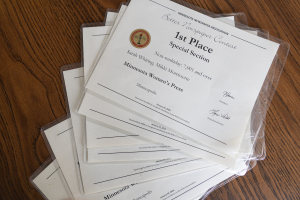 For 2025 coverage, Minnesota Women’s Press earned a community leadership award, three photography awards, and four editorial awards, including for coverage of social issues and for our Spring 2025 “Know Your Rights” special section supported by Unidos MN. Our publisher was named Journalist of the Year by Violence Free Minnesota for gender-based violence coverage.

