

Commentary: The Pervasive Smallness of Using Labels to Cause Harm
Minnesota Women's Press immigrant storytelling is supported by the Minnesota Council on Foundations.

Supporters gathered at a rally to support Rep. Ilhan Omar Monday, after her D.C. home was raided by federal agents (photo by Sarah Whiting)
Two story threads stood out for me last week, in a conversation with a group of Somali mothers (for an upcoming story). One was about trauma: the renewed fear of people who had fled civil war and were now seeing violent government tactics in their Minnesota neighborhoods — “they wouldn’t ask you questions, they would just surround you. There would be a group of them terrorizing you, pushing you around, yelling, threatening. … We knew the individuals were not law-abiding citizens themselves. They didn’t care what due diligence was, what is lawful, what is not lawful.”
They also talked about the trauma experienced by their young children afraid they might find a parent missing when they came home from school.
The other through line in our discussion was how they served their sense of community and resilience — despite the fear — by making sambusas and tea to offer people visiting the memorial sites for Renée Good and Alex Pretti. They felt compelled to be there because, as one of them put it, “They were murdered for us and for our community. They were among many neighbors standing up for us.”
I thought of those women in particular, who had shared two hours of conversation with me at the office of Reviving Sisterhood (RISE), when I read a U.S. President’s words a few days later: “The once Great State of Minnesota is being taken over by Somali Immigrants. … The Somalians should not be allowed to get away with what they are doing. They view you as weak and stupid people. Fight back Minnesota, fight back! If you need, the Federal Government will come to your rescue.”
U.S. Representative Tom Emmer of Minnesota immediately parroted Trump’s message, referring to Somali-Americans as “enemy combatants” and complaining that Democrats were not “rounding them up [and] putting them in jail.”



Incomprehensible Racism
I have written before about two pivotal moments in my childhood:
- When a neighbor I had known as a jovial bus driver was furious that my parents had taken in a few traveling Black gospel singers from Chicago, connected to a performance at our Catholic church — because the color of their skin was unfathomably something he did not want living for two days across the street. How bewildering that was to me.
- A few years later, when I was studying the Holocaust as an eighth grader, my first “interview” was with a Holocaust survivor who was a humanities professor at the University of Minnesota, where my mother had returned for a new degree. His willingness to talk to me about his personal experiences was sacred — and life-changing for me.
Why a person’s skin color or faith background is something other people judge as inferior continues to be unfathomable to me.
On Sunday, I was teaching a Neighboring Faiths class to young students at my First Unitarian Society of Minneapolis congregation. The focus was on Judaism. It was clear that many of the students, fifth to seventh graders, had not yet learned about the Holocaust in school. But when I asked what they would like to see fixed in the world, several of them said ‘racism’ and ‘violence.’
Coincidentally, the next day a publicist sent me a forthcoming memoir by Minneapolis-based Judi Shink, Speaking Through Silence: A Memoir by the Granddaughter of Four Holocaust Survivors.
One passage in the book particularly stood out to me:
“Neither Grandpa Jack nor Grandpa Ted walked through childhood thinking their Jewishness defined them. They were boys, soccer players, storytellers, apprentices, sons, grandsons. Until the moment society pressed a label onto them so firmly that they felt it on their skin…. The outside world decided that one part of us, this identity we carried quietly, almost unthinkingly, was the most important thing. The only thing they saw when we showed up. The only way they knew us.”

Yusra Mohamud and Arshia Hussain of Baddies for Progress are working to get out the vote (photo by Sarah Whiting)
‘Jewish,’ ‘Muslim,’ ‘Indigenous’ …
When Minnesota’s U.S. Rep. Ilhan Omar was eight years old, civil war in Somalia forced her to flee with her family to a Kenyan refugee camp, where they lived for four years. The family moved to Minneapolis in 1997. She became a legal U.S. citizen in 2000 and was elected to Congress in 2018.
The origin of Omar’s birth is one reason she has been a target of the Trump Administration. In 2019, Trump said she should “go back” to the country she came from and stood on his platform while a crowd chanted “send her back.”
As Heather Cox Richardson explained in her October 12 “Letters From an American” digest, “Right-wing radicalism was on full display this morning, when agents from the Department of Homeland Security conducted a predawn raid on the Washington, D.C., home of Representative Ilhan Omar. According to the Fox News Channel, which appears to have been read into the raid ahead of time, the Justice Department claimed that the search ‘stems from a criminal fraud investigation’ over immigration paperwork filled out by her late father in the 1990s when Omar was a child.”
With two notable candidates of Muslim origin on the ballot for an election that concludes November 3, including Minnesota attorney general Keith Ellison — who also has been a thorn in the side of radical right wing tactics — the raid is suspected of being political theater designed to rile up hostility by people who judge others for skin color and faith traditions.
A few hours after the raid, Trump targeted Omar during a rally in Youngstown, Ohio. According to The Guardian, he said, “She comes from one of the worst countries anywhere on the planet.” He urged supporters to vote Republican “if you want to stop Ohio from being plundered, ransacked, and destroyed like Minnesota’s being destroyed.” The crowd of Republican supporters chanted: “Deport, deport.”
A rally in support of Omar was held in Minneapolis Monday afternoon, with many voices connected to Indigenous People’s Day — a reminder of how forced removal and cultural suppression have been part of the country’s DNA.

Wintana Melekin (photo by Sarah Whiting)
Wintana Melekin, executive director of Groundwork Institute, opened up the rally by saying, “We will not allow anyone, federal government or local, to tell us that our neighbors do not matter. Nobody in the state of Minnesota has been as clear about that message than Congresswoman Omar.”
She shared a story about a Sunday morning during Operation Metro Surge when ICE was at her church. “I jumped out of bed in my pajamas, drove straight to my church — very afraid to see my pastor in my pajamas. I thought I’d be the only one there. But people were covering every single entrance of my church, handing out information cards, talking about the legal options. That solidarity, that compassion, that is how Minnesotans protect each other.”

Mary Kunesh (photo by Sarah Whiting)
Minnesota Senator Mary Kunesh said, “I am the descendant of a long line of strong Lakota ancestors. … Democracy means confronting the abuse of power wherever it appears and standing with people whose dignities and rights are under attack. A government that uses its power to intimidate a political opponent, target an immigrant, or send a message to an entire community is not protecting its democracy.”
She added, “No one should be singled out because of their race, because of their religion, because of their ancestry, because of their politics, because of who they love, or their immigration story. So today on Indigenous Peoples Day, we honor those and all of you who resist domination and defend our communities. We need to carry this courage forward — not with hatred, not with revenge, but with solidarity.”

Rachel Dionne-Thunder (photo by Sarah Whiting)
Rachel Dionne-Thunder. co-founder of the Indigenous Protector Movement, said: “Every day since the beginning of colonization over 530 years ago, we have been fighting back against the colonial government of the United States of America. … We know what it is to have our children taken. We know what it is to have our communities invaded. We know what it is to be attacked, to be villainized, to be criminalized. … Today on Indigenous Peoples Day, don’t just think of the history and the traumas we’ve been through, but look at our resistance as an example of how to move forward in love, in kindness, and in true power of the people united against violence and fear. There is more to come, but also there is more of us than them. Stay strong. Stay feisty. And stay salty because salt melts ice.”
Zaynab Mohammed, Minnesota Senator (District 63–Minneapolis), said the political retribution against Omar is because she “stands up against this administration for their inhumane policies. They’re attacking her because she represents what every Somali American can be: a young woman, a young Somali woman, a young hijabi mom who can be in Congress, who can be herself authentically, who stands up for her community without fear. She is what Minnesota is. She represents who we are.”

Bernie Burnham (photo by Sarah Whiting)
Bernie Burnham, president of the AFL-CIO of Minnesota, said: “We in Minnesota know the danger of right-wing extremists and the rhetoric they spew. Melissa and Mark Hortman were assassinated. John Hoffman and his family were brutally attacked. There was a list that had many of our legislators and community leaders on it. This kind of hate can and does create fear in our communities. But we must continue to stand together, stand up, and push back against hate.”

Malika Dahir (photo by Sarah Whiting)
Malika Dahir, executive director of RISE, said: “When people are overwhelmed by fear and uncertainty, they can lose trust in the democratic process. They can begin to believe that their voices don’t matter, that their votes won’t count, or that participating isn’t worth it. Voters choose who their representatives are, not the president, not federal law enforcement. We do. And when attacks on one elected official spill over to an entire community, we have even more reason to protect our democratic process.”
Jaylani Hussein of the Minnesota chapter of the Council on American-Islamic Relations (CAIR-MN), said, “I don’t think it was an accident to carry the burden of the murder of George Floyd right here in Minneapolis. I do not believe it was an accident to carry the burden of Operation Metro Surge here in Minneapolis and the Twin Cities. That is because there is something unique and special in this great state. … What we have accomplished so far, and what we are going to accomplish, will change the history of this nation.”
He indicated that Minnesota’s 5th Congressional district was the first to send a Muslim to Congress — Keith Ellison was elected in 2006 and served until he became attorney general in 2018. Omar was elected to replace him in that office — “The first female Muslim hijabi woman and refugee. So, I tell you today, this is not a moment to be frustrated. It is a moment to hold our heads high because we are the front lines for democracy right here.
“We’re going to be known in the history books as the people united who stood up for this country and Constitution in a moment where America needed residents to come out of their neighborhoods and stand up for each other. So you Lutherans and Catholics, and the immigrants that came from Laos and Vietnam, the Hmong people, and the Somali people, and the Latina people — we are a compilation of what America is going to be. So today is a day to say we will stand up for each other.”
A message from Omar was shared that said she and her family are okay, she will not be silenced, and “Thank you for having my back. I’ll be home soon to get out the vote.”

Sen. Zaynab Mohammed and Jaylani Hussein of CAIR (photo by Sarah Whiting)

Youth of the Sunrise Movement at the rally in support of Rep. Ilhan Omar (photo by Sarah Whiting)

(photo by Sarah Whiting)

(photo by Sarah Whiting)
Related Stories
Support our ability to tell the stories that don’t often get told:


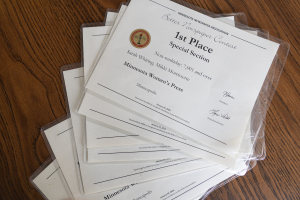 For 2025 coverage, Minnesota Women’s Press earned a community leadership award, three photography awards, and four editorial awards, including for coverage of social issues and for our Spring 2025 “Know Your Rights” special section supported by Unidos MN. Our publisher was named Journalist of the Year by Violence Free Minnesota for gender-based violence coverage.

