


Commentary: How Women Are Seeing the Big View in Grand Rapids

Downtown Grand Rapids
This is the first in a series of perspectives from a visit to Grand Rapids, thanks to the underwriting of Minnesota Community Action Partnership.

KOOTASCA Big View participants Amy Blomquist and Jane Spade (photo by Felicia Smith, MN Community Action Partnership)
At my annual summer talk delivered at First Unitarian Society of Minneapolis, the reading prior to the talk quoted a blog post by a financial planner named Katie Gatti Tassin. She indicated that we have become a culture that spends money for strangers to do errands and projects for us, instead of asking a friend or neighbor to help. We have become so abhorrent of being dependent on anyone that the ties that normally bind us to community are weakened.
After moving into a new neighborhood, Gatti Tassin wrote, neighbors invited them over for dinner. Since then, “Every time we exchange excess baked goods or text one another to check in, I feel that sparkling little reminder: Someone’s looking out for me, and I, them. … We glorify individual ability and self-sufficiency, which are great — but to be human is to need. So, too, is to give. ”
I was reminded of those words during a conversation with more than a dozen women in Grand Rapids recently. They were assembled to share insights about how they have been engaged in community conversations hosted by the KOOTASCA Community Action program, Big View. Since 2007, the program has offered community-wide knowledge and awareness about a variety of topics. A series about the opioid epidemic was highly popular. A guest lecturer about “1946,” referencing the first year the term homosexual was included in a bible translation, drew a challenging audience. Conversations about racism, white supremacy, and the science of transgender, also have been well-regarded.



One of the primary and original topics of the program, as one participant put it, is about “the impact that poverty has on all people, not just the people in poverty.”
Community engagement director Alice Moren says of the program: “In the Big View, we are trying to get people to think bigger or differently. We can so easily fixate on individual behavior as a piece of poverty — ‘because of the decisions that you’ve made, the choices you’ve made, that’s why you’re where you’re at.’ There are so many people who are doing all the right things, but they’re not getting ahead. Whether it’s because of low wages, or health issues, or lack of housing or transportation. It’s easy to just say ‘that was a dumb decision’ and end of conversation. Poverty is so much more than that.”
The following represents a few of the perspectives shared during our conversation in Grand Rapids. [Some of the women have given permission to be quoted; others have not yet responded, but will be named after approval is granted.]
“It Could Happen to Anyone”
One woman indicated that after a lifetime of helping others, she recently needed a fundraiser to get through some tough times. She said it was very difficult to be in that position.
In response, another participant indicated the importance of learning how to both give and receive, and was thinking of teaching her kids to think about ‘how did you get help today?’ “We’re always used to fixing and solving things. I don’t think we’re often taught to receive.”
Another participant indicated she had grown up in poverty. “It was terribly difficult for me to ask for help. I grew up thinking ‘I can do this myself, I can take care of it.’ I’m glad you ask your children something different. Because, unfortunately, I think I raised my children to be fiercely independent as well.”
The monthly cost for a nearby rental at an old two-bedroom cabin is $1,400, which is out of the grasp of so many young adults in the community, one mother indicated. She wondered why some landlords are able to get away with a $200 increase in rent, which can send renters into a nose dive that leads to couch-hopping and homelessness.
Amy Blomquist, who has worked with Headstart and other organizations, as family support staff and as a mental health practitioner, indicated she has “seen the impact of what happens to families when they’re not supported in our community. … Capitalism isn’t there for the poor.”
Briana Anderson, a city clerk in a nearby town, indicated how important it is to talk to people who have actually experienced the issues, “because they can give you better answers and a better perspective than third-parties who think they know what the solution is.” She also noted the importance of remembering that you cannot pull yourself up by your bootstraps if you don’t have bootstraps to begin with.
Marian Barcus, a licensed social worker, says: “It’s the difference between fixing and partnering. We think we know what’s best and so our society builds it, we create it. It becomes part of our system. Yet the problem doesn’t go away. I think it’s because we haven’t actually partnered, we haven’t actually joined, we haven’t listened. We haven’t gotten information from people who have the needs about what they want, what will work for them.
“The other part of that is the big context. You can try to fix anything you want. But if the outside environment is not supporting it, if it’s actually working against it, then all those little fixes are not going to make it go away.
“Is our society really structured in a way that supports change for the have nots, for people who need change? Is our economy really structured there? Are we just struggling upstream against this raging torrent? We have this economic system that leads to and creates the have nots. We can’t function without it.”
Another woman said, “Thinking about my own experience, having to be able to take care of yourself also comes from that myth in the system that comes from capitalism — that if you work hard enough, you can get ahead. Big View helps to give us the opportunity to be reminded, ‘No, you can do everything right [and still not get ahead].’ I think about all the people in my life who work so hard, and they’re on the verge of homelessness, or they’ve been homeless, or they are homeless. It’s not right.”
Reflection Question
This story notes how it can be easier for people to give help than to receive it. It also indicates how difficult it can be to get ahead today, especially for young people, even when the right steps are taken. If this resonates with you, please share your experience anonymously in the comments and we will compile it into a future “Readers Respond” essay.
Become a Badass member to keep apprised of future stories in series about Hometown Values & Vision, Collective Health, Diversity in Politics, Addressing Gender-Based Violence, and Ecolution.
Related Stories


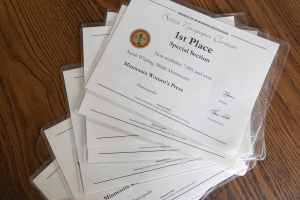 For 2025 coverage, Minnesota Women’s Press earned a community leadership award, three photography awards, and four editorial awards, including for coverage of social issues and for our Spring 2025 “Know Your Rights” special section supported by Unidos MN. Our publisher was named Journalist of the Year by Violence Free Minnesota for gender-based violence coverage.

Leave a Reply
Want to join the discussion?Feel free to contribute!