

COMMENTARY: Building Systems That Can Truly Respond Beyond Silence
"This Is US" coverage, and the March/April magazine issue, made possible by the deep underwriting of Unidos MN.
On March 18, civil rights leader Dolores Huerta issued a statement: “I am nearly 96 years old, and for the last 60 years have kept a secret because I believed that exposing the truth would hurt the farmworker movement I have spent my entire life fighting for. I have encouraged people to always use their voice. Following the New York Times’ multi-year investigation into sexual misconduct by Cesar Chavez, I can no longer stay silent and must share my own experiences.”
She indicated that, as a young mother in the 1960s, she felt manipulated and pressured into having sex with Chavez: “I didn’t feel I could say no, because he was someone that I admired, my boss, and the leader of the movement I had already devoted years of my life to.” She indicated something similar happened a second time, when she felt trapped into complying. “I convinced myself these were incidents that I had to endure alone and in secret.”

Ana Mariella Rivera (submitted photo)
I received with sadness the reflections Dolores Huerta shared, and also with deep respect for the courage it takes to speak a truth like this after so many years. At the same time, I am sitting with a sense of hurt and betrayal. Cesar Chavez has long been one of the leaders I admired — someone whose story I have shared with my children as part of the history of Latino dignity, struggle, and leadership.
Now, like many others, I find myself having to hold a more difficult conversation with them: How someone can contribute so much to a collective cause while also causing deep harm in intimate and personal ways. There is no easy answer to that question, but there is a responsibility in how we hold it.
For me, that has meant allowing space for both accountability and complexity, without collapsing one into the other. In my work as a psychotherapist, I have sat with many women who have experienced abuse at the hands of men who were respected, admired, or held positions of authority. What I have come to understand is that silence in these situations is often layered by fear, survival, loyalty, confusion, grief, and the emotional weight of knowing what speaking might disrupt in one’s family or community.



For many in the Latino community — which may resonate in others — there are often deeply held cultural values shaping these conversations. Familismo, loyalty, and collective identity are sources of strength, protection, and resilience. At the same time, when harm occurs within the family or within respected leadership, those values can make it more difficult to name what is happening. Over time, what remains unspoken can move across generations, creating patterns of silence that are deeply felt.
The misuse of power, emotional domination, and harmful expressions of masculinity are part of larger cycles that have shaped families and communities.
It is not enough to focus only on personal behavior, or even on cultural dynamics, as important as those are. We also have to examine the systems that respond when harm is disclosed, and how those systems can sometimes reinforce misunderstanding, deepen harm, or contribute to continued silence.
Through my work with colleagues — including my policy fellowship at the Humphrey School of Public Affairs — we have been thinking more deeply about how systems shape the way harm is recognized and responded to. What becomes clear is that even systems designed to protect can fall short.
Systems reliant on rigid protocol can limit the level of curiosity and reflection needed to truly understand what a person or family is experiencing. Without that, understanding can remain surface-level, potentially leading to distancing and the re-traumatization of victims.
I have seen this in practice when survivors and families come into contact with systems that misinterpret their responses, overlook cultural context, or apply labels that do not reflect the complexity of what they are navigating. In those moments, the system itself can become another layer of harm.
Sitting with all of this, I find myself returning to the same tension that started this reflection: The tension between admiration and accountability, between collective history and personal harm, between what we have inherited and what we are now being asked to confront more honestly.
Perhaps what makes this moment so difficult is also what makes it meaningful. It invites us to look more closely at what has been normalized, what has been silenced, and what we are now willing to name. And maybe that is where something begins to shift.
Ana Mariella Rivera, LICSW, is a mental health strategist, psychotherapist, and adjunct instructor and an adjunct instructor at St. Catherine University. She is a board member of the Minnesota Council on Latino Affairs. Originally from Peru, she partners with Telemundo Minnesota, and is the creator and host of Historias y Huellas, a podcast that elevates immigrant stories and Latine leadership narratives.
We are hosting an April 1 members conversation with people about healing from trauma, including the ICE occupation; join the community for this and other future conversations. And sign up here if you want the opportunity to discuss Ana’s commentary here and what resonates with you.

See also this story from The 19th: “Dolores Huerta feared speaking about her abuse for years. The farmworkers she advocates for understand.”
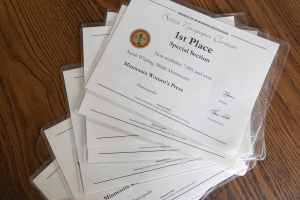 For 2025 coverage, Minnesota Women’s Press earned a community leadership award, three photography awards, and four editorial awards, including for coverage of social issues and for our Spring 2025 “Know Your Rights” special section supported by Unidos MN. Our publisher was named Journalist of the Year by Violence Free Minnesota for gender-based violence coverage.
