


COLUMN: Aging Across Borders, #3

Since Fall 2023, my spouse and I have been living on the road. We were 65 when we began. We are closing on 67 now, living on social security and one pension. We stay for one month in each place. So far, we have lived in Portugal, Spain, Albania, Montenegro, Northern Macedonia, Wales, France, Belgium, Germany, the Netherlands, Norway, Sweden, Northern Ireland, Iceland, Turkey, Greece, and now Egypt. It has given me a chance to compare how elders live in different societies and to consider some of the universal things we humans need as we age. While the desires and conditions differ, access to public spaces and services is a common denominator.
The best place for aging, in our experience, is Madrid, Spain. Though the city has an air pollution problem, that was offset by many other essentials. Water is potable and there are food markets of all kinds on every block. Streets are safe for elders. I saw women in their eighties walking alone at night, going to cafes and markets by themselves. Health care is free and high quality, with neighborhood clinics as well as big hospitals. Mass transit is readily available, including busses and subways We took a bus at midnight across the city, and felt safe.
Madrid has local parks like Minneapolis does. What impressed me most was the robust system of free, city-sponsored programs for all ages. The huge Retiro Park in the center of town, had every kind of class tucked into every corner of the park, many of them sponsored and paid for by the city, all of them sanctioned. We found a daily exercise class in small park across the street from us, for retired folks. The instructors were excellent, and the comraderie among participants delightful. We went every day, relishing the opportunity to be part of community. There was much laughter, singing of lyrics of music, mutual support and beautiful trees to look up at while moving to the music.



Other Good Aging I Have Seen
On the wharf in Istanbul, Turkey, where musicians played, old men and women joined young people sitting in the sun, listening to the music, and watching the water. An accessible path along the water and shielded from traffic gave people of all ages a chance to enjoy some peace in a noisy city.
Three elderly women in Istanbul
In tiny Whitehead, in Northern Ireland, people sat on benches overlooking the sea. There, like in Istanbul, they could walk or roll on an accessible cement walk. The path extended a couple miles along shore and cliff. Those with the physical ability could take the path another mile up the cliff. Stairs and handle bars were provided to assist.
In Corfu, Greece, the city sponsored multigenerational marching bands. Musicians in their 80s play alongside ten-year-old prodigies. There were also musical opportunities for elders only. We saw an old men’s choir, led by an old woman, singing in the square. They sure sounded sweet. Access to music, across the age span, was a priority in Corfu.
Bicycling in the Netherlands was not just for the young or athletic. I relished seeing people of all ages and sizes on two or three wheels. The robust network of bike paths were accessible to wheelchairs as well. Most riders went slow. The focus was on getting to work/ school/ shopping/ play in a mellow manner. I enjoyed seeing people of all ages and sizes on their bikes.
In Turkey, the public baths in neighborhoods were cheap, People of all ages, but especially elders, have their backs rubbed and bodies cleaned. The scene was gender segregated, social, and intimate. Though I struggled to understand the rules, given my lack of Turkish, the language of touch was healing.
I noted the women who joined the domino games in Berat, Albania, even though most were men. The players sat under cool trees in a public park by the river. Each group of players attracted small crowds of elderly onlookers, waiting their turn.
In Norway, in a community just outside Oslo, people love their privacy. There was an island with small beach areas, each with a bench, to allow individuals and groups discreet bathing. People changed into suits using towels as changing rooms. There were several bathrooms in the woods. There was an assisted living facility on the island. I watched one elderly woman come down for her daily swim, on a chilly day when younger people were just dipping their toes.
In Egypt, people were so kind, resilient, and caring of each other across the age spectrum. The culture was ancient and beautiful, but the current government provided only for the rich and the military, making it increasingly difficult to grow old. Under President Abdel Fattah el Sisi, (perhaps Donald Trump’s favorite dictator), you have to be rich to access anything, including a walkable sidewalk, a view of the Nile, healthy food, potable water, and a park to sit in.
Old people need public access like everyone else, but the word “access” has different meanings as we age. Barriers to healthy basics — like water, food and housing — to socializing, to creative and intellectual endeavors, to green spaces all need to be prioritized for good aging.
Government support is essential to secure that access. In each culture, different things are prioritized. But everywhere, good aging requires prioritizing human needs.
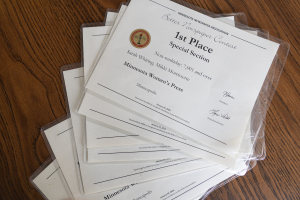 For 2025 coverage, Minnesota Women’s Press earned a community leadership award, three photography awards, and four editorial awards, including for coverage of social issues and for our Spring 2025 “Know Your Rights” special section supported by Unidos MN. Our publisher was named Journalist of the Year by Violence Free Minnesota for gender-based violence coverage.

