

Building Trust: The People Who Try to Help Veterans Access Benefits
Ecolution reporting made possible by Seward Co-op, which has been a community-owned grocer since 1972: Together, we continue to cultivate a cooperative economy.

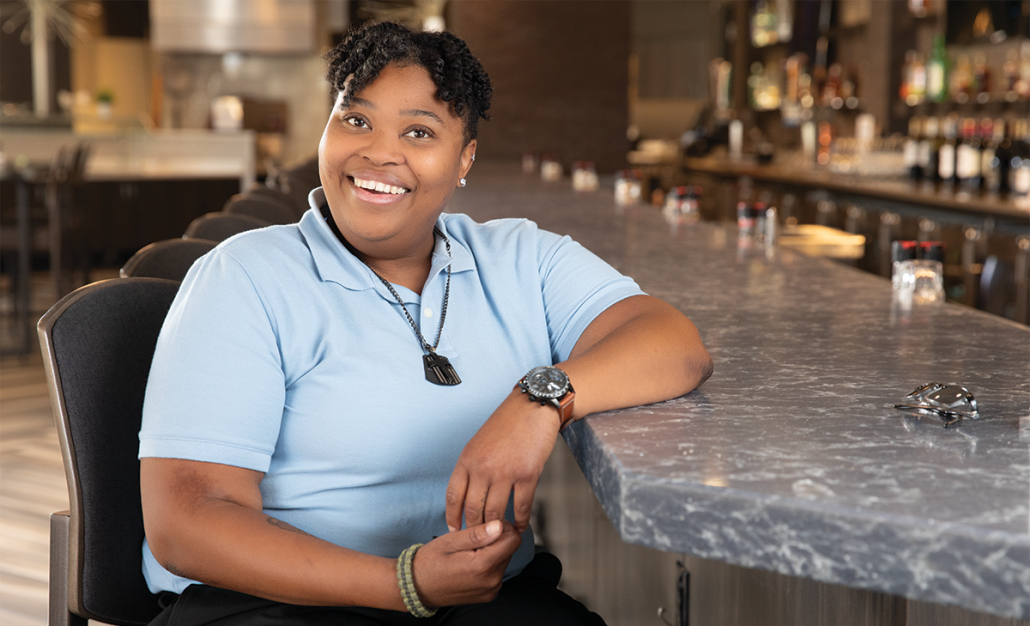
Brianna Gibson sits near the coffee shop at Aire MSP Apartments, where she was placed for housing in July. Photo Sarah Whiting
Brianna Gibson is a disabled veteran — defined as living with an injury or health issue caused by service in the military. “I have multiple service-connected disabilities and PTSD, which make my daily life difficult and isolating,” she says. “Safety, accessibility, and convenience are extremely important to me.”
However, while living in Illinois, her access to Veterans Affairs (VA) benefits was not great. She also was unfortunately exposed to toxins in her apartment. With the help of her sister, she moved to Minnesota and connected with Angela Overlin at the Minnesota Assistance Council for Veterans, who went “above and beyond to get me housed. It happened so quickly, I had barely even gotten my homeless paperwork signed for Minnesota. I had never known there were so many resources and organizations that cared enough to make sure I had food, shelter, a bed, daily essentials, and a way to get to my many doctor appointments.”
Gibson also expresses gratitude for “wonderful people at the American Legion, Bridging, Veteran Movers, and a slew of others for furniture, television, games, bedding, kitchen furnishings, and most of all, restoring faith in others that I had lost.”
Women now make up roughly 22 percent of veterans in the United States. Gibson is among a relatively small percentage of veterans — of any gender — who trust the veterans’ system enough to access the housing and health care benefits they are entitled to.
According to the U.S. Department of Veterans Affairs, only 44 percent of women veterans access VA health care benefits.



Many men do not access the veterans’ benefits they are entitled to either. Of 16.5 million veterans overall, according to the U.S. census, only 9 million are accessing services. Service providers and veterans say that people who do not use their benefits — including those who suffer from mental, physical, housing, and addiction issues — do not trust the system to take care of them, do not want to ask for help, have limited access in rural areas, or have found the labyrinth of providers and paperwork overwhelming. Prior to passage of the PACT Act in 2022, the backlog for responding to claims was long; the processing workforce has increased by 50 percent since then.
 Jennifer Shumaker is a veteran claims advocate for the Minnesota Department of Veterans Affairs in her Rochester community. She and a colleague are “working on a survey, trying to find where the lack of resources is for women veterans in Minnesota, and then not only address that — to get these women the help that they need — but also address it nationally, with our legislators, to point out health care access problems. A man who lives in a rural area can go to the local clinic and get his prostate checked out. But they often don’t have gynecology or mammogram services at that clinic. Women veterans might have to drive two hours.”
Shumaker indicates that even for women who served alongside men in the military, it can be daunting to step into waiting rooms and lobbies filled with men. This can especially be the case for the many veterans who suffered from service-based trauma. “Military sexual trauma is not specific to women veterans, but if they walk into a facility that’s all men, that might be hard for them,” she says.
One woman she worked with from the Vietnam era, Shumaker says, “didn’t come forward about her sexual assault until she was almost 60 years old. She had never even told a friend about it. It wasn’t until she experienced another traumatic event in her life that it hit her like a ton of bricks and brought up the past. We got her the help that she needed. She ended up going to a female civilian provider, instead of one in the VA system.”
She said transgender and LGBTQ+ veterans have similar issues to confront. A separate entrance is being created for a women’s veteran health care clinic at the Minneapolis VA Hospital, to open in about 18 months, in order to provide more welcoming access to women veterans.
Veterans Serving Veterans
Shumaker and her older brother grew up with supportive grandparents, and a mother who suffered from mental health issues. After her brother joined the military, he advised her, “This is your way out.” So she signed up.
Shumaker retired in 2015 from the Minnesota Army National Guard, after 20 years of active duty and National Guard time. She had been deployed in Iraq from 2004 to 2006, and Afghanistan from 2009 to 2010. She was a motor transport operator who trained National Guard troops in how to drive convoy vehicles.
Eventually, as a civilian soldier, she ran a veteran disability program for a nonprofit and was a service officer with the Disabled American Veterans local chapter. She worked 10 years as a county veteran service officer, and spent five years as a district, state, and national VFW legislative leader. She had to give up her Harley motorcycle after being fitted with a prosthetic arm, but is still in the Combat Veterans Motorcycle Association. She has hosted a disabled American veteran deer hunt for 14 years, and a women veterans event for seven years.
“I enjoy serving other veterans,” Shumaker says. “They speak my language. They had similar experiences.”
With her master’s degree in psychology, she also has run a post-traumatic stress disorder support group. “It started with three veterans in the back of a bar on a Monday night once a month. It was a very quiet atmosphere at our local Elks Lodge; generally a bartender and two gentlemen playing pool. Now here we are, 14 years later, and we have about 30 participants. We also offer the group to civilians, because there’s no other organization in the area that offers a PTSD support group. I’ve had abused women. I’ve had sex-trafficked women. I have a gentleman that suffers from a traumatic brain injury and PTSD due to a drug overdose.”
Recently, Shumaker was at a conference in Washington, D.C., focused on women veterans. More than 1,400 advocates came from around the U.S. to talk about the special needs of women veterans that are not adequately served.
For example, she says, she worked with a man who served in Iraq and suffered from gynecomastia — a kind of breast cancer for males. His claim for surgical removal of pockets to check for cancers was granted. “I did the same for a female vet who served in Iraq, and her claim for breast cancer treatment was denied. Veterans Administration is a top health care research center, which is great because of the unique toxicity exposures where veterans serve. But we are not there yet on all of the health issues, especially impacting women.”
She notes that many women veterans have had multiple miscarriages after being in Iraq or Afghanistan. As of March 2024, the new PACT Act — described by the VA as the largest health care and benefit expansion in its history — expands service to veterans exposed to burn pits, Agent Orange, and other toxic substances. Shumaker is among those working to correct disparities for women veterans.
Medical research about toxic exposures thus far has been primarily focused on men’s health. “Just like Agent Orange exposure — it took them 20 years to do that medical research and start finding new ways it affects veterans,” Shumaker says. “When I was a county vet service officer, I saw Vietnam veterans with a multitude of kidney conditions, so the VA paid attention.”
After Vietnam-era vets returned from war, Shumaker says, benefit access was very different. “Unless you were missing a limb or an eye, you were not getting seen at the VA Medical Center,” she says. “And PTSD mental health issues did not become a diagnosis in the DSM-5 [Diagnostic and Statistical Manual of Mental Disorders, Fifth Edition] until 1982. Women and men drafted during the Vietnam War came home from combat and needed care — but they were not going to get it.”
Now, with the PACT Act and other policy changes, there are many ways to get VA health care. Coverage also includes veterans who served during peacetime but have a household income lower than $61,000 annually. Shumaker says it is common for veterans of all genders to say, “‘if I didn’t serve in combat, those benefits should be for someone else,’ but I explain to them that these benefits are available to all veterans. I treat it like the highway projects: if we don’t use it, we lose it. So I ask them to please apply and use their benefits. This is an entitlement to veterans who served.
“It’s not a welfare thing. It’s not a free handout. This is an entitlement that was promised to you because you served in the Armed Forces.”
Shumaker also encourages people to join the VFW, American Legion, or other clubs to enhance representation in Washington, D.C. “So many people think it is simply about raising funds for your community, or having that camaraderie at a bar. But it also is a vote in Washington.”
Housing First
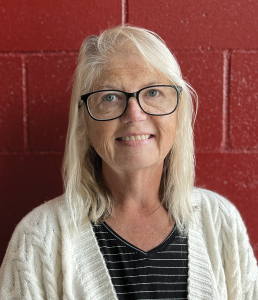 Katie Splittstoesser is a Healthcare Navigator with Minnesota Assistance Council for Veterans (MACV). “Mental and physical disabilities go untreated because there is distrust of the system that could treat them,” she says. “Healthcare Navigation attempts to be the bridge to treatment of both mind and body, inside the VA system, or outside with private-practice doctors.”
Splittstoesser grew up in northern Minnesota and worked in the Twin Cities as a union bricklayer for 12 years. She is not a veteran herself, but her father was a helicopter mechanic during the Korean War; her uncle is still considered missing in action. Her brother is a Vietnam vet. After she earned a master’s degree in social work she began working for MACV, connecting veterans to health care, food, and housing. “The veterans we serve are often battling disabilities that are unseen,” she says.
MACV uses a Housing First and harm reduction model, which supports getting homeless veterans off the streets and does not make that housing contingent on sobriety. Homeless veterans have high rates of chronic disease. After being housed and working toward safety, the veteran can move forward with other priorities.
“Since working at MACV, I can speak from experience about the difficulties vets have in navigating VA benefits and health care services,” Splittstoesser says. “It can be hard for veterans to figure out where to start. In many cases, it has been years since their service, so some who are eligible do not realize benefits are available to them. Many believe they need to have suffered life-threatening injuries. Others had extreme experiences that left them not wanting to have anything to do with remembering their military time. I have found this to be true of those who served in peacetime as well as war; for those who served overseas and those who served in the U.S.”
Building a working relationship with the veteran, she says, is the best way to help them build trust and a relationship with the VA system. Finding small “wins” within the experience builds trust. Making phone calls and setting appointments, then following up with transportation — and possibly attending those appointments with the veteran — are important starting points.
Often, veterans are encouraged to connect to their County Veteran Services Officer (CVSO) for additional support in explaining benefits and applying for grants for something perhaps as basic as buying dentures, Splittstoesser says. Some of those county officers, however, are overloaded with cases, which can slow the process.
Physical health services tend to be easier to direct veterans to than mental health services.
“There are waiting lists, and appointments can be weeks to months away,” she says. “We explore community care options with them, which can be difficult to access due to income and medical insurance limitations, but can be used more quickly. Connecting them with a provider that is not the VA can be helpful. Their primary care provider can prescribe medication or talk about therapy options. But they often don’t want to bring up their trauma with anyone.”
Shumaker concurs, saying, “Most veterans have not been seen for mental health service because that stigma still exists. I had a guy who was deployed nine times to Iraq and Afghanistan. He didn’t even have time to breathe and he was back again. To get that veteran to go to a mental health provider to get a diagnosis, that’s hard.”


 For 2025 coverage, Minnesota Women’s Press earned a community leadership award, three photography awards, and four editorial awards, including for coverage of social issues and for our Spring 2025 “Know Your Rights” special section supported by Unidos MN. Our publisher was named Journalist of the Year by Violence Free Minnesota for gender-based violence coverage.
