

BOOKS AND ART: My “Like Water for Chocolate” Tour at Mia
Minnesota Women's Press arts coverage is supported by the Minneapolis Institute of Art, offering inspiration, family fun, date nights, and galleries to unwind and relax. Everyone is welcome.
 What does it mean to feel and what happens when true emotions are repressed for a lifetime? Those are the questions asked in the novel, Like Water for Chocolate, by Mexican novelist and screenwriter Laura Esquivel. The novel follows Tita, who longs for Pedro, yet cannot be with him due to her mother’s strict tradition: the youngest daughter of the family must not marry, instead caring for her mother until death.
Tita navigates life largely heartbroken as her elder sister marries Tita’s true love. Her one solace is the kitchen, where she can express herself and feel what she is told to quell. Blending romance, magical realism, and recipes, the novel spans lifetimes in its pages.
The novel reached critical acclaim. It was on the bestseller list in Mexico, when it was published in 1989, and in the United States, when it was published in 1992. It has been adapted into multiple movies, television series, and even a ballet. A tour at the Mia was a good place to reignite the fire set within the pages of this novel in yet another form during an “Inspired by Books” tour led by one of its guides.
“Each of us is born with a box of matches inside us but we can’t strike them all by ourselves.”



Museum Tour

Virgin of the Milk (Virgen de la leche), c. 1500. Circle of Gil de Siloe, active Burgos, Spain, 1486–1501. Polychromed wood. Minneapolis Institute of Art, The William Hood Dunwoody Fund
The guide started us off in front of a medieval sculpture on the third floor – Virgin of the Milk (Virgen de la leche), c. 1500. The piece depicts the Virgin Mary breastfeeding her son in striking realism, as Mary dons a look of contentment. Her breast milk was said to have similar redemptive powers to the blood of Jesus on the cross. It was a nod to Tita, the main character of the novel, who breastfeeds her nephew in a moment of necessity, feeling tranquility and connection that had been uprooted when her sister bore a child with Tita’s true love.

Chocolate pot, c. 1703. William Charnelhouse, English, active 1703–1712. Silver. Minneapolis Institute of Art, Gift of James F. and Louise H. Bell
We then ventured to the silver room’s Chocolate Pot, c. 1703. The mounts applied around the handle and spout are detailed and refined, almost resembling flames — analogous to the desire of the novel’s characters. The phrase “like water for chocolate” (from the Spanish como agua para chocolate) means that emotions – passion, love, arousal – are reaching a boiling point. Tita, alongside most of the characters in the novel, hover at this boiling point, battling repression and family responsibility that keeps them from truly erupting.
photo submitted by author
In a room of photography, the guide led us to La Cuisine d’Azzedine Alaïa, Paris, 2007, a striking portrait of Azzedine Alaia (1940–2017), a renowned Tunisian-born couturier and shoe designer. The portrait was taken in his kitchen, just as most of the novel centers around the kitchen as a space of tension, peace, and growth. While the room around him is buzzing and blurry with conversation and movement, Alaia stares directly at the camera with sincere intensity. The glare stops you in your tracks, commanding you to submit — mirroring what I imagine the gaze of Tita’s mother, Mama Elena’s, would look like. The matriarch of the family commands with unfeeling efficiency, punishing her daughters — especially Tita — for the fact that her own parents forbade her from being with her own true love, a Black man. This portrait encompasses Mama Elena’s presence in the novel, as she rules the ranch and passes her livelihood of repression onto her daughters.

submitted by author
The work of María Berrío, a Colombian artist who mainly works in collage, closed out our tour. The artist layers hand-cut Japanese paper onto canvas, creating larger-than-life scenes brimming with texture and color. Oda a la Esperanza (Ode to Hope), 2019 is a work by Berrío that depicts girls in matching striped dresses sitting in chairs and holding birds in their hands. In Spanish, esperanza means both “hope” and “wait,” with both meanings portrayed in the girls somber expressions as they stare straight ahead. This double meaning further reflects Tita in the novel – a woman forced into a state of waiting by her mother’s rule, yet Pedro forever within reach because of his marriage to her sister. Like Tita, with a pigeon she cares for in a moment of deep depression, the girls hold the birds, simultaneously caring for them while keeping them trapped.
“Now, seeing her hands no longer at her mother’s command, she didn’t know what to ask them to do, she had never decided for herself before. They could do anything or become anything. They could turn into birds and fly into the air! She would like them to carry her far away, as far as possible. Going to the window facing the patio, she raised her hands to heaven, she wanted to escape from herself, didn’t want to think about making a choice, didn’t want to talk again. She didn’t want her words to shriek her pain.”

submitted by author
One of María Berrío’s earliest works, Knitting the Wind, 2015, tied up the themes of the novel for me. The world of Like Water for Chocolate dances in the realm of magical realism, as does this work of art. The novel’s characters are grounded in a reality like our own — yet there are moments in which food causes dramatic weeping or skin to be set aflame. Emotions become tangible in both the novel and this artwork, letting feelings exist outside the body and inside the world around it.
The tour proposed the question: how can emotion be portrayed outside the confines of words?
Perhaps feeling isn’t something that can be explained, and magical realism is the closest we can get to the truth.
Related Events
- María Berrío’s artwork is on display in a special exhibition until January 10, 2027. Two informal conversations with a Mia guide will explore narratives hidden within Berrío’s layered scenes: September 29 and 30, 11am–noon
- Find future “Inspired by Books” tours
Support our unique story sharing

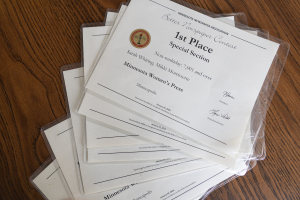 For 2025 coverage, Minnesota Women’s Press earned a community leadership award, three photography awards, and four editorial awards, including for coverage of social issues and for our Spring 2025 “Know Your Rights” special section supported by Unidos MN. Our publisher was named Journalist of the Year by Violence Free Minnesota for gender-based violence coverage.

