


UPDATED BOOKS: A Variety Pack of Minnesota Authors
As part of our ongoing self-care space — from the monthly Creativity & Connections newsletter about books, arts, and events, we have book titles to share from local authors.
Added 12/30, from staff member Sarah Whiting
 Stacia Kalinoski is the one in every 26 people affected by epilepsy. In her recent book Racing Uphill: Confronting a Life with Epilepsy, Kalinoski recounts her path from early signs she experienced in college through her brain resection surgery. The book is filled with bare facts about epilepsy — signs and symptoms, medications and procedures — and works as a great resource for those with epilepsy and those who care for them.
In addition to factual details, Kalinoski is brutally candid about her experience. She explores epilepsy from the inside out, bringing readers on her journey as she first learns what it is like to experience epilepsy and later, what it is like to watch a seizure. As a competitive runner, she describes the pain and frustration of being unable to enjoy her favorite activity because it brings on seizures. She explains the difficulty of having a career as a journalist because the seizures rob her of her memory and her ability to do her job.
Some of the most terrifying moments she recounts are not surgeries or seizures, but the moments after a seizure happens.
“Doctors tell people who experience seizures to avoid risky activities like swimming and rock climbing. Preparing any food that requires a sharp knife should be added to that list of cautions. Carrots lay in front of me and I started to chop. Without any indication of a seizure or how much time had passed, I came to and looked around in a daze, soon realizing the cold kitchen floor was beneath me. ‘Where am I?’ I called out nervously. But there was no one to answer me. My head slowly circled to see a fridge, a dishwasher — and then blood on the floor.”
As she searches for relief from the debilitating illness, Kalinoski does not forget about those by her side. She acknowledges caregivers in the forms of friends and family who suffer along with her.
Racing Uphill is Kalinoski’s honest confrontation of the disease that initially robbed her of her career and her health, and the surgery that allowed her to run again without fear.
A member of our team, Olivia Worcester, offered summaries of four books she read recently.
 The Book of Kin: On Absence, Love, and Being There, Jennifer Eli Bowen – Milkweed Books
Jennifer Eli Bowen’s novel The Book of Kin is an essay collection that explores what it means to have connection, and what people’s obligations are to one another. Bowen explores themes of community, solitude and love, meditating on her own experiences as a mother, daughter, and founder of the Minnesota Prison Writing Workshop, the country’s largest prison-based literary organization. Bowen’s prose is unique and captivating, utilizing knowledge she’s gleaned from her career as well as her personal life. “Open Window, Burning House” describes a relationship with her absent father, who vanished one day. In “Surrogates,” Bowen recounts adopting her dog, Twin, and raising backyard flocks of chickens. In “Watched,” she recounts a tour of a Norwegian prison facility. Connection, or a lack therof, permeates Bowen’s essay collection. As Bowen puts it, in a loving paragraph dedicated to her sons: “May whatever love I give, and whatever love I misapplied, flourish in them and theirs. … May it sustain the strongest pulses in their kin and theirs.”
 From Generation to Generation: From Lithuanian Shtetl to Freedom, Family and Future in the City of Lakes, Lynn Bolnick – Roundtable Press
Lynn Bolnick’s first novel is an up-close snapshot of her family history. From her Lithuanian immigrant grandparents to their children’s children, this memoir traces three subsequent generations as the Bolnicks planted roots in the City of Lakes after fleeing Eastern Europe during a period rife with Jewish pogroms and governmental oppression. Bolnick touches on her upbringing as a daughter of Jewish immigrants, divulging the customs and values Judaism instilled in her that have guided her decision-making, as well as how her family’s experiences have been meaningful in ways that helped shape her career in public policy. In honor of those who preceded her, and those who have come after her, Bolnick provides a rich, loving tribute to her family’s lives, beginning in 19th century Varniai and continuing through 21st century Minneapolis, l’dor v’dor, from generation to generation.
 Finding Our Way: A Guide on Care, Finances and Helping Through the End of Life Journey, Leslie Vick – Pine Book Writing
Growing up, Leslie Vick watched her grandmother tirelessly care for her grandfather as he battled a lifelong illness — her first example of the intense work of caregiving. In Finding Our Way, Vick intertwines her first-hand experience as caregiver for her father’s dementia alongside widely developed resources and advice for those on their own caregiving journeys. In Vick’s experience, caregiving is much more than managing prescriptions and doctor’s appointments. It also includes proper home maintenance, proactive budgeting, and end-of-life support — aspects that are often overlooked and can contribute to the difficulties and loneliness of caregiving. Above all, Vick’s book balances the hardships of caregiving with its value, and the precious time it gives with a family member. “Giving ourselves and sharing experiences instead of ‘things’ is the best way to live out what time you have with your loved one,” writes Vick.
 The House on Rondo, Debra J. Stone – University of Minnesota Press
A work of historical fiction, and a dedication to the once lively Rondo Avenue, The House on Rondo follows 13-year-old Zenobia, who must reckon with the destruction of her grandparents’ home and their Saint Paul neighborhood to make way for the new I-94 highway. The reader follows Zenobia’s endeavors to defend her community in the face of impending loss, joining in protest against the scheduled demolition of the vibrant Black community that called Rondo home. Based on the experiences of author Debra J. Stone’s grandparents, she writes: “Our families are resilient. Stronger than the bulldozers that struck down the houses of Rondo. We’re still alive in the memory and hearts of those who will continue with their stories. And mine.” A heartfelt ode to Rondo’s once-thriving neighborhood, this novel showcases the grief of a targeted community, and most importantly, their resilience and determination in the face of systemic injustice.



Our photographer/designer Sarah Whiting read a memoir from the Twin Cities DJ Mary Lucia.
 What Doesn’t Kill Me Makes Me Weirder and Harder To Relate To, Mary Lucia – University of Minnesota Press
I imagine Mary Lucia wordlessly handing this book to anyone who asks her about her experience with a stalker. Painfully and frankly, she explores the experience that many people who crossed her path during those years profoundly misunderstood — and she does it in a way that implies she never wants to talk about it again. Unapologetically witty and biting, Lucia conveys the toll this pursuit takes on her health, family, friendships, and work. Weaving throughout the narrative are segways of normal life — trips taken that feel like freedom, the deaths of loved ones, and rants and raves about music and musicians. Lucia’s dark humor entertains.
Lucia does not whitewash her anger at the response of most police officers and her higher-ups at The Current. At moments it feels like she is repeating herself, and in some areas the writing feels like it could be trimmed, but the repetition also implies the hammering in her head as her thoughts and dreams turn more and more into a version of the stalker’s own obsession. Because he cannot stop thinking about her, he refuses to allow her to stop thinking about him. “It took a while before I realized I would lay in bed trying to sleep with tightly clenched fists,” Lucia writes.
Readers find themselves carried down a stream in which the undercurrent is increasing isolation and fear as a victim is relentlessly pursued by an unstable individual. Though there is little catharsis in the book, in the end we find Lucia with her fists a bit less clenched.
This local author offered a personal reflection about her memoir.
Tree Trek: A Daughter’s Walk Through Grief, Stephanie Mirocha

Author Stephanie Mirocha
There are moments when connections coalesce, leading to a roller coaster of action. That roller coaster for me resulted in my memoir, Tree Trek: A Daughter’s Walk Through Grief. The book is structured around reviving an annual event my dad initiated after he retired; the Como Park Tree Trek guided visitors on an educational tour of tree species . I describe the joy, healing, and calm I felt following my late father’s footsteps while learning natural history.
The winter after my dad died, I waited for spring to arrive and the snow to melt. Then, I walked my dad’s original route using his initial map to locate trees while planning my first Tree Trek. The Douglas-fir from my dad’s photo was the first tree I looked for. I crested the brick stairway of a park monument and stepped into an area of the park where I had never been before. As a child, I rode my bike around the lake and to the Lily Pond pool below the memorial, and often climbed its brick steps, but never had an interest in exploring further. This day, I felt a great adventure opening up before me and my whole body became energized. Sure enough, there it was. A cream-colored tag with text and a drawing, clearly visible in contrast to the dark tree trunk.
In the introduction to my book, I write about how trees can help us tell our stories:
“I have learned the particular traits and idiosyncrasies of each species which, in a nonscientific way, imbues them with personality. As my dad used to say about any species, ‘That’s their nature.’ These traits can reflect our own inner natures and make connections to our own lives. A swamp white oak in winter holding onto its leaves may strike some people as stubborn, others as steadfastly persevering, still others as merely decorative, or it might make a connection to some memory from long ago.”
Related Books Stories
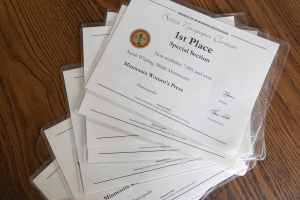 For 2025 coverage, Minnesota Women’s Press earned a community leadership award, three photography awards, and four editorial awards, including for coverage of social issues and for our Spring 2025 “Know Your Rights” special section supported by Unidos MN. Our publisher was named Journalist of the Year by Violence Free Minnesota for gender-based violence coverage.
