


BOOK: An Ojibwe Home in the City
Minnesota Women's Press arts coverage is supported by the Minneapolis Institute of Art, offering inspiration, family fun, date nights, and galleries to unwind and relax. Everyone is welcome.
“What does it mean to be part of an urban Native community?” Sasha Maria Suarez wonders. It’s a question her book, An Ojibwe Home in the City: White Earth Women and Community Organizing, clarifies and redirects. “What if the home was always the place that Native women were organizing?” Suarez asks.
Suarez is a direct descendent of the White Earth Nation and an assistant professor of history and American Indian and Indigenous studies at the University of Wisconsin–Madison. Her research and writing have roots inspired by education. Re-examining and rejecting narratives, Suarez was guided by her education in the Minneapolis Public School System to a deep exploration of Ojibwe history and tradition in the Twin Cities.
An Ojibwe Home in the City centers the stories of Native women often lost not only to Minnesota history but to Native history as well. “I wanted to root my project in words of the community itself,” Suarez says.
The historical archive often has obscured the voices of the White Earth Ojibwe people in Minneapolis, especially women, who “were vocal about what they wanted: self-determination.”
The American Indian Center in Minneapolis was established thanks to the efforts of White Earth women. Suarez began a quest to uncover their contributions and their history, which led her to a guiding touchstone in her book: the home as a place where Ojibwe culture persists and thrives.



Centering the Home
“Settler-knowledge” — which refers to the system of truth created and perpetuated by colonizing societies — has perpetuated the devaluation of home life, ignoring its role as the “root of public wellness” for Ojibwe people. “Home is the center of all organizing,” Suarez says. “Without the home, I don’t know what urban Ojibwe history would look like.”
The home she refers to is not only a private familial place but a public one — an autonomous space for Anishinaabe culture in the Twin Cities. “Ojibwe women are the ones that hold it all together,” she says.
Sewing clubs are one vital chapter in White Earth community organizing. For example, the Sah-Kah-Tay Sewing Club in Minneapolis was founded during the Great Depression era as a space for Ojibwe women to gather and connect with tradition.
The Meriam Report of 1928 was a government study that struggled to understand how — despite migration away from reservations — the Ojibwe community in Minneapolis in particular continued to have a strong identity. Suarez says the report noted: “They seem assimilated by all accounts. They have fairly nice houses. They have modern appliances. They have, in some cases, cars. They go to the movies.”
Federal researchers did not understand, however, how such mundane details of urban living did not also equate to a rejection of Ojibwe culture. In fact, Suarez says, “The Minneapolis Native community was doing political and social organizing out of family homes.”
The founding of the Division of Indian Work and the Minneapolis American Indian Center in Minneapolis is thanks to the efforts of White Earth women. Suarez credits White Earth leaders such as Emily Peake, Ignatia Broker, and Winnie Jourdain as three of the women who pursued the center as “an embodiment of [survival] in urban space.”
Suarez hopes her book will impart lasting lessons about reframing history. “I hope that people talk about the women I write about. I hope they become a regular part of the conversation about the history, not just of Minneapolis, but of Ojibwe history — of wider history, of native history,” she says. “The work they did was transformative and important.”
She also hopes the book reaches people “who just need the reminder that they are Ojibwe ‘enough,’ no matter where they are. … We come from a people who have always understood how to take our community and our home with us,” Suarez says. “For me, that is the biggest lesson I’ve learned from these women. You can always find your way home if you know that.”
Book Excerpts
Among the Twin Cities Chippewa Council’s founding members were Fred and Louise Peake, who had moved from White Earth Reservation around 1914 with their first child, Natalie. By all accounts, the Peakes have typically been identified as part of the middle-class group of Minneapolis Indians described in the Meriam Report. … Their long-term participation in the founding and continuation of [the Council] directly refutes any assumption that they were happily assimilating into Minneapolis’ white community.
…
Support our unique story sharing

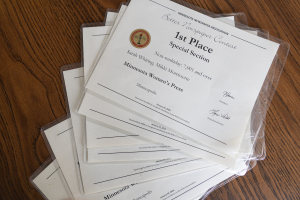 For 2025 coverage, Minnesota Women’s Press earned a community leadership award, three photography awards, and four editorial awards, including for coverage of social issues and for our Spring 2025 “Know Your Rights” special section supported by Unidos MN. Our publisher was named Journalist of the Year by Violence Free Minnesota for gender-based violence coverage.

