

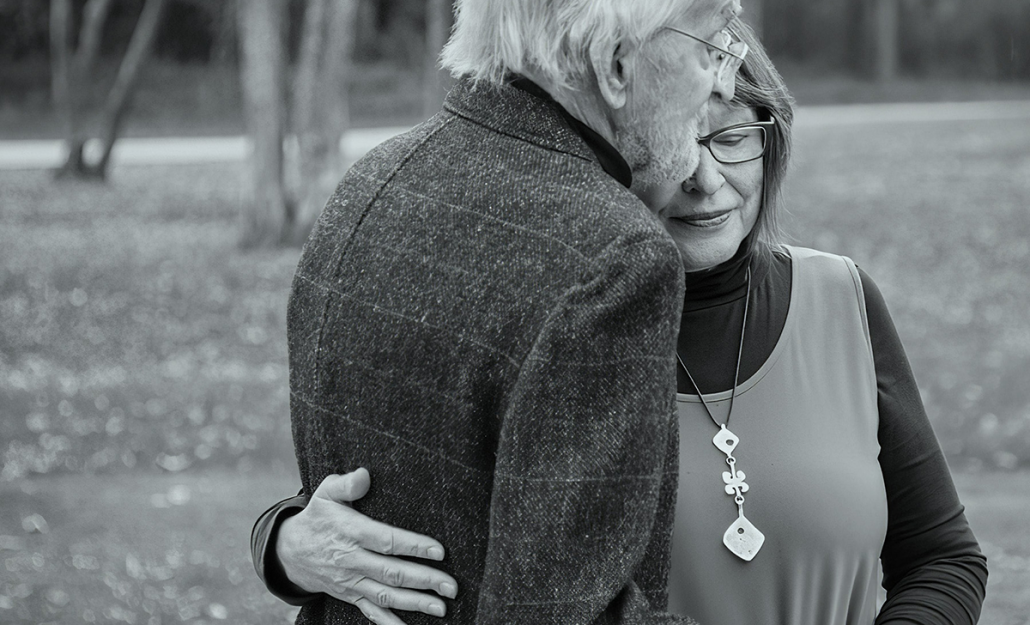
BOOK: A Memoir of Dementia
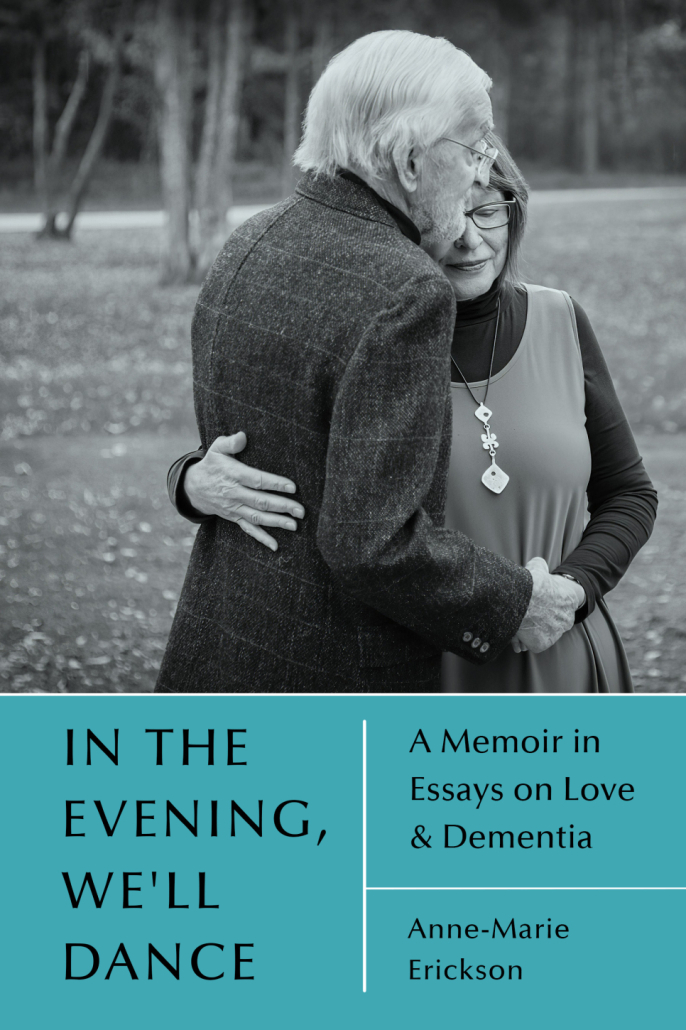
In the Evening, We’ll Dance: A Memoir in Essays on Love & Dementia by Anne-Marie Erickson, is published by Holy Cow! Press in Duluth. These excerpts were published by permission.
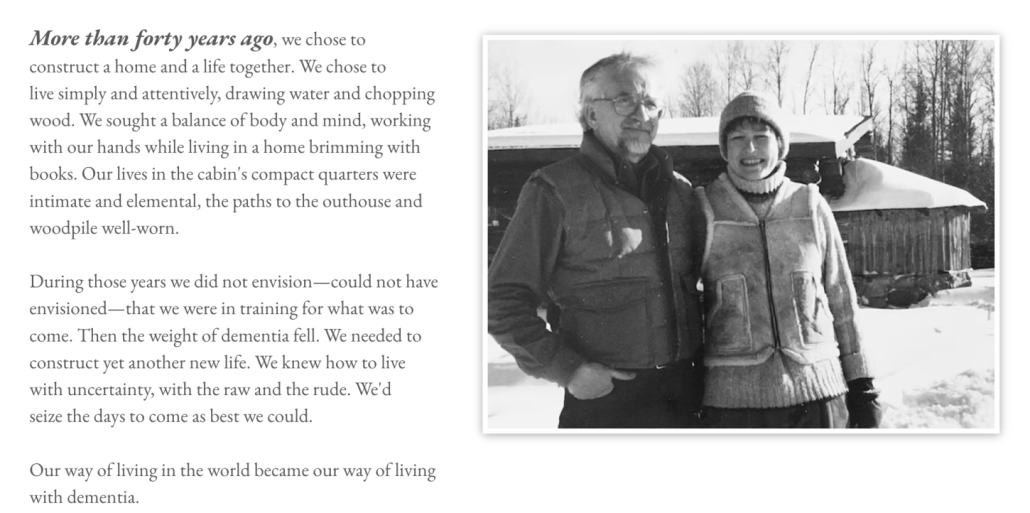
Dementia, that thief, moved into our lives in 1998. It picked the pockets of my husband’s mind: first, the front pockets that held his recent memories, then the back pockets, with the older memories. It stole the names of friends, then the names of his children, Jenny, Anna, and Joe. And, sometimes, my name: Who are you? Susan? Kate?
We struggled desperately against this thief. We wrestled with the confusion, fear, and anger that arose with each new loss. At times, we fought against one another. I documented it all — the lapses, the losses, the battles. I chronicled his medical appointments, late-night trips to the emergency room, the many hospitalizations. I made note of the drugs that failed, the few drugs that helped. I stowed it all: his agenda books, my letters and e-mail messages to family and friends, my jottings on scraps of paper and in commonplace books.
The essayist Maria Popova discusses ideas presented in Actual Minds, Possible Worlds by Jerome Bruner, a psychologist. She concludes that scientific pursuit is concerned with how to know truth, while the storyteller is concerned with the question of how to endow experience with meaning. Bruner explains that both are “ways of knowing.” Scientific analysis results in information, whereas stories produce meaning.
I needed both ways of knowing. I turned to science for information, hoping it would reveal truths about the cause of Dick’s dementia. And I turned to stories as a way of endowing our experience with meaning.



When Dick was seventy-four, he was evaluated at the Mayo Clinic in Rochester. The discharge summary described him as “pleasantly confused.” His thought process was “vague,” and the doctors discerned “limited judgment and insight.” His diagnosis: dementia, probable Alzheimer’s type.
I asked his physician if that meant he would wander about, a lost soul, like a few of the patients I’d seen. It was likely, yes. I asked if that meant someday he would no longer know my name, know who I am. Again, that was probable. I said I’d rather one of us would die before it would come to that. How could I become a stranger to the man I’d loved for decades?
So every night at bedtime, we’d kiss and then I’d say, “I love you, Dick Cain.” He’d smile and reply, “I love you, Anne-Marie Erickson.”
Even as he neared the end of his life, my name and voice would call him up from deep slumbers when aides were unable to. He’d lie motionless, eyelids closed tightly against any efforts to rouse him. I’d call his name; his lids would flutter, and he’d warily peek through his lashes. “Annie?”
I’d answer, “Yes, it’s me, Annie.” Then Dick would open his eyes and re-enter the world. At the end of the visit, I’d kiss him and say, “I love you, Dick Cain.”
Often, there was a pause. Then, “And I love you, Anne-Marie Erickson.”
How does it feel to have your name lost to a parent who named and nurtured you? Several years ago, when Jenny, Anna, and Joe were all in their early fifties, I asked them to choose a few adjectives to describe their dad prior to his dementia. He was, they said, witty, funny, smart, strong, able, handsome, caring, loving, understanding, and “passionate about life and the things that he believed in.” Just as I’d seen him.
As Dick lived through the late stages of dementia, he — and they — lost much of what made him the father he had been. Where was that able, strong man? They still loved him, but, as one of them said, “He does not feel like my dad.” A friend found that statement shocking. I didn’t. They felt a mixture of sadness, anger, impatience, and guilt. So did I. He was still funny at times, but they also described him as repetitive, tedious, scared — and scary. Sometimes, they said, they feared him, because he could be angry or unpredictable. He seemed distant. He was “not himself.” The picture they had of their father — and he of them — had grown distorted.
 The swamp-margin lies at the edge of the cemetery in George Saunders’ Lincoln in the Bardo. It’s the furthest margin in a marginal place called the bardo, where spirits linger between death and rebirth. The face of one denizen, Mr. Papers, has faded into an unrecognizable smudge. Mr. Papers calls out to passersby, “Cannery anyhelpmate? Come. To. Heap me? Cannery help? . . Place hepMay.”
I’ve heard such calls: my mother’s nursing home roommate, quietly pleading, “Help meee, help meee, help meee,” as she sank into forgetfulness. A man’s cries careening down the halls of the geriatric psychiatric ward, “Helpme!Helpme!Helpme!” They ripped through the quiet of my husband’s room, unsettling us.
I felt like I was crossing into the swamp-margin when I visited my husband in a memory care facility. I’d entered an “anteroom to another realm,” as the author Rebecca Mead puts it. The residents often were inarticulate and adrift, like Mr. Papers. They were not fully there, but not yet elsewhere. They lingered in the anteroom.
Waiting rooms are the anterooms with which we are most familiar. Recall the hours spent in hospital waiting rooms, slumped in chairs. Time’s pace slackens, the room grows close with thick air, sultry, like a claggy day in England. Another type of anteroom is the narthex, a space near the entrance of early churches. The narthex separated penitents from the congregation. Such a space also might be described as threshold or liminal. Liminal places are transitional and therefore ambiguous. We can lose our bearings and grow disoriented in these unmapped no-man’s lands.
Historically, a “no-man’s land” divided countries before there were borders. To be in a no-man’s land was to be neither in Spain nor in France. Neither here nor there.
Nursing homes and memory care units are neither here nor there: they’re in a community, yet marginal to it. The residents often are socially isolated, compatriots in an involuntary outsiderhood.
Dick and I understood outsiderhood. When we built our log cabin, we chose to live outside of the mainstream. For almost thirty years, we hauled water and heated with a small wood stove. We worked within the community while remaining at the social margins. When his dementia became more noticeable, we continued to be both a part of and apart from.
Beyond love and language, music sustained us. The Latin root of sustain means to hold up. To sustain is to bear a weight without breaking, falling, or sinking. To sustain also refers to sustenance, the nourishment of spirit, life, and health. While we bore the load of Dick’s dementia, music sustained us, enlivening our minds and feeding our souls.
In music, a sustain is a steady state of sound. When I practiced the piano as a child, I loved to use the sustain pedal, even when the score didn’t call for it. The sound seemed to envelop me. The pedal prolonged the vibration of the strings after I let up on the keys. It also prolonged the waning of the sound as it faded into silence.
The part of the brain that responds to music is the last to atrophy and succumb to dementia. Even when the dementia is advanced, music still has a therapeutic role, since “musical perception, musical sensibility, musical emotion, and musical memory can survive long after other forms of memory have disappeared,” according to the neurologist Oliver Sacks.
Through music, people with dementia seem to temporarily transcend the disease. “There are many levels at which music can call to people, enter them, alter them,” asserts Sacks. Music can calm, focus, anchor, and engage persons who have dementia. I witnessed those effects in Dick and others.
In July of 2015, four months before he died of complications related to dementia, my husband said to me, “The two of us have been asked to say something wonderful.” It seemed important, so I wrote it down.
Find a discussion guide for her book, as well as resources, at anne-marie-erickson-books.com/resources
To support our unique coverage:

Following are statewide readings scheduled:
Saturday, August 30, 2025
Noon-2:00 pm
Meet-&-Greet
Beagle and Wolf Books & Bindery
Park Rapids, MN
Thursday, September 4, 2025
7 – 8:30 pm
Launch Party
MacRostie Art Center
Grand Rapids, MN
Thursday, September 25, 2025
7- 8:30 pm
Reading & Discussion
Zenith Bookstore
Duluth, MN
Wednesday, October 1, 2025
7- 8:30 pm
Reading & Discussion
Magers & Quinn Booksellers
Minneapolis, MN
Saturday, November 8, 2025
1-3:00 pm
Meet & Greet / Book Signing
Twin Cities Book Festival
Union Depot, St. Paul


 For 2025 coverage, Minnesota Women’s Press earned a community leadership award, three photography awards, and four editorial awards, including for coverage of social issues and for our Spring 2025 “Know Your Rights” special section supported by Unidos MN. Our publisher was named Journalist of the Year by Violence Free Minnesota for gender-based violence coverage.
