


Belts, Battles, and Balance: How Karate Shaped Who I Am Today
Eve Wandering (center) practices at Shotokan Karate in Northeast Minneapolis. Photo Sarah Whiting
At five years old, I was full of energy and curiosity. The dojo — our training ground for martial arts — smelled of sweat and fresh mats. My tiny fists clenched as I mimicked the instructor’s movements, more wobble than warrior. The sharp kiai of older students startled me, but it also sparked something inside — a desire to be part of that world of precision and power.
By the time I earned my green belt at 13, I had learned to steady my stance, channel my energy, and push through tough training sessions. Then Covid hit, and the mats I had grown so familiar with vanished, replaced by the creak of my living-room floorboards. My sparring partners were now chairs and coffee tables, their constant presence making every block and strike feel awkward. On the screen in front of me, a patchwork of students kicked and punched in bedrooms and basements. Without the physical presence of my instructors or peers, I felt detached and discouraged. Eventually, I stopped going to karate altogether.
For a couple of years, I avoided the dojo, convinced I had outgrown it. When I was almost 16, I realized that discipline shouldn’t depend on location; it’s a mindset. I needed to retie my belt and try again.
Returning to the dojo was like stepping into sunlight after a long storm. The air hummed with energy, and the communal rhythm of drills reminded me of why I fell in love with karate. Though it took some time to get back into my flow, muscle memory guided me. With determination and grit, I worked my way from green all the way to brown belt, and stopped being just another student. I began teaching in some of the summer camps I used to attend, passing on the lessons I’d learned to the next generation. When I guided them through their first kata or helped them correct their stances, I saw myself in them. Teaching these kids was like revisiting my own early steps in karate. It was during the camps that I got to know Jethro, who is now my boyfriend, and a wonderful sparring partner.



Competition days are always a blur. The echo of cheers and the steady cadence of judges’ commands create a sense of controlled chaos. I remember only the feelings evoked at my first tournament: the knot of nerves before stepping into the ring, the laser focus as I bowed to my opponent, the exhilaration of giving everything I had. Every match since has been a lesson in resilience and grace.
The thrill of competition reminds me why I love karate: it’s not about winning, but about challenging myself and learning from every experience.
Karate isn’t just a sport to me. It’s the hours spent perfecting a single movement, the shared laughter, and the connection forged through training. It’s in everything I continue to learn as a teacher and student. Karate shapes who I am. It’s a journey I’ll carry with me for the rest of my life.

Eve Wandering as a white belt. Her brother Tyler (l) practices with her. Photo Sarah Whiting
If you appreciate our stories:
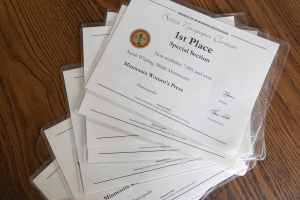 For 2025 coverage, Minnesota Women’s Press earned a community leadership award, three photography awards, and four editorial awards, including for coverage of social issues and for our Spring 2025 “Know Your Rights” special section supported by Unidos MN. Our publisher was named Journalist of the Year by Violence Free Minnesota for gender-based violence coverage.
