


Barriers and Preventative Action: A Conversation on Domestic Violence in Rochester
Thanks to Press Forward Minnesota and Lenfest Institute of Journalism for a grant that enabled us to visit Greater Minnesota cities for story conversations like this one.
Minnesota Women’s Press co-hosted an October conversation in Rochester with representatives from the Rochester Women’s Shelter and Support Center, which serves a ten-county area in southeastern Minnesota. The conversation was facilitated by shelter director Kara Hoel-Kleese. It featured unique perspectives from Women’s Shelter advocates, survivors of domestic violence, and community housing navigators. Barriers in the housing and law enforcement sectors were discussed, as well as actionable steps toward breaking those barriers.
Thank you to Press Forward Minnesota and Lenfest Institute for Journalism, which supported our ability to host statewide conversations in 2025.

Kara Hoel-Kleese, from an earlier story we did about Rochester and domestic violence. Photo Sarah Whiting
Barriers & Challenges: Housing After Shelter
The conversation began by discussing ongoing barriers to survivors fleeing from abuse, with director Hoel-Kleese pointing out that access to stable housing after a survivor’s shelter stay continues to be a staggering challenge. Shelter stays are disruptive to a person’s life — at times uprooting family — so the transition from shelter to housing should be a sigh of relief. The problem? Landlords.
Kristin Haas, the Shelter’s Outreach Advocate, pointed out that the issue of securing safe housing is exacerbated by a lack of understanding landlords, who are not willing to see past a survivor’s life on paper.
“Finding landlords [who] are willing to either accept the housing program the client has, or work with their limited work history or their criminal record — I really wish that was a requirement,” Haas said. She said vouchers should also be a non-negotiable requirement.
Princess Madison, a survivor, has found this lack of education among landlords deeply frustrating. “When you’re applying for apartments, let’s say you have utilized the WIA (Walk-In Access), and when you’re trying to explain your situation to them, people really don’t understand, or they have their own bias[es] about what domestic violence is. You can only educate a person so much as to what they’re willing to listen to.”
Survivors are often deemed “domestic violence risks,” and therefore have a harder time finding stable housing with landlords willing to work with them. Renting in Rochester is already both strict and expensive. Shelter Coordinator Heather Ringuette said that, “Buying a house and paying a mortgage is cheaper than renting. But there are a lot of people who don’t have the credit or ability to buy a house.”



An abuser’s influence is widespread, ranging from the physical, emotional abuse a survivor can endure to financial abuse — ruining the survivor’s credit score or their chances of employment — which creates more obstacles to a survivor seeking stable housing.
Ringuette explained that if someone is still living with an abusive partner, they are not considered homeless; as a result, many programs cannot authorize a coordinated entry into shelter. “So you have a person that’s sitting there trying to figure out how to work and how to support her family and her kids if she does leave. This often makes a person stay.”
Many landlords require the survivor to share personal information about their situation, which can be complex and invasive. Said Madison, “I have had to show my Order For Protection (OFP), [and] I’ve had to write a letter in full detail explaining what’s going on and why I want to live in this apartment complex. It’s excessive, and you shouldn’t have to experience that.”
Another survivor agreed, sharing that her experience fleeing a rental property resulted in an eviction on her record. “I’ve just created another barrier for myself,” they said, “A lot of these landlords want you to tell them what happened. Why do I have to tell you that? I’m just looking for housing. I have a job, and I also have these kids that I’m raising. I just need to be able to get in. I shouldn’t have to share my personal story with you.”
A community housing social worker explained various ways Rochester leases are strict. One big one is that landlords and other housing providers cannot accept partial payments. “If a family, depending on when their benefits come in, can’t make that rent payment on the first [of the month], they can pay $200 because that’s what they have — [but landlords require] full payment. Then they get a late fee, so that adds,” the participant explained.
Rochester renters are also responsible for their guests’ actions. If an individual “breaks the telephone entrance box trying to get in, as the tenant, you’re responsible for a $6,000 charge to replace the telephone box. You need to pay that $6,000 before you pay rent, because they can’t accept a partial payment.”
Connie Cohen, a homeless education navigator with the Rochester Public School system, expressed her wish for more education for landlords. Similar to Madison, Cohen has experienced the disconnect that landlords have from domestic violence situations, and encouraged having a seminar for landlords — because “they’re actually causing more [barriers].”
One survivor advocated for more awareness to prevent abusive behavior from landlords themselves. “The landlord can turn into an abuser. They can abuse you emotionally and financially.”
Ringuette recalled instances where landlords informed an abuser about a survivor’s intention to leave. “If [the survivor] come to us and ask us to help them with a break-the-lease letter so that they can leave, and then the landlord tells the abuser that information because they’re on the lease as well, that causes more issues.”
How Law Enforcement Can Improve Its Response
Rochester law enforcement has partnered with social workers to respond to calls related to mental health or substance abuse, called co-response. This method frees up officers’ time and allows for proper handling of the situation by qualified mental health experts.
When it comes to domestic violence response, however, community members agree law enforcement can do better. “I know law enforcement has education that they go through,” said Madison, “but [they’re] a huge part of the problem when responding to violations of OFPs and things like that. When you’re calling it in and reporting [it], sometimes you don’t even get an officer. Sometimes they don’t show up at all.”
In Minneapolis, women who fight back against their abuser fall under a category of response known as “resistive violence,” which is distinctly different from the coercive control that abusers employ. Officers are trained to identify this, but is not regularly taken into account in Rochester, according to the women at the conversation Minnesota Women’s Press hosted.
“I’ve seen some women get arrested after they start fighting back,” said Ringuette, adding that sometimes the abuser does not face consequences. Officers are not always able to understand the full scope and history of a violent situation. When a past charge is labeled as “disorderly conduct,” for example, there is no history of domestic violence on paper, which challenges a survivor’s credibility.
Mariam Mohamed, Intercultural Mutual Assistance Association’s Victim Service Coordinator in Rochester, talked about experiencing law enforcement from an immigrant perspective. “When you’re dealing with police officers or landlords and you’re trying to tell your story, a lot of people resonate with the person they can understand the most. It [increases] that barrier, because you haven’t been in this country [long]. You don’t know the resources or the system.”
Sometimes, she added, when an officer shows up, “the abuser can be the charming one” who gaslights the officer into believing the survivor escalated the situation.”
Ongoing Solutions and Programs that Help
Although there are many barriers, there are also changes and improvements being made in Rochester.
Ringuette said that shelter advocates recently attended a training with approximately 500 police officers, where officers expressed what they need to work on to better respond to domestic violence situations.
Haas expressed her satisfaction with the shelter’s increased communication with the police department. “I think everyone’s benefited from it,” said Haas, adding that some officers have come to a Halloween party to go trick or treating with families. “I think every good experience they can have with those officers [is important]. The ones that come to our shelter are absolutely fantastic.”
One solution suggested was to have housing navigators in Rochester develop more partnerships with certain motels, which can reserve specific floors for people in crisis to stay in. However, Rochester has a rule that a person booking a room cannot have a local address — to discourage parties — which is another hurdle getting temporary housing if the shelter is full.
Rochester Public Schools offer resources for unhoused families, with systemic methods of discreetly identifying a family in crisis. Staff have a special alert system code for the computer system to indicate when a family is experiencing homelessness or domestic violence. “We have pop-ups in our system that tells us [a parent] can’t be on the premises, or if there’s an OFP,” said Cohen.
A community housing social worker indicated that special events for unhoused families enable organizations — like the domestic violence team — to offer information and answer questions.
The district also enables students to enroll regardless of whether all documentation is in, which is helpful in cases where a child is fleeing a violent home environment with their parent.
Hoel-Kleese, Haas, and Ringuette were pleased to share at the discussion that they are moving to a larger facility, which will enable them to increase capacity to help those in need.
Cohen put it succinctly: “It takes a community. It’s not a one person problem. It’s all of our problem. If we live in this community, we have to be willing to help.”
Minnesota Women’s Press did not get a hoped-for 2026 grant to deepen its coverage of gender-based violence and action steps. We need your support to continue this reporting and story sharing.
Related Stories


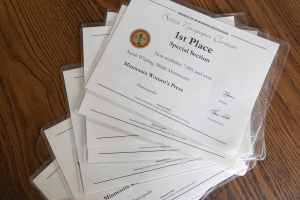 For 2025 coverage, Minnesota Women’s Press earned a community leadership award, three photography awards, and four editorial awards, including for coverage of social issues and for our Spring 2025 “Know Your Rights” special section supported by Unidos MN. Our publisher was named Journalist of the Year by Violence Free Minnesota for gender-based violence coverage.
