


Allison Lussier’s Death: Minneapolis City Council Hears Long-Standing Criticism of Police Response to Domestic Violence

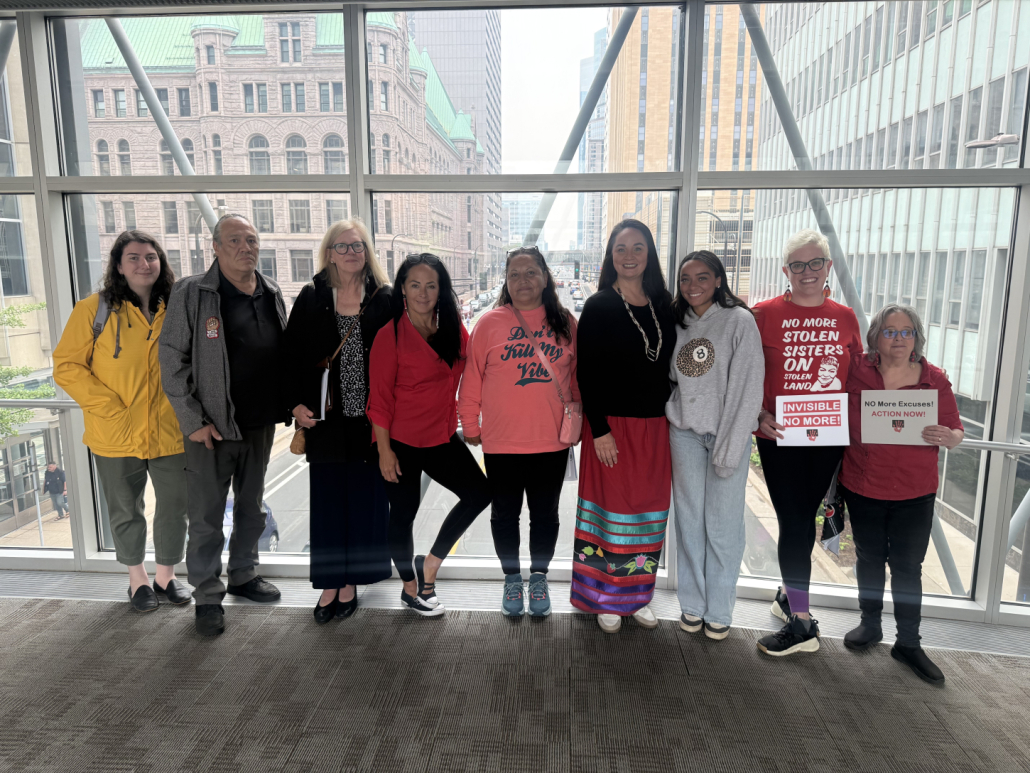
Some of the support group at the Allison Lussier testimony presented to the Minneapolis City Council: (l-r) Olivia Reed, Mike Forcia, Cheryl Thomas (who testified on behalf of Global Rights for Women), Jana Williams, Lissa Yellow Bird-Chase, Nicole Matthew (who testified on behalf of Minnesota Indian Women’s Sexual Assault Coalition), Kiora Matthews, Janelle Ryland, and Stacey Gurian Sherman. Courtesy photo.
June 10, 2025 – On Tuesday June 3, the Minneapolis City Council heard presentations by community leaders and the city’s Domestic Violence Working Group. This follows the council’s decision in February to request an independent after-action review investigating the Minneapolis Police Department’s (MPD) handling of Allison Lussier’s death in February 2024.
“Allison Lussier should be here today,” said vice chair of the council Aurin Chowdury. “It’s devastating that there were so many points [for police] intervention that could have prevented the loss of her life. We failed [her].”
“Where was the urgency?”
Lussier’s death was originally determined to be a drug overdose by police. The Hennepin County Medical Examiner eventually ruled that Lussier had suffered a subdural hematoma — a blood buildup between the brain and the skull. Her family believes that Lussier was murdered by her longtime abuser, Chuck Foss, and claim that the MPD failed to take known threats to her life seriously.
Present in the audience were members of Lussier’s family and of the community, who pleaded with the city council and the MPD for justice. Signs in the crowd read: “No More Silence, No More Victims.”
Cheryl Thomas, executive director of Global Rights for Women, gave the first of three presentations about the public safety problem caused by inadequacies of MPD procedure when dealing with cases of domestic violence.
Thomas has worked with Lussier’s family in the aftermath of her death. She said that despite every sign of domestic violence, police neglected to take Lussier’s complaints seriously. On multiple occasions Lussier had called the police indicating that her abuser was going to kill her. There were signs that her abuser was a high-risk offender, yet he was not held accountable.
In 34 years of advocating for legal reform for domestic violence, Thomas stated that she has “rarely seen a more dangerous abuser than Chuck Foss.” Thomas wondered, “Where was the urgency to save [Allison Lussier’s] life?”
Minneapolis has a “dangerous record of failing to address gender-based violence,” Thomas pointed out, and frustration about Lussier’s case is not new to the city. “Felony domestic violence cases from the MPD are second in number only to drug cases in the percentage of the entire caseload,” Thomas reported. But domestic violence, she indicated, is often disregarded because “it disproportionately affects those who are marginalized,” such as indigenous women, women of color, and immigrant women, leading to “systemic negligence due to racial and gender bias.”
In June 2023, Global Rights for Women published an institutional analysis of the MPD’s response to domestic violence, developed in response to a request in 2017 from the Minneapolis Police Conduct Oversight Commission. This report was intended to be a roadmap for police reform, Thomas explained. She reiterated the analysis for the council, identifying the report’s findings as “gaps” between survivor safety and police response, including detailed recommendations for change.
One important gap that Thomas brought up is laggard police response if abusers have fled the scene before they arrive. According to the report, “officers and follow-up investigators often [do] not attempt to locate [abusers] at all, leaving victims in a more dangerous position, [and] more vulnerable to future violence.” Knowing that police will not attempt to track them down, Thomas stressed, abusers “are empowered.”
This system breakdown impacted Lussier. On one occasion prior to her death, police were with Lussier and her abuser — after multiple complaints about his conduct and applications for orders for protection — but police allowed him to leave the scene without detention or arrest.
As an indigenous woman, Lussier suffered the “systemic failures” of a police department and city that has a history of racial bias, noted Nicole Matthews, executive director of the Minnesota Indian Women’s Sexual Assault Coalition.
During her presentation, Matthews noted that indigenous women make up about 1 percent of the population in Minnesota, but represent over 8 percent of murdered women in the state. “There is a systemic cycle of dismissing indigenous women, Matthews believes — a “cycle of not responding to us, of not getting justice for our families and our communities.”
Matthews hears from families of murdered indigenous women that their deaths were classified as overdoses or suicides, even though their families reported that there had been threats to their lives.
It is “always the families that [are] pushing and pushing and pushing [for justice] — as we have seen with Allison’s case; pushing and pushing and demanding that something happens.”
“We need leadership”
The Domestic Violence Working Group, led in part by Amirinthi Keefe, executive director of the Domestic Abuse Project, is building collaborative efforts to “better understand how the system works as a whole, so that we can effectively work with victim survivors.”
Keefe and Deputy Chief of Investigation for the MPD, Emily Olson, said the group’s goals include collective “culture change” in order to implement recommendations outlined in the report coordinated by Global Rights for Women and funded by Minneapolis Foundation.
Also involved in the working group are the Hennepin County Attorney’s Office, the Minneapolis City Attorney’s Office, the Hennepin County Department of Community Corrections and Rehabilitation, the Domestic Abuse Service Center, the Minneapolis Police Department, the Minneapolis Navigator Program, and the community organizations of Cornerstone, Tubman and the Domestic Abuse Project.
Olson announced that a three-month pilot program targeting the MPD’s risk assessment in domestic violence cases would start in July, aiming to “objectively identify high-risk offenders.”
The intent is to streamline police response to domestic violence cases that have a high-risk component, such as strangulation attempts. This will involve looking at the cases of domestic violence histories, including 911 calls and escalation of violence “to determine what type of response would be most effective to shift the trajectory of the case for high-risk [situations].”
Olson indicated that a goal is to make sure officers are asking the right questions and connecting survivors “to safety services and resources in a more seamless and timely way.”
Distrust in the police, especially in responding to cases of domestic violence, prevents many women from seeking justice, which will take time to adjust, said Keefe.
Council members asked if three months was enough for the pilot program to set reform in motion. Keefe indicated the time frame was designed to allow the working group to adjust in short-term intervals.
Thomas said in her concluding comments that a report almost identical to the one recently published by Global Rights for Women was written 30 years ago by the Battered Women’s Justice Project about the police response to domestic violence in Minneapolis.
“We need leadership. We need accountability. I hope you will demand it of your leaders, the mayor, the chief of police, the county attorney, the city attorney — please,” Thomas said.
Related Stories


 For 2025 coverage, Minnesota Women’s Press earned a community leadership award, three photography awards, and four editorial awards, including for coverage of social issues and for our Spring 2025 “Know Your Rights” special section supported by Unidos MN. Our publisher was named Journalist of the Year by Violence Free Minnesota for gender-based violence coverage.
