


Alice Moren: Taking the Big View in Grand Rapids


Alice Moren in Grand Rapids. Photo Sarah Whiting
As a lifetime resident of Grand Rapids — a northeast Minnesota town of just over 11,000 people in Itasca County — Alice Moren has learned how to help her neighbors have civil dialogue. Over the past dozen years, she has helped organize and moderate conversations about religion, LGBTQ+ issues, race, bullying, drugs, and more. In 2004, her role started with hosting the Circle of Support program, which focused on not only giving low-income residents a supportive place to talk about their concerns, but also helping others understand why poverty exists.
As Moren explains, some people wonder, “Why don’t people just get out of poverty? If you don’t like your circumstance, move, do something, change it. ‘Get a job’ is the famous simple answer.” The program “highlighted the need for the community to have a better understanding around the systemic nature of poverty. It is so easy to just stop at ‘it’s their own fault’ thinking.”
Moren wants people to understand the interlocking pieces.
“Even understanding the history behind Columbus Day. Why does it matter that today we also celebrate Indigenous Peoples’ Day and Juneteenth? How does that help some of our community members feel seen?” she says. “Many of us didn’t learn about these things in the K–12 education system [or learn] how historical trauma has an impact. Addiction, suicide rates, health outcomes, stress, economic mobility, student success. It is all interconnected. People just want to blame people, without realizing that there are so many other things going on that cause poverty.”



Roughly once a month, Moren moderates local Big View conversations as part of her role with the KOOTASCA Community Action program (representing Koochiching and Itasca counties). She has a bachelor’s degree in social work and a master’s degree in counseling and psychotherapy, which helps her steer conversations in a manner that is safe for participants.
“I’m framing the conversation, and then facilitating the audience discussion that follows,” she explains. “Most of the time it is productive. About ten percent of the topics require keeping things calm — validating someone’s concern even when they are angry. We’ve had some tense moments. I try to do caretaking so no one is being harmed or disrespected.”
Some of the stressful discussions have been related to LGBTQ+ rights, and a workshop about white supremacy, which some neighbors believed was a made-up concept. “I didn’t walk into this knowing how to tame an angry audience,” Moren says. “That has come with practice over time.”
When the 110-member Twin City Gay Men’s Chorus sang at a local venue, it involved more than six months of planning with partners, partly to anticipate responses and security needs. In the end, the event was peaceful. Subsequent events — including a program focused on the science behind transgender identities — did spark controversy.
The Frustrations of Funding
One frustration, Moren notes, is that funding often requires proving impact with data. Donors want to know, for example, how many people have left poverty because of the programming. She knows that the impact is more about making improvements in people’s lives, which generally doesn’t happen in a measurable way. Depression, anxiety, coping with trauma, lack of trust, and other precursors are not reduced simply by becoming aware of them. “I think individual growth comes from feeling heard,” Moren says.
Many institutions, she adds, use the discussions as training for employees who need to understand clients and the intertwined nature of hunger, housing, transportation, and available low-wage employment.
Recognizing the importance of social assets — having people to connect with as a way to reduce suicide rates, for example — is not easy to measure but can have enormous long-term impact. The pushback tends to be: “So you want to help poor people make friends? I want to see something that gives big numbers faster.”
Conversation Topics
In the future, Moren would like to host a conversation about food insecurity. “We see senior citizens who worked their whole lives but didn’t have a pension — the food support they might get does not last a month. I try to help the community understand all faces of poverty.”
Moren does not position herself as an expert on the topics, other than discussions about poverty. Generally she brings people in as guest speakers. In one year, topics included “Selma: The Bridge to the Ballot,” “The Indian Mascot: 21 Years Later,” “Homelessness in Itasca County,” and “Youth Sexual Exploitation: It’s Happening Here.”
A discussion about addictions proved so popular that it led to a series exploring the life of an opiate addict, the concept of harm reduction, youth addiction, and the question “disease or choice?” Speakers came from the medical profession, emergency responders, treatment centers, and people in recovery.
With the long-time popularity of Big View, people often suggest topics and speakers to her. Sometimes that involves showing and discussing controversial films they do not want to host themselves, like The Doctrine of Discovery, about the dehumanizing history of indigenous people through white domination, and 1946, about how one word in a mistranslated Bible largely led to the anti-gay movement.
When a documentary about bullying in schools was shown, led by a gay man, Moren had to negotiate with its long-term venue at a church. “Those two things collided in a way that helped me understand we need more conversations around the oppression experienced” in the LGBTQ+ community.
Moren is proud of past discussions about racism in the history of the Iron Range, including the presence of the Ku Klux Klan in Grand Rapids. One topic she has not yet felt ready to address includes how police handle people in a mental health crisis.
“I hope that when people leave Big View conversations,” Moren says, “they go away with something they didn’t know before, or a willingness to think about things in another way. When you are opposed, yet sitting in a room with someone who is explaining their experiences, sometimes it can be shocking because we view some of these issues as happening elsewhere, not here. I think you have to change people’s hearts before you’re going to be able to change their minds.”
 Alice Moren wants readers to commit to correcting false narratives. Attitudinal barriers create divisions that promote shame, intolerance, racism, and homophobia. For example, she says, “Help family, friends, and neighbors broaden their understanding of why poverty exists by modeling civil conversations despite opposing viewpoints.” Learn more: kootasca.org
From Grand Rapids: Local Media Talk About Political Leadership, Housing, LGBTQ+ Acceptance, and More
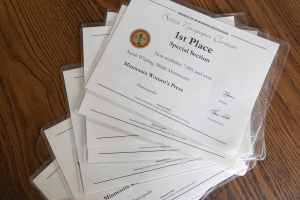 For 2025 coverage, Minnesota Women’s Press earned a community leadership award, three photography awards, and four editorial awards, including for coverage of social issues and for our Spring 2025 “Know Your Rights” special section supported by Unidos MN. Our publisher was named Journalist of the Year by Violence Free Minnesota for gender-based violence coverage.
