


NEW COLUMN: Aging on the Run, by Anne Winkler-Morey

I read Tom Wolfe’s You Can’t Go Home Again in the fall of 1975, at Oberlin College, before I dropped out. In the autobiographical novel, a young white man from Asheville moves to New York City and then returns to the South, where he feels he no longer belongs. Despite Wolfe’s protestations, he and his fictional self still clung to the racist ideas he grew up with.
As a young person who left Wisconsin and spent formative years in North Carolina and the Northeast, the book agitated me. I remember debating Wolfe’s relevance in college, asking why we didn’t instead read Toni Morrison’s The Bluest Eye, which takes place in Loraine, Ohio, eleven miles from Oberlin. I got a B-minus in that class.
It was the title of Wolfe’s book that was on my mind when, after a year away, I returned to Minnesota for a visit in October. I wondered if I had the right to call it a homecoming. Many would not consider me a Minnesotan. I wasn’t born there, and I have no ancestors there. In 1976, at age 17, I ran away to the Twin Cities with dreams of becoming a dancer. I found the love of my life in Minneapolis, and we raised a child there. Five decades passed. It is as close to a homeland as I have.



I have a bittersweet relationship with Minneapolis; joys, yes, but also attacks, rejections, resentments, and persistent blues. I often dreamt of leaving, but I’d persist because in the 1970s — when the Twin Cities was like a ground zero for Anonymous groups — I joined one. I was not a Twelve-Step success, but one of the program’s aphorisms stuck with me: There is no geographical cure. When I desired a break from what bogged me down in the Twin Cities, I would remember that mantra and try to hold on.
In 2011, however, I did get away for a year, cycling the perimeter of the U.S. with my spouse David — an experience that only increased my wanderlust. In 2023, after we had both retired, we sold our home and gave away our possessions, put what we could carry in backpacks, and began a life on the run.
 A year later, after living in 19 countries, we returned “home” for a visit. I was nervous. How would it feel to be in Minneapolis without a place to live that was ours? Would anyone want to see me? Would I wish I had never left? Would I want to stay?
I made sure we had reservations for the next six months of travel, as though the town itself would suck me back in if I didn’t have a planned exit.
The return was as emotional as I imagined, but in different ways. We saw one-third of the people we wanted to see, and did a quarter of what we planned to do. Much time was spent on health care. We attended the wedding of our nephew from a distance. Our child, Emily, came for the wedding and caught Covid. David and I never tested positive, but we curtailed our time with others in case we did.
I thought it would be tough to see the house we lived in for 30 years, but it wasn’t. I felt removed, like it belonged to someone else, which it does. What made me weepy was walking to old haunts: the creek, the holding pond, the grocery store, the café, sitting on a favorite park bench while watching a great blue heron walk on water.
We joined the parade that circles Bde Maka Ska at dusk. We also walked Lakes Phalen, Wildwood, White Bear, Como, Powderhorn, and Harriet. We crossed the Mississippi River and followed the path along Minnehaha Creek.
We traversed the Cities on foot. In the first days, we walked the boulevards of Bloomington, past signs supporting police as well as a fence with George Floyd’s name woven in. We stayed in our old neighborhood for ten days and did the South Minneapolis circuit: Butter Bakery Café, George Floyd Square, and the 37th Street cemetery, which honors Black souls killed by police in the U.S. We attended a small pro-Palestine protest in Powderhorn Park. We met beloved friends at cafés. We walked from South Minneapolis to downtown Saint Paul to meet with the Twin Cities Labor Chorus.
I felt no claim to our house of 30 years, but walking these familiar paths, I sensed indelible ownership. Where my foot falls is mine to remember and nobody can take that away from me — not even me.
Some things had changed. During our October visit, the lilacs were blooming! Deep purple, white, and lavender. Lilacs are a Minnesota sign of spring. Back in the day, before we had a house or a bush, David and I used to steal lilacs in springtime and put them on our table for each other’s May birthdays. Walking by our former home, I saw purple blossoms envelop the roof. Beautiful, yet an ominous sign of a climate in flux.
Some things were the same. There were still unhoused encampments in parks and parking lots. I found this social neglect newly shocking. In Paris, Dublin, and Lisbon, I did see people living outside in tents, but nowhere have I seen people without homes in such numbers as my Minneapolis, a city so rich in Fortune 500s and nonprofits.
I write this from Istanbul, where our host tells me that homelessness is nearly nonexistent in Turkey. I was skeptical at first. After two weeks here, I am starting to believe him.
In some ways, the more things have changed, the more they have returned to old patterns. A Jewish Israeli scholar of genocide, Raz Segal, was offered a job in the Center for Holocaust and Gender Studies at the University of Minnesota. The offer was rescinded after he analyzed genocide in Gaza.
This outrage reminded me of Michael McConnell. He and his husband were the first gay couple legally married in the U.S. In 1970, he came to the University of Minnesota to fulfill a job offer, only to have the university library rescind it because he was openly gay. Luckily for Minneapolis, he found work with the Hennepin County library system and settled in the city.
Had Professor Segal been able to stay in Minnesota, he would have found fertile ground for collaboration with progressive thinkers and doers in our community. That activism — despite disappointments — is why the Twin Cities will always be a home to me.
Anne Winkler-Morey is writing an online “Aging on the Run” column, thanks to underwriting support from Joan Gilles of Financial Planning Partners.
If you appreciate our unique coverage:
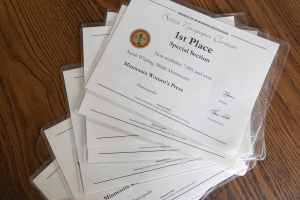 For 2025 coverage, Minnesota Women’s Press earned a community leadership award, three photography awards, and four editorial awards, including for coverage of social issues and for our Spring 2025 “Know Your Rights” special section supported by Unidos MN. Our publisher was named Journalist of the Year by Violence Free Minnesota for gender-based violence coverage.
