

AGING ON THE RUN: Against Forgetting


author Anne Winkler-Morey
In the fall of 2023 my spouse and I sold our house in Minnesota and began traveling the world. Instead of hitting all the tourist spots, we live without a car, in different country each month, trying to get a feel for everyday life in that location.
As we travel, I have been contemplating the way different countries process their traumatic histories and past transgressions.
In Portugal, I saw museums and local governments preparing to commemorate the 50th anniversary of the Carnation Revolution — the uprising that ended 36 years of military dictatorship — with parades and historical retrospectives that promised messages of “never again.”
In contrast, Spain seemed eager to erase their decades of fascism. The history museum in Madrid barely mentioned Francisco Franco. We were in Cadiz, Spain, on December 6, the official holiday commemorating the day in 1978 when a new constitution ended nearly a half-century of dictatorship under Franco. There was no parade. No speeches. It was a day off from work. Locals went to the beach.
Perhaps the difference between the two neighboring countries has to do with how their dictatorships ended. The Portuguese took their government back. In Spain, after Franco died, opposing parties signed the Pacto del Olivido, the Pact of Forgetting.



This past November, in Turkey, I met activists in Istanbul who are against forgetting. Many of them had spent five or ten years in jail following the 1980 military coup in Turkey that targeted left-wing radicals. They were collecting and publishing oral histories to make sure that their wounds speak. I told them about my Minneapolis Interview Project and we connected on the need for peoples’ histories that speak truth to power.
One of the people under surveillance in the 1980s was Hrant Dink, a Turkish-Armenian. In 2005 he was arrested repeatedly for “denigrating Turkishness” by asserting publicly that the Armenians suffered a genocide at the hands of Turks after World War One.
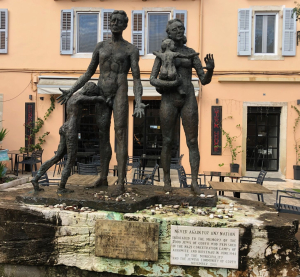
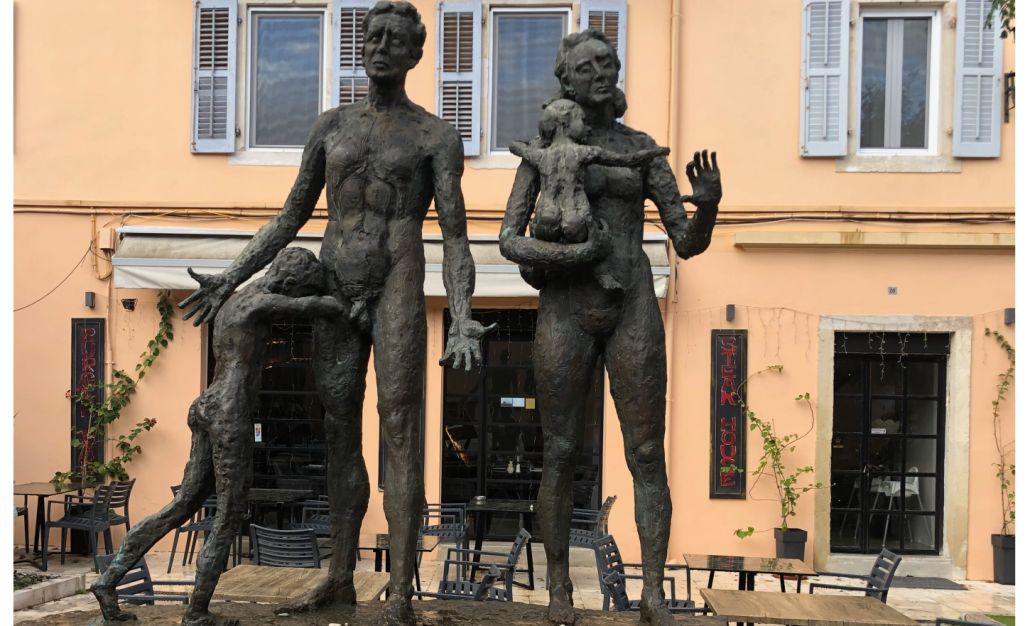
The author wrote this column in December 2024, while in Corfu, Greece, where this statue memorializes Jews of Corfu who perished in Nazi concentration camps. It is designed to remind visitors that “never again” means nothing if it does not pertain to every nation.
While Dink courageously defied Turkish law to assert the reality of historical crimes, he also argued that current discrimination should be the main focus of Armenian human rights work in Turkey. He was critical of European governments for refusing to grant Turkey EU membership because of genocide denial. He pointed out that European, Russian, and United States governments use the Armenian genocide and the struggle for Kurdish autonomy in Turkey for their own ends, with no honest concern for the human rights of either people. The hypocrisy so incensed him, that when France made it illegal to deny Armenian genocide, he planned to go to Paris to defy their law. He was assassinated in 2007, before he could do it.
Dink understood that the abuse of traumatic history takes many forms. There are the deniers, and there are those who will twist the story for their own purposes.
As a Jew, watching the weaponization of antisemitism today, I understand Dink’s frustration. When we were in Germany in June 2024, I saw police harassing a lawful Islamic wedding procession. My mind went immediately to stories my father told me about his Jewish childhood in Nazi Germany.
Unlike the Turkish government, the Germans do not deny the genocide they perpetrated against Jews. In fact they are global leaders in confronting their fascist era. But their treatment of Muslim immigrants shows the understanding of “never again” has not been universal or transferable.
Like my new activist friends in Istanbul, I am against forgetting. That is why I became an historian. It was the purpose of my Minneapolis Interview Project.
But, like Dink, I believe the present always comes first. For 15 months, I have seen my ancestors’ trauma twisted to justify the genocide of Palestinians. We must not allow political and economic elites to use past atrocities to divert attention from their current crimes, or encourage bigotries that keep us from building solidarity across borders.
This essay is part of Anne’s new “Aging on the Run” series for Minnesota Women’s Press, underwritten by Joan Gilles of Financial Planning Partners.
If you appreciate our unique coverage
 For 2025 coverage, Minnesota Women’s Press earned a community leadership award, three photography awards, and four editorial awards, including for coverage of social issues and for our Spring 2025 “Know Your Rights” special section supported by Unidos MN. Our publisher was named Journalist of the Year by Violence Free Minnesota for gender-based violence coverage.
