

A Tribute to Karen Clark
Coverage supported by the deep donations of long-time supporters Kristin Siegesmund and Becca Brackett.

Former Minnesota senator Patricia Torres Ray was one of the emcees for the memorial service honoring former representative Karen Clark
One of the most diverse memorial services I have attended was for long-time Minnesota legislator Karen Clark on September 18, which featured a cross-section of people engaged in justice, public health, environmental activism, and civil service. Clark was an above-and-beyond community advocate for much of her 80 years, including as a nurse practitioner and a state representative from 1981 to 2019. Clark was not only a light for LGBTQ+ and environmental issues over decades, but she proactively worked with diverse and young voices throughout her career as a politician and farmer.
Former Minnesota Senator Patricia Torres Ray — who officiated at Clark’s wedding 12 years ago to Jacquelyn Zita, her partner of 36 years — opened the memorial service sharing Clark’s motto that “whenever we are called to act, silence is never an option.” She indicated that Clark’s “unbreakable spirit” was hard to say no to, engaging in “good trouble” many of the hundreds of people who filled the Orchestra Hall auditorium that night.
Torres Ray shared Clark’s accomplishments in supporting undocumented immigrants, holding companies accountable for pollution especially in low-income communities, getting partial neighborhood ownership of the former Roof Depot space to support community needs, and the “unshakeable belief that we are all one family. No one is left to struggle alone.”



As a Legislator and Advocate
Clark was the first openly lesbian member to serve in the Minnesota Legislature, and the longest-serving openly lesbian member in a state legislature. She served parts of the Whittier, Phillips, Ventura Village, Seward, and Lyn-Lake neighborhoods of Minneapolis (now represented by Aisha Gomez).
Her work had statewide impact. Clark was instrumental in 1993 in amending the Minnesota Human Rights Act to ban discrimination against LGBTQ+ Minnesotans in employment, education, housing, and more. In 2013, after Minnesota voters rejected an anti-marriage equality constitutional amendment, she was the House chief author of successful legislation that made marriage equality legal in Minnesota for LGBTQ+ communities.
She successfully passed a workers-right-to-know bill regarding exposure to toxins in the workplace, and the Cumulative Health Impact Analysis, which provides a comprehensive look at all environmental, pollution, and health burdens that affect a neighborhood. She and Zita were co-founders of the Women’s Environmental Institute (WEI). Most recently, she was a strong advocate for the East Phillips Neighborhood Institute’s Roof Depot project, an urban farm project in south Minneapolis. [We wrote about it here, including a previous essay by Priscilla Trinh that included a tribute to Clark’s work.]

Snippets From the Memorial
 Music and dance include Brass Solidarity, Indigenous leader Sharon Day — who had a farm near Clark — and fellow singers Nicole Christian and Gio Cerese, the Hiddo Soor Somali Cultural Performance, and the Kalpulli Yaocenoxtli dancers. Attendees included U.S. Senators Amy Klobuchar and Tina Smith, Minnesota attorney general Keith Ellison, and many other civic servants and advocates.
Her sister Cynthia opened up remarks on behalf of Clark’s three younger siblings by pointing out that her big sister would not have known what to make of the event starting on time — which prompted laughs from a large crowd knowing Clark’s penchant for not moving to the beat of a clock.
Collie Graddick spoke of her collaboration in getting test results for soil samples from polluted lands to create environmental justice policy changes.

Minnesota Senator Scott Dibble (at podium above) spoke — surrounded by some members of the 15-person gay caucus now at the Minnesota legislature — to acknowledge Clark’s pivotal and pioneering work on behalf of the LGBTQ+ community. That work included empowering young people to step up to political work. He said he was a young street advocate when Clark tapped him to run one of her campaigns, seeing in him something he did not.
At one door-knocking conversation, Dibble said Clark reshaped his perceptions when he saw her engage so warmly with with an isolated man who had mental health issues. She responded to the man with such humanity and dignity, Dibble said, that it changed his own trajectory, reinforcing that “no one is disposable or beyond reach of our love. That was Karen.”
Dibble shared a lesson for everyone to take home that he learned from Clark: have conversations with young people about what you see in them, and help others develop their own power.
Abdirizak Bihi spoke about her support of new Somali refugees — who fled civil war and arrived to Minnesota in the 1990s —helping them find footing to build stable families and workplace settings. She was a friend to them, always making herself available, and encouraging them to not reinvent the wheel of self-advocacy, but to learn from Native, Latine, and Hmong communities.
Aileen Rosa Sanchez said Clark was a mother, mentor, and hero in the Latine community. She said Clark emphasized that their dreams mattered, that driver’s licenses for all and the Dream Act was attainable. Jovita Morales said Clark did not want to speak for them but nurtured their own leadership.
Zita shared the address of her first kiss with Clark decades ago and indicated how much she would miss her partner’s “joyful spirit.” She said Clark created the mission statement for their WEI farm: “The Women’s Environmental Institute works for environmental justice through agricultural, food, gender and racial justice strategies in urban and rural places.”
One theme during the service was how much Clark believed that everyone can plant seeds, literally and figuratively, setting the landscape for what is to come.
Donations are accepted to continue Clark’s environmental work at w-e-i.org

Priscilla Trinh (back center) of the East Phillips Neighborhood Institute shares some of the work Karen Clark was engaged with.
Support our unique grassroots story sharing

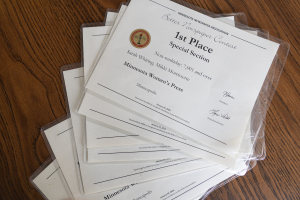 For 2025 coverage, Minnesota Women’s Press earned a community leadership award, three photography awards, and four editorial awards, including for coverage of social issues and for our Spring 2025 “Know Your Rights” special section supported by Unidos MN. Our publisher was named Journalist of the Year by Violence Free Minnesota for gender-based violence coverage.

