


A Story For These Times: Knowing Where the Ground Holds
Coverage supported by the deep donations of long-time supporters Kristin Siegesmund and Becca Brackett.

The writer’s grandmother, who taught her about footing on Minnesota land
If you grew up in Minnesota — really grew up here — you know there are places that look solid but aren’t.
Muskeg is one of them.
It’s ground that pretends to be land: a thick mat of moss and grass floating over water and mud. From a distance it looks firm enough to cross. Step carefully and it might hold you. Step wrong — or move too fast — and it gives way. The danger isn’t dramatic. There’s no warning sign. Just a slow give under your feet, and then the sudden understanding that appearances were misleading.
People underestimate muskeg because it’s quiet.
But muskeg is strong enough to swallow a moose.
Every few years, someone comes across one — a full-grown animal, sunk in deep, unable to regain its footing once the ground gives way. Not because it was reckless. Because weight and momentum don’t protect you when the ground isn’t what it seems.
That’s why people who know muskeg don’t test it with confidence.
They test it with humility.



I learned how to move through muskeg from my grandmother.
She was born in 1916 in Bemidji, and she knew the land the way people did then — not from books or maps, but from time spent paying attention. She could read ground by how it smelled, how it sounded underfoot, how the light sat on it in the morning.
She taught me where not to step.
Where to pause.
How to test the ground without challenging it.
She also loved spring-fed lakes — the cold, clear kind that stay the same temperature year-round. She swam in them whenever she could, without much concern for propriety. Around our lake, the term was skinny dipper. She said the water was good for you — and she was right.
There was nothing fearful about how she moved through the world.
She wasn’t reckless either.
She understood that danger and beauty often exist side by side — and that knowing the difference between them is a skill you pass down quietly, the way you pass down recipes or stories. By walking together. By watching.
And if you look closely, muskeg is never the whole story.
Running alongside it — sometimes just a few feet away — are the deer trails.
They’re easy to miss if you don’t know what you’re looking for. A narrow path of white sand, packed firm foot over foot by generations of hooves. The ground there doesn’t wobble. It doesn’t pretend. It holds.
Deer don’t take these trails because they’re fast.
They take them because they’re safe.
Over centuries, they learned where the land stays dry, where the footing is steady even after rain, where you can move without sinking or slipping. The trail curves gently around danger instead of challenging it. It doesn’t announce itself. It just keeps going.
Walking a deer trail feels different in your body.
Your shoulders drop.
Your stride evens out.
You stop watching every step.
There’s a quiet confidence to it — not the kind that comes from force, but the kind that comes from repetition and memory. Someone has passed this way before. Many someones. Enough to leave the land changed, just slightly, into something that welcomes you through.
That trail becomes a kind of orientation.
A reminder that even in difficult terrain, the land has already taught us how to move without harm.
And that knowing doesn’t stay in the woods.
Even right next to danger, there is usually a deer trail — a path of firm footing where the ground has learned to hold over generations. That trail is a beacon of quiet peace: not loud, not demanding, just visible if you know how to look for it.
We see that truth in the land — and we see it in our people.
Yet right now, in our cities and neighborhoods, something else has moved in alongside the dangers we’ve always known. Federal immigration enforcement actions — sprawling operations led by U.S. Immigration and Customs Enforcement — have brought violence into places that depend on stability and trust. A 37-year-old Minnesotan mother was shot and killed by an ICE agent during a Minneapolis enforcement sweep, an act that has drawn widespread criticism and protest from residents, officials, and civil rights advocates alike.
In the week since, tensions have only grown, with reports of yet another shooting involving federal agents and widespread community resistance.
Whatever the official narrative, whatever legal defenses are advanced, many of us here know what it feels like when external force treats our ground as if it were foreign terrain — unaware, unfeeling, and unconcerned with local life, family, and history.
Minnesotans don’t mistake bravado for strength.
We don’t mistake force for peace.
We don’t mistake presence for welcome.
When the terrain turns unstable — whether it’s bog underfoot or federal power flexing where it doesn’t belong — we don’t march louder into danger. We look for the paths that hold. We orient toward what supports life, community, and steady ground.
In these tough times, Minnesotans know how to do that.
We claim our rights with respect.
We protect what’s dear without abandoning our humanity.
We assert our joy even when the sky is gray.
And we remember that February is just as cold as January — and Minnesotans are made for this weather.
The muskeg of confusion and conflict may be ahead,
but the deer trails of peace and shared ground are right beside it —
beacons for those who choose to see them.
We stay on what holds.
We keep walking.
And we keep each other safe.
Please support our unique media platform:





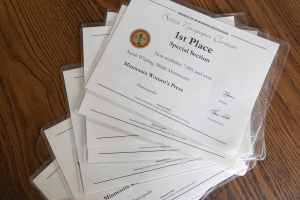 For 2025 coverage, Minnesota Women’s Press earned a community leadership award, three photography awards, and four editorial awards, including for coverage of social issues and for our Spring 2025 “Know Your Rights” special section supported by Unidos MN. Our publisher was named Journalist of the Year by Violence Free Minnesota for gender-based violence coverage.
