


A Conversation with Roya Akhavan About Re-Defining Effective Leadership


Roya Akhavan
Roya Akhavan was born in Iran, where she lived until she was 16. As part of a persecuted religious minority, the Bahá’í — who believe in establishing a unified world order of prosperity for all — she grew up in an Iranian culture where gender equality was not a widespread reality. Yet, even growing up with two brothers over a decade her senior, she was brought up with equal standing in her family as well as within the Bahá’í subculture.
After graduating from the University of Minnesota with a degree in architecture, she went on to get a PhD in mass communication, became a university professor, and was offered a job in international marketing for a China-based company. She wrote a proposal for the Women Entrepreneurs Resource Center of the International Labor Organization in Beijing, and registered a foundation for gender equality education in Hong Kong.
In 2001, Saint Cloud State University recruited her back to Minnesota. She is a frequent lecturer about leadership and is launching a consulting business focused on the important values of feminine leadership.
“I began to go further,” Akhavan tells me. “As far back as the year 2000, I gave a talk about how gender equality is not just a women’s issue. The lack of gender equality harms men as well as women. I became very interested in how that happens.”



She cites Harvard professor William Pollack’s 1998 book, “Real Boys: Rescuing Our Sons from the Myths of Boyhood,” which identified the despairing mental health of boys feeling harmed by gender roles. Pollack did clinical work with more than 150 adolescents to explore the “boy code,” and why boys commit suicide at rates four times higher than girls.
In 2017, Akhavan published a book that discussed root causes of war, racism, nationalism, religious strife, gender inequality, and extremes of wealth and poverty. In it, she indicates that gender inequality is not often considered one of the root causes of war, “but it is, in fact, the most insidious of all.”
Research shows, Akhavan says, that effective and true leadership consists of “traits that we associate with the feminine aspects of humanity.”
In an essay for the Global Governance Forum, published in January 2024, Akhavan writes: “What is required is a paradigm shift that elevates the values and behaviors associated with the feminine aspects of humanity — namely, compassion, caring, cooperation, communal orientation, emotional intelligence, and moral courage — in leadership by both men and women to resolve global challenges; a paradigm shift that goes beyond expanding the number of women in leadership positions to effect a complete transformation in how leadership is defined and enacted.”
She indicates that both men and women are capable of compassion. What prevents us from moving into a more prosperous and safer world, however, are the “systematically ingrained and psychologically internalized patriarchal values that have glorified power over service and control over empathy.” Equating compassion with “feminine” and “weakness” — and requiring female leaders to be “tough” in a hypermasculine perception of strength” — continues to inhibit growth.
At a recent talk at a conference about ethical business, she says, her ideas were supported by both men and women in the audience. She feels society — despite current politics — has become a more receptive audience for a collaborative approach to gender equality. This paradigm shift will start with educating parents, teachers, community leaders, and youth about, for example, the notion that “what we consider strong and weak is not correct. It takes a lot more strength to be kind, to be empathetic.”
She has written essays that indicate young thought leaders are re-defining what it means to be a “real man.” She believes a growing percentage of men are expressing a desire for change in the rigid definitions of “masculinity” and are rejecting violence and toughness as a concept associated with what it means to be a man.
Akhavan has quoted ʻAbdu’l-Bahá, leader of the Bahá’í faith from 1892 to 1921, as saying: “The world in the past has been ruled by force. . . But the balance is already shifting. Force is losing its dominance. Mental alertness, intuition, and the spiritual qualities of love and service, in which woman is strong, are gaining ascendancy. The new age will be an age that is less masculine and more permeated with the feminine ideals.”
Since this form of collaborative and compassionate leadership is not new to Minnesota Women’s Press readers — but is so slow to move forward — I ask why she is optimistic that we are at a turning point.
She responds that there are “two processes, constructive and destructive, that have moved parallel to each other during the last 200 years. The constructive process has never stopped, and it cannot be turned back. The destructive mindsets are threatened — they are going to push back. But they can’t stop it. Because when you track the forward movement of the constructive collective global consciousness, you can see that it cannot be turned back.”
She gives the example of electricity and what it can do for people. If you ask people to simply forget it exists, and stop using it, that is not possible.
“This consciousness is moving forward. Pushbacks are just part of the process. The key is to stay the course. It is the truth of who we are as human beings. As human souls, we do not have gender. In our physical form, we do have physical differences, because we need to procreate, but in terms of who we are as human beings, we are pretty much the same — there is no gender.”
In her college courses, she has asked students to do presentations about stereotyping in the media, sexual objectification of women, and toxic masculinity.
“I have had groups of guys talking about toxic masculinity. They did a great job. In the class, I taught that the gender we are born with doesn’t determine anything — it is largely our socialization that shapes us and leads to certain behaviors. If the topic is presented in an inclusive way, and it acknowledges the humanity of everyone, and is not presented as women versus men or men versus women, that’s really the secret. That’s where I want to help reframe the discourse around gender equality.”
When I ask if phrasing leadership as “masculine” or “feminine” is hindering the receptiveness by bringing in a kind of gendered defensiveness, like describing society as “patriarchal” compared to “matriarchal,” Akhavan responds that she wants to elevate the term “feminine,” because it has been put down in the minds of men and women. “We are socialized that boys don’t cry, that if you don’t punch back you are weak. People are swimming in this, so [being able to embrace the strengths of feminine is] a discourse that needs to happen.”


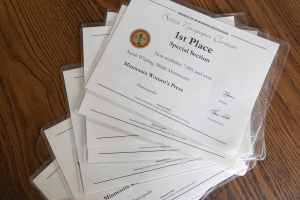 For 2025 coverage, Minnesota Women’s Press earned a community leadership award, three photography awards, and four editorial awards, including for coverage of social issues and for our Spring 2025 “Know Your Rights” special section supported by Unidos MN. Our publisher was named Journalist of the Year by Violence Free Minnesota for gender-based violence coverage.
