

2026 Midterm Elections: The Celebrations of Last Night
Most of us probably still suffer from the trauma of the 2016 and 2024 Presidential elections. I know I didn’t trust polling optimism — and even pollsters are never sure of the relatively random nature of taking a population’s pulse. That weighted feeling began to dissipate as soon as DFL guests at the Saint Paul watch party last night saw what was happening in Ohio, South Carolina, and Texas. By the time Amy Klobuchar took the stage in Saint Paul around 11pm last night, and Peggy Flanagan around midnight, thousands of people had erupted in cheers so many times as televised results were coming in from around the country that the room was ebullient even before learning who won in Minnesota.
Minnesota has elected Klobuchar as its first woman governor, after her 20 years in the Senate, and sent Flanagan as the first Native American woman elected to the U.S. Senate (with Mary Peltola’s election in Alaska yet to be determined). Re-elected officials who took the stage last night included Rep. Betty McCollum — whose ranking in the new House majority likely lifts her to chair of the House Appropriations Subcommittee on Defense — Rep. Ilhan Omar, Rep. Kelly Morrison, Attorney General Keith Ellison, Secretary of State Steve Simon, and newly elected state auditor Zack Filipovich.



Part 1: What the Newly Elected Shared Last Night

Newly elected Minnesota governor Amy Klobuchar (photo by Sarah Whiting)
Amy Klobuchar
In her victory speech, Minnesota’s governor-elect framed her election as a rejection of divisiveness, big money and political extremism — and a call to rebuild trust through practical results. Reflecting on a difficult year marked by violence, political turmoil, immigration enforcement, and public demonstrations, she celebrated the resilience of Minnesotans and promised a government focused on serving its people. “You deserve a state government that matches your drive and ambition,” she said. “If something works, we will keep it. If it’s broken, we will fix it or get rid of it. … All the headwinds we face may well be a constant. They can never be an excuse.”
The $2 billion spent on federal races — an agenda item that needs to change in the future, according to post-election analysts quoted later in this story — led to “ugly and hateful attacks that were meant to divide us,” Klobuchar said. “Dark money doesn’t win, even when we were outspent two to one on ads.”
Reflecting on community response to federal immigration enforcement and the killings of Renée Good and Alex Pretti, she said: “We didn’t look down. We looked up. We didn’t look away. We looked at each other. You showed up when ICE descended on our state. You brought food to strangers and kids to school. You marked 50,000 strong in sub-zero weather in what will be one of the top civil rights moments of our century in this country.”
She recalled receiving the news that Minnesota would receive the Profile in Courage Award, named for President John F. Kennedy, and insisting it belong to the people rather than an elected official. A young student, she said, was excited to realize that meant she had received the award, too.
As the granddaughter of an iron ore miner who was unable to graduate from high school, and the daughter of a teacher and a newspaperman, Klobuchar said: “Our past has made us who we are, but our future is up to us.”
In short, Klobuchar’s speech indicated that Minnesota’s future depends not on political victories alone, but on restoring trust, delivering tangible results, and recognizing the power of people who show up for one another. She warned that people in the room would not agree with all of her choices, but her closing message was an invitation to collective responsibility: “We have a lot of work to do. Let us move forward.”

Newly elected U.S. Senator Peggy Flanagan (photo by Sarah Whiting)
Peggy Flanagan
A Native American drum introduction, and joyful chants of “Peggy,” brought Minnesota’s newly elected U.S. senator to the stage. She delivered a message about collective action, economic fairness, Native representation and the responsibility of government to serve ordinary people rather than wealthy interests. “We are not just the land of 10,000 lakes. We are the land of 5.8 million neighbors,” she said. “You believe that your neighbors are always worth fighting for. And you proved that when Minnesotans fight for one another, we can inspire a nation to join that fight. Because when you come for one of us, you come for all of us.”
She credited grassroots organizing for overcoming powerful political and financial interests. Her campaign, she said, began at kitchen tables and in libraries, churches, cafés, union halls, barns. and garages across Minnesota. “We asked each other, ‘What worries you? Who are you fighting for? And what brings you hope?’ And we shared our stories.”
She shared the realities of some of those conversations, which reveal the everyday economic pressures facing Minnesotans: a farmer’s wife with a $16,000 health insurance deductible, a hotel worker who also runs a bakery because one job isn’t enough, and a mother worried about losing health coverage for her child.
Flanagan promised to take those stories to Washington and fight to lower costs, champion universal healthcare, support farmers’ right to repair their equipment, challenge the influence of corporations and billionaires, and defend due process and prevent families from being torn apart by immigration enforcement. “We refuse to let this country leave anyone behind.”
She emphasized the historic significance of her election. Referencing her Ojibwe name and identity as a daughter of the White Earth Nation and member of the Wolf Clan, she connected her achievement to generations of Indigenous resilience. “Do not be told that it took 250 years for one of us to get here. Be inspired by the fact that with grit and determination and the resilience of our people, whichever one of you is next, you’re going to get here a lot faster.”
Her message to young people who have been overlooked or underestimated was direct: “You know who you are. You know where you come from, and you know what you can do. There is no stopping you from achieving your dreams.”
And her promise to Minnesotans: “When I get to Washington, I know I’m not going alone. I’m bringing all of you with me.”
Re-Elected U.S. Representatives

Re-elected U.S. Represenative Ilhan Omar (photo by Sarah Whiting)
U.S. Rep. Ilhan Omar said: “Thank you for once again showing the world who we are and what we stand for. We rise above fear and division. We reject hatred and bigotry. … Minnesota has delivered a mandate. A mandate for the politics of joy over fear, for the power of grassroots organizing, and for the strength of our diversity. A mandate for Medicare for All, universal school meals, abolishing ICE, peace instead of endless wars, climate action, and student debt cancellation. And a mandate to hold Trump accountable for his corruption, his weaponization of the federal government, and his daily abuses of power.”
In reference to the raid on her home by federal agents shortly before the election, Omar said: “Trump wants us to be afraid. He wants people to believe that speaking out comes at too high a cost, that even a duly elected Member of Congress can be threatened into submission. But Minnesota elected me to be their voice in Washington. I will not be intimidated. I will not back down. And I will never let Donald Trump silence me. Minnesota will never let Donald Trump silence us.”
Betty McCollum said, “We’re going to make healthcare more affordable. We’re going to hold Donald Trump accountable for corruption and cruelty to our neighbors. We’re going to keep fighting for our values.”
Kelly Morrison thanked all the people who dedicated time and energy into campaigns to “make our state and our country better. None of this would be possible without each and every one of you.”
She lifted up Minnesota legislator Melissa Hortman, who was killed in June 2025, in this “first election night without her. … Her presence and her leadership are deeply missed every day, and tonight especially, I know she’s here in spirit.”
Morrison said, “Our state has lived through more traumas and tragedies and attacks from our own federal government than any of us could have imagined. This period has been marked by so much negativity and division that it can make us despair and feel hopeless. … But when this Administration tried to break us, did we back down? Did we give in to silence? Did we turn against our neighbors? No, we did not.”

Keisha Lance Bottoms

Amy Acton

Gina Hinojosa
Part 2: What The Nation Offered as Post-Election Analysis

Stacey Abrams photo by Sarah Whiting; find our story here.
In a post-election analysis with team members of The Nation magazine, national affairs correspondent Joan Walsh said that so much of the election results were “powered by women. Everywhere I went, the candidates and hardest workers were women.” She gave a shoutout to Georgia’s Stacey Abrams as someone who laid the groundwork in Georgia for not underestimating the power of a diverse people — offering multilingual literature before most candidates during her 2018 governor’s campaign there. “She understood [the demographics] in a big way. We wouldn’t be here without her.”
She also said that while following Peggy Flanagan around Minnesota, she fell in love with the candidate as “an extraordinary woman.” Walsh started to weep as she relayed why women are “mad as hell,” with the loss of abortion rights. She says we still have a long two years, and she doesn’t want to speculate on 2028 Presidential candidates yet, but with this year’s surge of women into power, likely starting with the women’s march efforts that have not stopped, women in political change might get even more powerful.
Walsh said she isn’t sure that she could stand another loss of a woman Presidential candidate in the near future, but she named Flanagan as someone she thinks would make “a great first woman President,” as well as Keisha Lance Bottoms of Georgia, now the first Black woman elected governor, and Deb Haaland of New Mexico, now the first female Native American governor-elect in the U.S. [Two male Native Americans have served as Oklahoma governor.]
Other themes of the night reflected that working-class voters — who had stopped voting or shifted right — responded as voters to the desire to see affordability and corruption dealt with in politics.
Bhaskar Sunkara, president of The Nation and former vice-chair of the Democratic Socialists of America, said that although exit polls have to be relied on with caution, non-college educated and rural youth moved left to 63:34, compared to 54:44 in favor of Trump in 2024. The move to acknowledge the needs and solutions for working-class families, he said, “cannot be one cycle,” as future campaigns need to address the need to see “shared prosperity, not just individual.” He said progressive candidate Andra Nixon in Florida narrowly lost to the incumbent Senator despite having very little funding.
Editor John Nichols said Troy Jackson, a former logger, took the Maine Senate seat away from Susan Collins partly by sticking to “core working-class talking points and ideas,” with his populist signature line: “We are not from the left. We are not from the right. We’re from the bottom, and we are rising.”
Walsh said what cannot be left out of the post-election analysis of how the balance shifted so dramatically across the country is because of the “cruelty to immigrants. “What we saw across the country was a backlash to the cruelty of ICE and anti-immigrant politics.” She noted that the notion of Ohio immigrants eating pets was considered laughable by some, but it was “not a losing message. This year it was.”
The Nation justice correspondent Elie Mystal said others underestimated that a top concern of voters was the swamp of corruption — as well as the rise of data centers, the popularity of oligarchs like Elon Musk, and the unchallenged focus on artificial intelligence. In conversations across the country, the failure for the current Administration to address anxiety over AI “comes up always; it is a much bigger deal than Trump/Vance or even Democrats understand.”
When asked where the incoming Democratic-led Congress should put its energies — accountability of current administration or affordability — The Nation publisher Katrina vanden Heuvel said: “We can walk and chew gum at the same time.” The corruption of the Iran war and administration can be pursued alongside an affordability agenda, including healthcare for all — even if the president vetoes it.
The language of dignity for all, the speakers concurred, is a workable and worthy mission. That includes eschewing the xenophobic and racist notion that some people are not equal. The message of New York City mayor Zohran Mamdani, for example, is that treating people with respect while addressing social issues, in a culture not built on bullying, is an authentically supported message.
Said Mystal: “The conservative closing argument was that these people are socialists who are going to transition your kids against their will. And people were just like, come on. That’s not even what’s happened. People rejected that crap. We don’t need to be scared of our own principles. Because the Republican smear campaign about what it means to be a socialist, what it means to be a progressive, what it means to be pro-trans, what it means to be pro-LGBTQ, doesn’t work. People aren’t scared. And so we shouldn’t be either as a party.”
Concluding Thoughts
In short, my takeaway is that the labeling of “centrist,” “progressive,” “socialist,” or even “right” can become less important when compared to principals and the work people want to see accomplished on behalf of the everyone rather than the few.
Which is partly why Minnesota Women’s Press will direct its energies as a new consumer-owned media co-op platform in 2027 to:
- amplify people power and talk about lessons from history about American economic growth (The Eco),
- revise practices that increase anxiety, including among younger generations, and connect around solutions for healthier communities (Collective Health);
- understand the ways party and identity politics have separated missions and what can be done differently (Future Forward).
More to come soon about these plans and discussion opportunities.
Please become a member to take part in conversations that will range from food systems to Minnesota’s political history (you’ll notice on state map that we are still predominately red rather than blue):

Sidebar: From the Secretary of State Office
Unofficial results show more than 2.8 million Minnesotans cast ballots in the 2026 Statewide General Election. This breaks the previous record for midterm participation set in 2018. In addition, Minnesota is projected to have had the highest voter participation rate in the nation, according to preliminary estimates from the University of Florida’s Election Lab. More than 30,000 Minnesotans served as election workers. Additional historical voter turnout statistics.
Election results are unofficial until they are reviewed and certified by the appropriate canvassing board. County Canvassing Boards will meet over the next couple of weeks to certify results for county offices and state legislative offices located entirely within the county. Canvassing Boards will certify statewide results and results that span multiple counties on November 19.
Recounts
Four contests fall within the margins of a publicly funded recount.
U.S. Representative District 1
Jake Johnson (DFL) 163,056 and Brad Finstad (R) 162,733. Difference of 323 votes (0.1%). The State Canvassing Board will certify the results of this race on November 19 at 2pm.
Rob Kupec (DFL) 18,103 and Austin Peterson (R) 18,107. Difference of 4 votes (0.04%). The State Canvassing Board will certify the results of this race on November 19 at 2pm.
Karin Housley (R) 23,977 and Nat Smith (DFL) 23,935. Difference of 42 votes (0.08%). The Washington County Canvassing Board will certify the results of this race on November 9 at 3pm.
State Representative District 32A
Nolan West (R) 11,833 and Amanda Matchett (DFL) 11,811. Difference of 22 votes (0.09%). The Anoka County Canvassing Board will certify the results of this race on November 10 at 3pm.
Learn more about recounts.
Please sign up for the newsletter, to keep apprised in ways that do not rely on oligarch-owned social media channels.
Related Stories
2026 Election Results
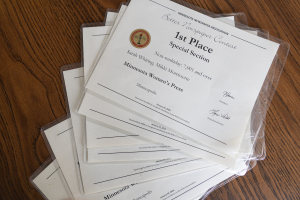 For 2025 coverage, Minnesota Women’s Press earned a community leadership award, three photography awards, and four editorial awards, including for coverage of social issues and for our Spring 2025 “Know Your Rights” special section supported by Unidos MN. Our publisher was named Journalist of the Year by Violence Free Minnesota for gender-based violence coverage.

